
Amsterdam Ad Ban Typifies Climate Alarmism’s Farce
Amsterdam just became the world’s first capital to outlaw public ads for both meat and fossil fuels. But advertising bans serve only to boost a feeling of moral superiority among urban elites while achieving nothing and jeopardizing much, says Vijay Jayaraj.

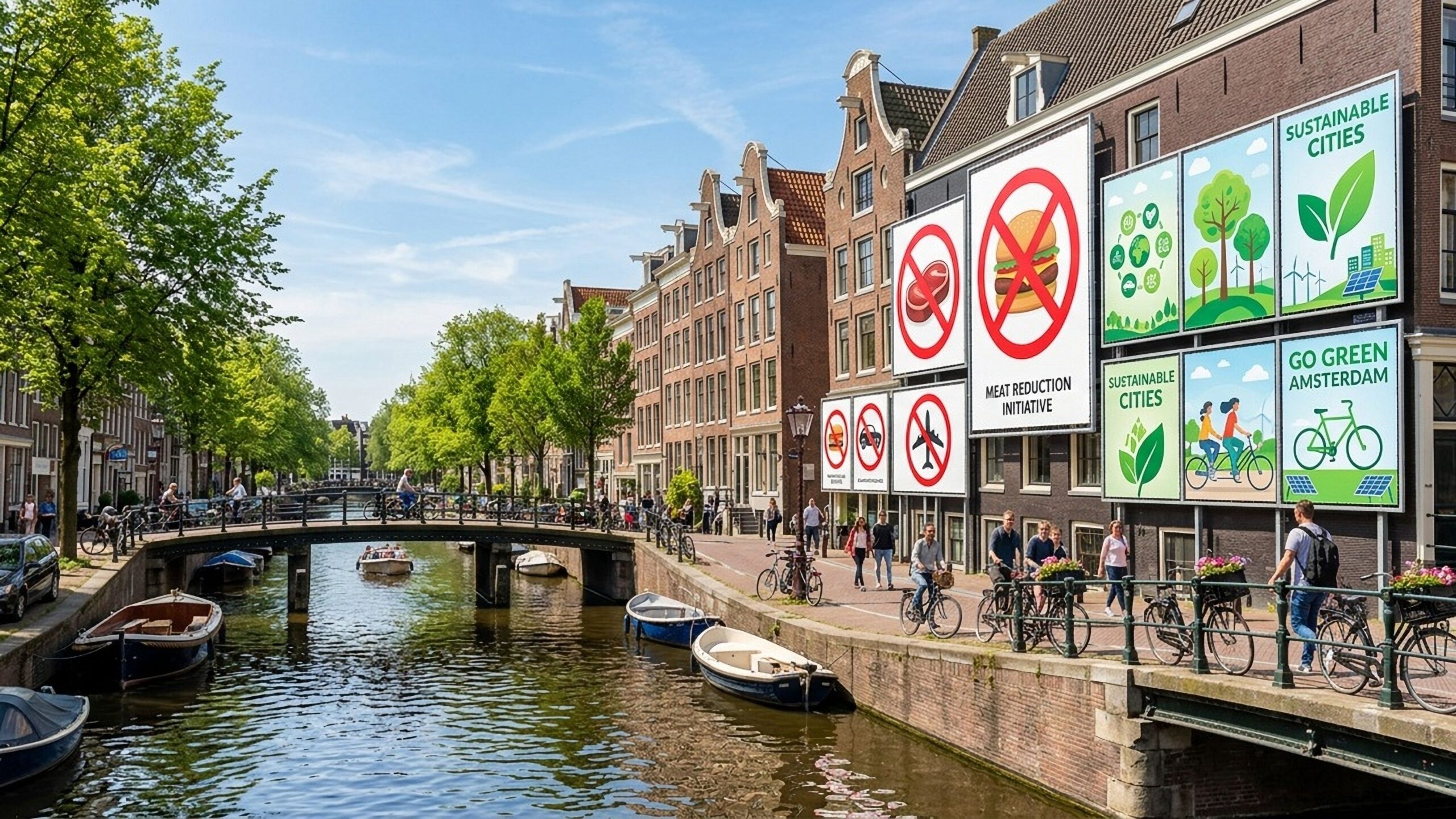
Image created with AI, not the reality. (Source: Shutterstock)
Vijay Jayaraj
28 May 2026
Amsterdam just became the world’s first capital to outlaw public ads for both meat and fossil fuels. Starting May 1, city officials scrubbed billboards, tram stops, and metro stations of promotions for gasoline cars, airlines, cruises, and distant vacations, along with beef, chicken, pork, and fish.
In place of the now illegal ads are posters for the Rijksmuseum and piano concerts, which apparently are included in the city’s vision of a carbon-neutral metropolis that consumes half as much meat.
Driving the ad ban through city council were two political parties, GreenLeft and Party for the Animals. Their claim of fighting impulse buying that locks in ‘high-carbon’ habits poorly disguises an abuse of political power that denies people reasonable everyday choices in exchange for nothing benefiting the environment. Attacking ordinary human life, Amsterdam officials now treat essential fuels and basic nutrition as societal evils that must be hidden from public view.
Other cities
City councillor Anneke Veenhoff likens the ban to helping people kick addictions by removing the temptation of a substance to force behavioral change.
Other Dutch cities have instituted ad bans, including Haarlem’s prohibition of meat promotion in 2024 and The Hague’s 2025 barring of fossil fuel advertising. Worldwide, more than 50 cities—from Stockholm and Edinburgh to Sydney and Florence—indulge the same folly.
France passed a national ban on fossil fuel ads in 2022, and Spain is considering one. U.N. boss Antonio Guterres cheered on such bans last year, calling for prohibitions on oil, gas, and coal ads while labeling humans the ‘meteor’ smashing Earth. This ‘attitude-shifting’ is presented as something akin to an anti-smoking campaign.
The ad bans are based on nothing more than climate pseudoscience, which draws on exaggerations of the effects of natural processes, fabrications of data, and speculative computer modeling. The apocalyptic predictions of anti-meat activists, for example, are easily refuted by empirical data. Methane emissions of ruminant animals purported to threaten dangerous atmospheric heating have an immeasurably small influence on the planet’s temperature.
Analysis
An analysis published by the CO2 Coalition (Virginia), shows that even extreme mitigation measures produce negligible results. Eliminating all 1.6 billion cattle worldwide was calculated to avert warming by about 0.04 degrees Celsius. The effect of killing 1.3 billion sheep would be 10 times smaller.
These figures represent changes so small that they fall below the threshold of detection in real-world climate systems.
Policies crippling to agriculture produce massive economic destruction for no benefit. No sane leader would spend a single taxpayer dollar to chase such statistically irrelevant and ludicrous objectives. Activists pushing these agendas demand immense sacrifices from working families while offering no environmental improvement.
The campaign against fossil fuels mirrors this same detachment from reality. Energy abundance remains a requirement for prosperity. Fossil fuels have powered innovation, extended lifespans, and expanded opportunity everywhere. Hydrocarbons power transportation, generate electricity, and serve as feedstock for countless products. From fertilizers that sustain crop yields to materials used in medicine, fossil fuels underpin modern life.
European politicians banning advertisements for petroleum-powered vehicles signal a profound ignorance of history and economics and a deficit of common sense. Modern economies rely on affordable, abundant coal and natural gas to power factories, build infrastructure, and move essential goods. When international bodies stigmatize these fuels, they threaten the economic advancement of the world’s most vulnerable populations and the sustenance of all.
Advertising bans serve only to boost a feeling of moral superiority among urban elites while achieving nothing and jeopardizing much. They represent a rejection of human progress and a dangerous embrace of unscientific dogma.
Amsterdam’s performative stunt exposes climate dogma’s hollow core of grand gestures and zero results that must be rejected at every opportunity.
This commentary was first published at PJ Media on 22 May 2026.

Vijay Jayaraj
Vijay Jayaraj is a Science and Research Associate at the CO2 Coalition, Fairfax, Virginia. He holds an M.S. in environmental sciences from the University of East Anglia and a postgraduate degree in energy management from Robert Gordon University, both in the U.K., and a bachelor’s in engineering from Anna University, India. He served as a research associate with the Changing Oceans Research Unit at University of British Columbia, Canada.

more news

Kathryn Porter: “The whole model is starting to crumble”
Policymakers and media institutions underestimate the dangers created by unreliable energy systems and rising electricity costs, energy analyst Kathryn Porter recently stated on the Heretics podcast. But she thinks the problem is much bigger than that: “Societies entering periods of political and economic stress, often become more authoritarian. The whole model is starting to crumble.”

Matthew Wielicki on Climate Debrief: “The human condition has never been better”
Students were crying during conversations about the future, their fears largely driven by repeated exposure to highly negative messaging about climate change, recalls ‘professor in exile’ Matthew Wielicki on the Climate Debrief Podcast. He encourages young people to approach environmental and climate concerns with balance, optimism, and practical action rather than despair.
Twenty years after the Stern Review
It’s now 20 years since the publication of the Stern Review on the Economics of Climate Change. This review began the UK-drive towards the crazy carbon-phobic policies which are helping to impoverish the nation, aided by unrealistic scenarios. Today, even Tony Blair can perceive that the pursuit of Net Zero is unwarranted and harmful to Britain.

