
Climate Models Have Greatly Overstated Greenland Meltwater Runoff.
A new paper in Nature Communications exposes a major flaw in how climate models simulate Greenland’s runoff.

Cap Allon
Date: 2 October 2025
For decades, once seasonal snow melted, models assumed the exposed “bare ice” was impermeable—so every drop of meltwater was credited directly to the sea.
Field evidence now shows that assumption is wrong. Much of Greenland’s bare ice is porous, with a near-surface “weathering crust” that stores meltwater during the day and refreezes it at night. This overlooked process reduces actual runoff well below model output.
The study tested the idea in southwest Greenland—a sector that produces a large share of the ice sheet’s surface melt—using in-situ discharge measurements and two process models. One (“SkinModel”) emulated the standard impermeable-ice assumption. The other (“IceModel”) incorporated subsurface heating, porosity, and refreezing.
IceModel aligned with real-world discharge; SkinModel and existing regional models did not.
Multiple lines of evidence point to the same conclusion. Field discharge data show that supraglacial runoff has been overstated by 21–58% in peak summer. Satellite gravity (GRACE) indicates runoff-driven mass loss was exaggerated by 21–47%, while altimetry shows surface thinning overstated by 14–40%. Supraglacial lake infill rates near the snowline reveal even larger biases, in the range of 58–81%.
Gigatonnes
In southwest Greenland alone, between 11 and 17 gigatonnes per year of meltwater were retained and refrozen in bare ice between 2009–2018—around 9–15% of that sector’s modeled runoff. Extending the melt season raises the estimate to ~17 Gt. Since more than three-quarters of Greenland’s modeled runoff originates in bare-ice zones, this missing physics is not a minor detail—it is central.
The mechanism plays out like this: Daytime sunlight penetrates about a meter into impurity-laden bare ice, creating a water-saturated layer with measured density around 681 kg/m³—far below the 900 kg/m³ assumed by modern models. With horizontal water flow very limited, much of this liquid persists until evening, when surface air often drops to -5 to -6 C. At that point, refreezing rates approach 1 mm per hour, locking in meltwater that models had already counted as runoff.
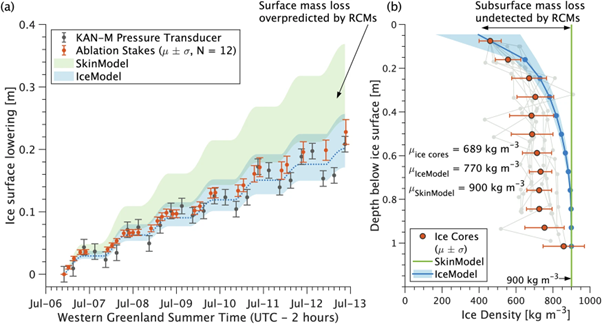
Figure: Field data versus models. Observations in southwest Greenland show porous bare ice retains water, aligning with IceModel. The standard impermeable-ice assumption (green) overpredicts surface loss and misses subsurface storage. Cooper et al., (2025).
Models have been consistently overshooting how much water actually leaves the ice sheet—often by more than half—because they fail to capture porous ice storage and nocturnal refreezing.
The authors stress that bare-ice refreezing is a buffer, not a brake. Greenland is still melting, but far less than models have assumed. Widely used climate models have been inflating runoff, particularly in peak summer, and projections built on those errors cannot be taken at face value.
For decades, Greenland has been cast as the ultimate climate “tipping point.” If its runoff has been overstated by such margins, then confidence in sea-level forecasts—and in the models that drive policy—demands re-examination.
Cap Allon is the owner of the website Electroverse.info which is now also available on Substack. It pays a lot of attention to cold anomalies around the world. This article was written for the Clintel website.


more news

Clintel Ambassador Ian Plimer on popular Triggernometry podcast: “Climate science is the biggest cult in scientific history”
Clintel-ambassador for Australia, prof. Ian Plimer, didn’t hold back in his recent interview on the popular Triggernometry podcast: “There’s a very large body of people out there who are actually using science to promote scams. It’s absolutely crippling Western countries. You can’t run an industrial society on sea breezes and sunbeams.”
Groundbreaking New Paper Challenges Foundation of Climate Change Assessments, Revealing Fatal Flaws in Ocean Heat Content Measurements
An international team of scientists has published groundbreaking research revealing that the primary measurement used to support claims of planetary “warming” is fundamentally flawed and scientifically invalid.
The Frontier of Climate Science: Solar Variability, Natural Cycles and Model Uncertainty
Climate scientist Nicola Scafetta has published a new book examining the complex interplay between solar variability, natural climate cycles, and the limits of current climate models. The Frontier of Climate Science explores how natural variability, observational uncertainties, and model limitations shape our understanding of past and future climate change.

