
Commentary Samuel Furfari – ‘Green’ Europe’s Industrial Masochism
Does Europe’s vaunted green leadership lead anywhere—or merely accelerate its own economic undoing?

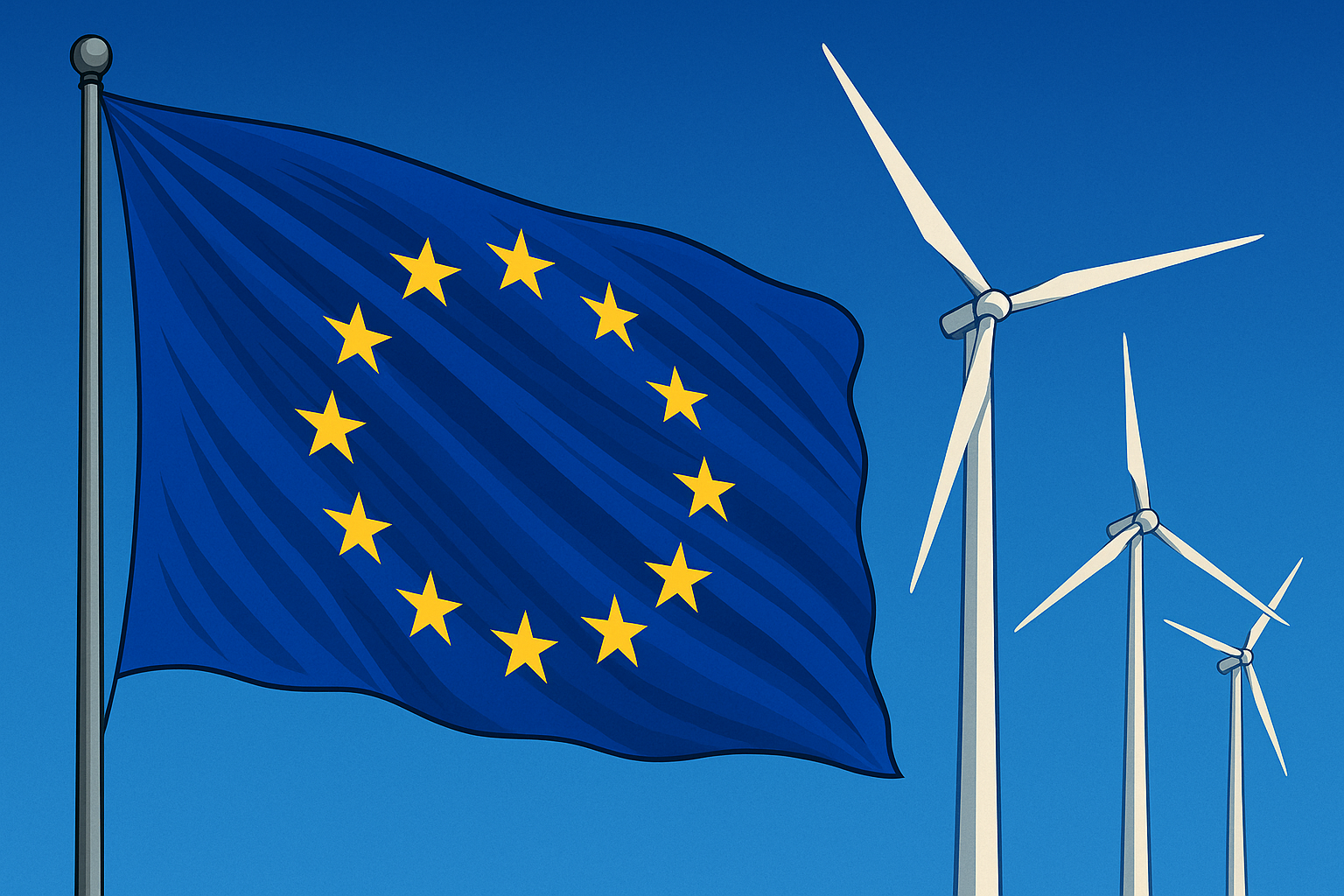
If a self-described leader finds that nobody is following, is leadership present? Perhaps. The next question might be, where is the leader headed?
These queries could well be put to the European Union’s makers of energy policy, who fancy themselves as groundbreakers for a supposed transition away from fossil fuels in favor of “green” technologies. (We use qualifying quotation marks because wind turbines and solar panels have plenty of environmental downsides.)
But according to recent Energy Institute data, European leaders are driving not a bandwagon onto which the world is jumping but rather a hearse toward self-destruction.
EU policy choices have led to so-called renewable sources—primarily wind and solar—constituting more than one-third of the European electricity mix, surpassing coal by a significant margin.
Globally, renewables are growing rapidly in absolute terms. In 2024, wind, solar, and other renewables contributed 5.6% to the global energy mix.
However, the growth in renewables is not keeping pace with rising global energy demand. Over the past decade, fossil fuel consumption increased more than seven times faster than the growth of renewables. Contrary to the narrative often presented by media, coal production has increased, rising more than 10% in the last decade.
Fossil fuels—coal, oil, and natural gas—accounted for 87% of the world’s energy in 2024, while renewables’ share remains in single digits despite more than $5 trillion being spent on wind and solar in the last 20 years.
Last year, global energy supply increased by nearly 2%, driven by rising demand for all types of energy. Accounting for 65% of the increase was the Asia-Pacific region, which represents 47% of the world’s energy consumption and where 83% of the coal is burned and reigns as king of fuel sources. Together, China, India, and Indonesia produced 71% of the globe’s coal.
Over the last 10 years EU energy demand has decreased by almost 6 exajoules, while worldwide use has increased by 13 times—almost 77 exajoules.
So, EU “leadership” has managed to decrease European energy use and increase the role of renewables on the continent. But at what cost?
“In 2008, the U.S. and Eurozone economies were about the same size,” writes Andy Kessler in The Wall Street Journal. “Since 2010, Europe’s per capita gross domestic product (GDP) has basically flatlined. Today, the U.S. nominal GDP per capita is almost twice as large as Europe’s.”
Rather than undergoing the global Energiewende imposed by Germany, the world is growing economically and in a phase of adding new sources to existing ones rather than replacing them. (See my paper “Energy Addition, Not Transition” for a fuller discussion.)
Given that most of the world’s population aspires to greater prosperity—and therefore cheap, abundant energy as desired by the EU before its conversion to ecologism—it is highly unlikely that these trends will be reversed. Economic and social imperatives, as well as the need for secure energy supplies, make a reduction of fossil fuel demand improbable.
As a result, the gap between ill-advised climate ambitions and the reality of global energy consumption will only widen further. Failure to meet announced climate targets is now so obvious that it is reasonable to anticipate an abandonment of the Paris Agreement, as it will become increasingly difficult to conceal the scale of this failure.
Paradoxically, while the latest edition of the Energy Institute’s Statistical Review of World Energy clearly demonstrates this failure, the European Commission continues to propose utopian targets, such as a 90% reduction in its own emissions by 2040.
The reality is that European industry is withering away, jobs are moving elsewhere, and citizens are growing tired of footing the bill for a climate policy that is inevitably leading to economic suicide. Yes, the EU may achieve net zero, but it will be zero across the board: zero industry, zero prosperity and zero global influence.
So, there you have it: the EU, champion of policies that can make no difference in the climate—and of industrial masochism.

Samuel Furfari
Samuel Furfari is an engineer, and PhD from University of Brussels. He is a Professor of energy geopolitics and policy. For 36 years he was a senior official in the European Commission’s Directorate-General for Energy. He is author of numerous books.


more news
Press release GWPF: Event Attribution Studies are “a blot on science”, says Ralph B. Alexander
Extreme weather attribution studies are based on flawed logic and misleading statistical practices, according to a new report by The Global Warming Policy Foundation (GWPF). Author Ralph B. Alexander argues that these studies, which link individual weather events to climate change, are driven more by political and legal agendas than by robust scientific evidence.
China’s Massive Coal-to-Liquids Expansion
In this article, Australian science writer Jo Nova examines China’s rapidly expanding coal-to-chemicals and coal-to-liquids industry. While much of the West focuses on phasing out fossil fuels, China is quietly transforming coal into fuels, plastics and fertilizers at massive scale—raising important questions about energy security and global climate policy.
New Ice Core Study Finds No Clear CO₂–Temperature Link
New research from ancient Antarctic ice cores is challenging long-held assumptions about the role of carbon dioxide in Earth’s climate history. Evidence suggests that CO₂ and methane levels remained remarkably stable over millions of years—even as the planet experienced dramatic temperature shifts. These findings raise fresh questions about the extent to which greenhouse gases alone can explain past and present climate change.

