
Sacré bleu! Macron blames renewables for Spain’s blackouts, France drops renewables targets, expands nuclear
Europe’s energy debate is shifting. After Spain’s major blackout, even long-time advocates of aggressive renewable targets are questioning whether power systems can rely so heavily on wind and solar without sacrificing stability.

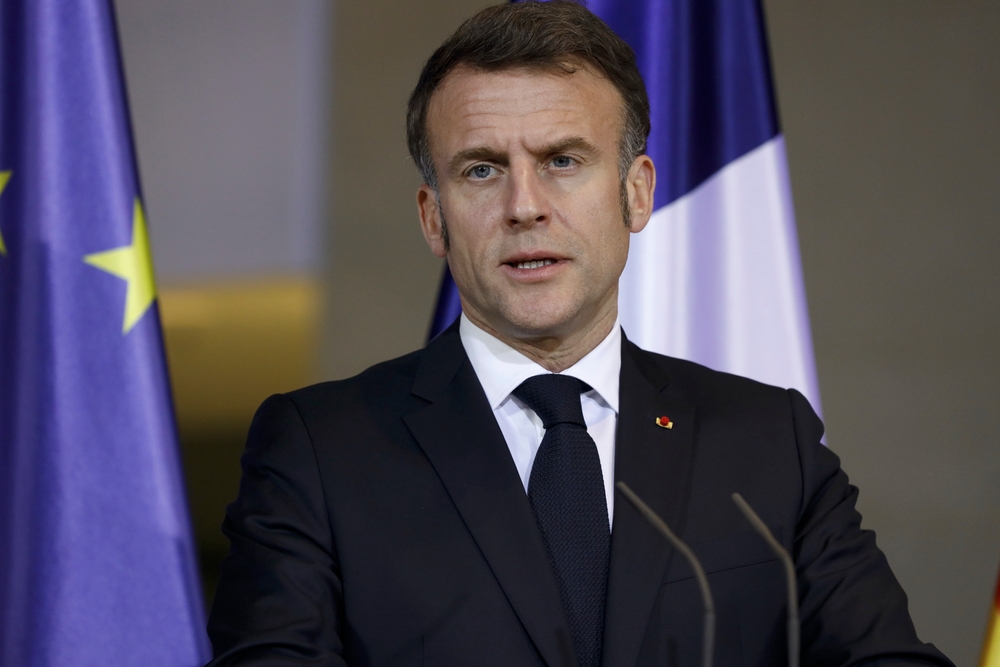
Emanuel Macron (Source: Shutterstock)
Jo Nova
Date: 14 February 2026
The world is backing away from renewables
Wow. What a turnaround. President Macron, a man of The Blob, has come right out and blamed the Spanish Blackouts on renewables. No system, he says, can be so dependent on renewables. Everyone knew this, but few in power would say the words.
Back in 2017 this was the man who had a plan to shut down 14 nuclear reactors in France. Today he plans to push through a law to reverse that. At the same time, the current French renewable energy targets have just been dropped by 20%. Instead of building 150GW of unreliable power, the new target will be about 120GW.
Back in April, Spain finally celebrated 100% renewable energy, and within days suffered a national blackout that caused at least five deaths and left thousands without lighting and the internet, and panic-buying petrol and food. The blackout spread as far as Portugal and Southern France.
Macron blames renewable energy for Spain’s national blackout
— By Kieran Kelly, The Telegraph
French president says European neighbour’s deadly power cuts were caused by shift towards net zero
In response to a large-scale power cut that left millions in the dark in April, the French president said no country could rely so heavily on renewable energy.
But Mr Macron said: “The Spanish power outage is not related to interconnections, but rather to the fact that no system, at least with current technology, can support such dependence on renewable energy. Stability in the energy mix is needed because otherwise, shocks that are too big occur. But it’s not just about interconnections. Networks are needed.”
Spain generates about 60 per cent of its electricity from renewable sources, including wind, hydropower and solar power, according to Red Eléctrica de España, its electricity grid operator. Around 20 per cent comes from nuclear power plants.
Supposedly renewable energy is free and nuclear plants are wildly expensive.
If renewables were cheaper, France would know — yet France chooses the nukes.
The French rebirth of nuclear power started a few years ago. But the plan to close these power plants still needs to be expunged.
Spain is aiming for 80% renewables by 2030 and the UK Labour government is aiming for 95% “clean”. But Australia is larger, hotter, and more sparsely populated, with tons of coal and gas, and has no interconnector cables to anywhere, yet we’re aiming for 82%. Fifty shades of crazy.

This article was published previously on joannenova.com.au

Jo Nova
Jo Nova is science presenter, writer, speaker & former TV host; author of The Skeptic’s Handbook.

more news

Challenges to the CO2 Global Warming Hypothesis: (13) Global Warming Entirely from Declining Planetary Albedo
Is the recent warming the result of less reflection of sunlight by the Earth? Two researcher state that declining albedo — not CO₂ — dominates the temperature trend.

Guardian Claims We’re Still Only Approaching the Climate Point of No Return
The Guardian claims the world is edging toward a climate “point of no return,” where unstoppable warming will lock Earth into a catastrophic “hothouse” future. Yet the geological record tells a very different story. Past periods of far higher temperatures and CO₂ levels did not end life or civilization’s prospects — they supported abundance and evolutionary expansion.
The EV experiment has become a bloodbath — $140 billion wasted — more to come
The electric vehicle push was supposed to reshape the auto industry and accelerate the energy transition. Instead, mounting losses and collapsing share prices are raising serious questions about whether governments and manufacturers misread the market. What began as a bold industrial gamble is now looking, to some critics, like one of the most expensive policy experiments in recent automotive history.

