
Houston lecture by Guus Berkhout: let the data speak
Guus Berkhout, president of Clintel, recorded a speech for the 2025 GSH spring symposium, that was held in Houston on March 5 and 6 2025. His talk was shown on March 6. As the title of his speech – let the data speak – suggests, Berkhout is favouring an approach for climate science in which measurements take a leading role and climate modelling a much smaller role.
The full – even somewhat extended – speech of Berkhout is available in written format here. One important message of Berkhout is that in the climate debate we focus too much on a simplified indicator for global warming, the iconic global average surface temperature. By showing this one-dimensional picture of the evolving climate, we forget to look at all the data and what we can learn from that.
The alarmistic discussions on climate warming are primarily based on a time function only, meaning that the complex 4D image is simplified to a simple 1D picture: From T(x,y,z,t) to T(t), see Figure 8. Mainstream scientists explain this simple 1D temperature picture by the single factor CO2. A simple narrative can be very appealing indeed. Philosopher Ockham already wrote in the 14th century “The simplest explanation is the best.” Ockham meant with this statement that if you have the luxury to choose from different models that all can explain the observations well, choose the one with the least assumptions. In the 20th century Einstein formulated it as follows: “Everything should be made as simple as possible, but not simpler.” In the past decennia we have seen that a single-factor climate model is too simple to explain the real climate world. Why do academies of sciences keep quiet?
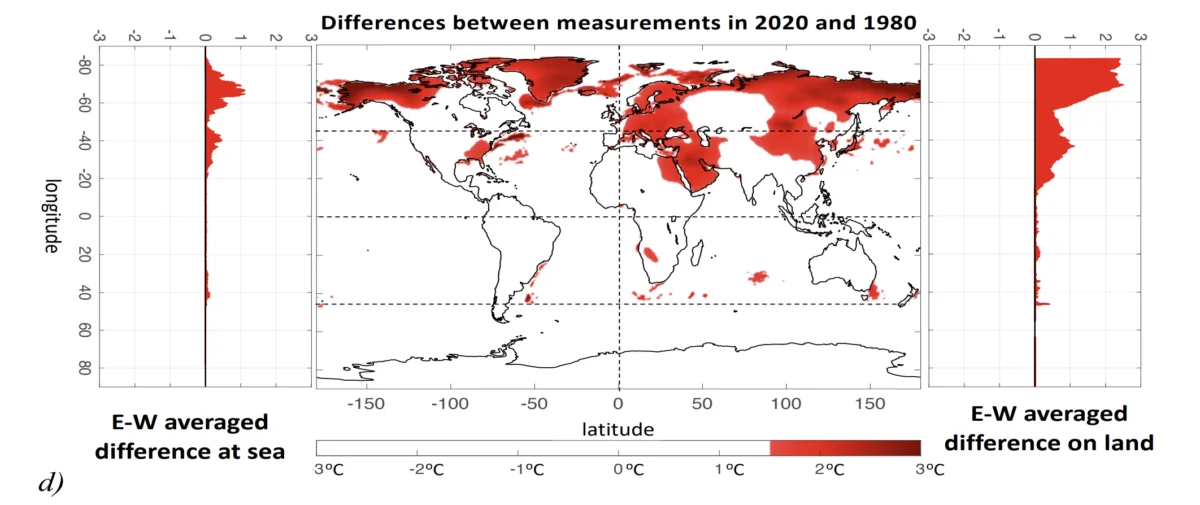
In his figure 7d Berkhout how much more you learn when you show and use all the data. Here in red you see those areas that warmed up more than 1.5 degrees Celsius between 1980 and 2020. Clearly we are not looking at global warming but mainly at warming on the Northern Hemisphere and especially on land and at high latitudes.
Guus Berkhout had a long career in geophysics, a field in which imaging techniques play a crucial role. He strongly believes that progress in climate science also should come from climate imaging and he encourages his colleages from the geophysics community to join his efforts.
The full written version of the speech is here. If you would like to contact Guus Berkhout: guus.berkhout@clintel.org
If you are interested in the World Climate Declaration, you can find it here. If you would like to sign the Declaration go here.
Clintel is an independent foundation, receiving support from citizens and SME’s around the world. If you would like to support us, go here. Clintel is a 501(c)3 in the US.

more news
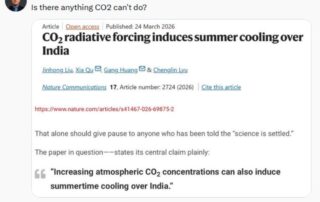
CO₂ Can Cause Cooling Too? Climate Models Say Yes (Sometimes)
As Dr. Matthew Wielicki dryly put it: “Is there anything CO₂ can’t do?” The study behind that remark claims that rising CO₂ levels may even lead to regional cooling under certain conditions—highlighting just how flexible—and uncertain—climate model outcomes can be.
Press release GWPF: Event Attribution Studies are “a blot on science”, says Ralph B. Alexander
Extreme weather attribution studies are based on flawed logic and misleading statistical practices, according to a new report by The Global Warming Policy Foundation (GWPF). Author Ralph B. Alexander argues that these studies, which link individual weather events to climate change, are driven more by political and legal agendas than by robust scientific evidence.

China’s Massive Coal-to-Liquids Expansion
In this article, Australian science writer Jo Nova examines China’s rapidly expanding coal-to-chemicals and coal-to-liquids industry. While much of the West focuses on phasing out fossil fuels, China is quietly transforming coal into fuels, plastics and fertilizers at massive scale—raising important questions about energy security and global climate policy.

