“It’s the sun, stupid!” gets new relevance
A new report from the World Meteorological Organization once again led to apocalyptic headlines in the newspapers last week about Climate Change. Unintentionally, writes Marcel Crok, the report opens the door to the most important factor in our climate: the sun.

The WMO included the photo above with its press release. Fitting: sun and oceans.
(Source: WMO 2026 Calendar Competition – Ahnaf Ibne Nasir)
Marcel Crok
Date: 1 April 2026
While bombs and shells rain down on the Middle East, causing death and destruction, it is also simply March—and thus time for the annual State of the Global Climate report from the World Meteorological Organization (WMO). “Earth’s climate swings increasingly out of balance,” read the headline of the WMO press release, and similar headlines also dominated the media in my country, the Netherlands. The NOS opened with “Meteorologists: Earth is trapping more heat than ever, consequences will be felt for centuries.” RTL Nieuws went with “Climate more out of balance than ever recorded, meteorologists warn,” while NRC’s verdict was “UN report: Earth more out of balance than ever recorded, all signs point to red,” and finally, Trouw stated, “The last eleven years were the warmest ever recorded, reports the UN meteorological organization.”
Anyone reading these articles would think our final hour has come. Not because of an impending nuclear war, but because of all-consuming climate change. “Human activities are increasingly disrupting the natural equilibrium, and we will live with these consequences for hundreds and thousands of years,” said WMO Secretary-General Celeste Saulo in the press release. By “human activities,” she obviously means those activities that lead to the emission of greenhouse gases, particularly CO2.
Earth out of balance
For the first time, the WMO is reporting on the Earth’s radiation balance. Of course, the WMO isn’t doing this without reason. Apparently, something alarming can be inferred from that radiation balance. Never before has the Earth been so out of balance, according to the WMO. “Never before” here refers to the last 65 years, as that is how far back their graph goes.
Climate skeptics, in particular, have regularly pointed out (a key paper was this one from 2003) that if you’re interested in the warming (or cooling) of the Earth, you’ll need to look at the energy content of the oceans. That’s where more than 90% of the climate’s energy is stored. The atmosphere, the thin shell in which we live, contains only 1% of the Earth’s energy. It is therefore commendable that the WMO recognizes this and is now reporting on it.
Over the past twenty years, work has been underway on a network (ARGO) of some 4,000 buoys that float freely in the oceans and dive into the ocean every ten days to take measurements. Once they resurface, the data is transmitted, after which a new ten-day measurement campaign begins. At the same time, NASA satellites (Ceres) have been deployed to measure how much radiation enters and leaves the Earth. Using the data from these two measurement campaigns, we can estimate the extent to which the Earth retains heat or, conversely, releases it. The WMO’s conclusion is therefore that the Earth is retaining a record amount of heat, and they also state that the rate at which this heat is being retained has been increasing in recent years (i.e., accelerating).
In the report, they link this (as one might expect) directly to the increase in greenhouse gases (they prefer to use the terms “accumulation” or “build-up”) in the atmosphere. They write: “The Earth’s energy imbalance is a key climate indicator that measures how fast the heat trapped by anthropogenic emissions of greenhouse gases is accumulating in the climate system.” In the Dutch newspaper Trouw, Frank Selten of the Dutch Meteorological Institute (KNMI) is allowed to say exactly the same thing twice (accidentally, I assume): “The further out of balance, the faster the warming.”
Alarmist narrative
The indicator (the Earth Energy Imbalance, EEI) thus fits perfectly into the WMO’s alarmist narrative. Unintentionally, however, the WMO has also opened the door to another important factor (or rather, the most important factor) in the climate: the sun. How so?
Virtually all the energy the Earth receives comes from the sun (a very small portion is heat emanating from the Earth’s interior). On this point, friend and foe alike agree. Scientists call this short-wave radiation. The Earth warms up due to the sun and, in turn, emits infrared radiation (scientists call this long-wave radiation, because the wavelength of this radiation is longer than that of solar radiation). Greenhouse gases such as CO2 and water vapor are able to “trap” that long-wave radiation, making the thin layer of atmosphere in which we live just a bit warmer (read: more pleasant) than if we had an atmosphere without greenhouse gases. Most calculations (though there is debate about this) suggest that without greenhouse gases, it would be 33 degrees colder on Earth, meaning that the average temperature on Earth would not be +15 degrees Celsius but -18 degrees Celsius, which would make large parts of the planet uninhabitable. Water and CO2 therefore make the planet habitable.
The Earth can therefore warm up in two ways: either because more radiation from the sun enters or is retained, or because less infrared radiation escapes due to those accursed greenhouse gases. In the sentence shown above, the WMO naturally refers to the second option. But NASA satellite measurements actually point to the first. Over the last twenty years, the Earth has been trapping more sunlight! About thirty percent of the sunlight that reaches the Earth is reflected, mainly by clouds but also by snow and ice (this is called albedo). In the last twenty years, however, that percentage appears to have decreased. Less sunlight is being reflected, and more is therefore being absorbed by the Earth. Where? Mainly in the oceans. It’s a new variation on a motto that many climate skeptics have been using for years: it’s the sun, stupid!
Diving
People who dive know that sunlight can penetrate deep into the water (to depths of up to 100 meters). Infrared radiation from CO2 and water vapor also radiates back to the Earth’s surface from the atmosphere but can only penetrate 0.1 mm below the sea surface. Further on in the WMO report, this possibility is also mentioned: “It [the disrupted energy balance, ed.] has also been linked to an increase in absorbed solar radiation associated with decreased reflection by clouds and sea ice.”
Why has the Earth started retaining more sunlight? Good question! Science is currently investigating this. We previously pointed out the eruption of the Hunga Tonga volcano, which likely had a major influence on the spectacular warming we saw in 2023 and 2024. There, too, increased sunlight reaching the oceans played a significant role. But the trend toward more retained sunlight has been ongoing for some time. Fewer clouds is a likely reason. A decrease in air pollution (which reflects sunlight) may also be a factor. This remains a puzzle for scientists.
Second law
But what the WMO overlooks is this: the oceans are warmer than the air above them, and according to the second law of thermodynamics, heat can only flow from hot to cold. We all know this: if you’ve taken a bath and leave the water running, the next morning it will be the same temperature as the air in the bathroom.
So the oceans warm up because more sunlight penetrates them. The oceans then warm the air above them, and through wind, warming will also occur on land (especially in coastal areas). Where in this story do greenhouse gases even come into play? Virtually nowhere! Over the sea, greenhouse gases have virtually no effect. Climate science is now trying, with some desperation, to keep their greenhouse gas narrative afloat. How? By claiming that, thanks to the greenhouse gases in the atmosphere, the air above the oceans will be relatively warmer, and that this will temper the heat flow from the oceans to the air. This is the marginal role that remains for CO2. Of course, the WMO report does not mention this, but it is the ultimate consequence of their own observations.
Snags
However, there are even more snags behind the WMO’s narrative. The WMO, as well as the IPCC (United Nations Intergovernmental Panel on Climate Change), claim that they can measure the Earth’s radiation balance with a high degree of precision. However, a recently published paper by a group of American and Australian researchers (press release here at Clintel) focusing specifically on the ARGO buoy network, states that the uncertainties surrounding the Earth’s radiation balance are a factor of ten greater than reported by the climate community. According to them, this means that claims such as “highest ever” and “accelerating” are completely unfounded (the uncertainties do not allow for such claims). They also note that NASA satellite measurements (Ceres) are adjusted to align with the results of the ARGO network. As a result, these are not independent measurements of one another and therefore cannot be cited as separate evidence of the Earth’s imbalance.
Extremes
As wonderful as it is that these measurement campaigns exist (and they certainly must continue), the measurements currently raise more questions than they provide clear answers. And if there is one thing we seem to be able to learn from the past twenty years of measurements, it is that the Earth appears to be retaining more sunlight, for unclear reasons.
It is completely misplaced to use the uncertain measurements of the Earth’s radiation balance to claim that it’s five minutes to midnight. Yet that is exactly what the UN is doing (of course). “The State of the Global Climate is in a state of emergency. Planet Earth is being pushed beyond its limits. Every key climate indicator is flashing red,” said UN Secretary-General António Guterres.
Of course, the topic of extreme weather is being brought up again. “On a day-to-day basis, our weather has become more extreme. In 2025, heatwaves, wildfires, drought, tropical cyclones, storms, and flooding caused thousands of deaths, impacted millions of people, and resulted in billions in economic losses,” according to Celeste Saulo. This is pure disinformation from the WMO and the UN. Yes, extreme weather did cause damage and casualties in 2025, but as previously published, the number of casualties from extreme weather has been declining dramatically for decades. In terms of damage, 2025 was a below-average year, as American researcher Roger Pielke Jr. shows on his Substack page.
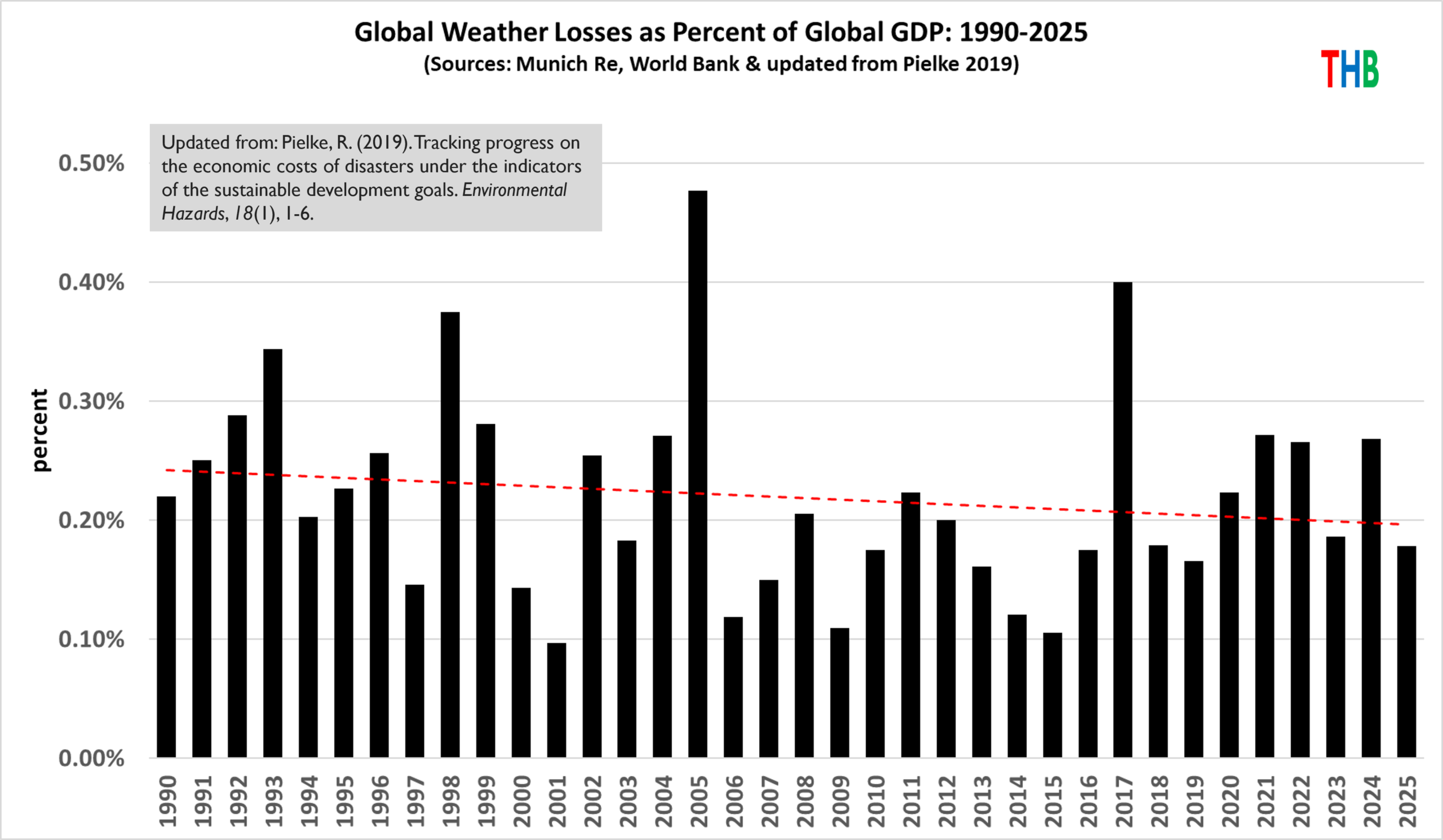
Damage from extreme weather as a percentage of GDP. (Source: Roger Pielke Jr)
Damage
Last year, damage amounted to approximately 0.18% of global GDP, which is below the long-term average of 0.22% and also below the long-term trend (red dotted line). Pielke also notes that the world’s largest reinsurer for this type of damage, Munich Re, made a profit of $6 billion last year!
A constant temperature is best for humans, says Frank Selten of the KNMI in the concluding remarks of the article in the newspaper Trouw. A curious observation. From winter to summer, people experience temperature shifts of tens of degrees. In both Oslo (annual average temperature 7 degrees Celsius) and Singapore (annual average temperature 27 degrees Celsius), people are perfectly capable of leading prosperous, long, and healthy lives. The idea that humanity would suffer from a degree or two of warming is quite absurd.
This article by Marcel Crok was published first in Dutch on Indepen on 31 March, 2026.

Marcel Crok
Marcel Crok is a Dutch science journalist who has been writing full-time about the climate debate and climate policy since an award winning article about the notorious hockey stick graph in 2005. He published two books in Dutch (De Staat van het Klimaat (The State of the Climate) and was co-author of the book Ecomodernisme (Ecomodernism)). With the British independent researcher Nic Lewis he wrote an extensive report about climate sensitivity, titled A Sensitive Matter. He was asked by the Dutch government to become expert reviewer of the IPCC AR5 report. Together with the Dutch climate institutes KNMI and PBL, Crok set up an international discussion platform Climate Dialogue.
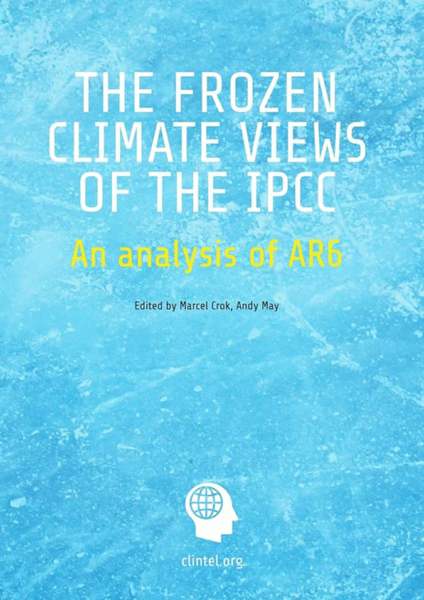
In 2019, Crok and emeritus professor Guus Berkhout founded the Clintel Foundation. They published the World Climate Declaration, which has now been signed by over 2000 scientists and experts. Together with Andy May and a team of scientists from the Clintel network, Crok contributed to and edited the book The Frozen Climate Views of the IPCC.

more news

Women are speaking out against the climate agenda
In the climate debate, it is mainly older, often retired male scientists who are challenging the prevailing paradigm. Female skeptics are few and far between. However, this has been changing recently. Both in science and the media, women are increasingly speaking out against what they see as a frightening and socially disruptive agenda. This is a positive development.
A review of The Frozen Climate Views of the IPCC, part 2
Clintel has analyzed IPCC’s Assessment Report 6 (AR6) and has published an important report on it, entitled: The Frozen Climate Views of the IPCC. It’s a report that provides many serious criticisms of the work carried out by the IPCC. Here you find the second and last part of a review of this important work by Clintel, recently published by the French website Climat et Vérité.
Javier Vinós on the Hunga Tonga Eruption and its extraordinary Climate Effects
In a recent ICSF/Clintel lecture, Dr. Javier Vinós argued that the January 15, 2022 Hunga Tonga eruption was the main cause of the extraordinary global climate anomalies of 2023–2024. He describes them as the first genuine multi-year global climate event in roughly 80 years, widely misinterpreted by mainstream analyses.