
Lindzen, Happer and Koonin: remove ‘Trojan Horse’ from the courtroom
A new edition of a science education manual for judges departs “sharply” from a “longstanding tradition of neutrality,” say three of America’s most distinguished physicists in a letter to U.S. Supreme Court Chief Justice John Roberts.

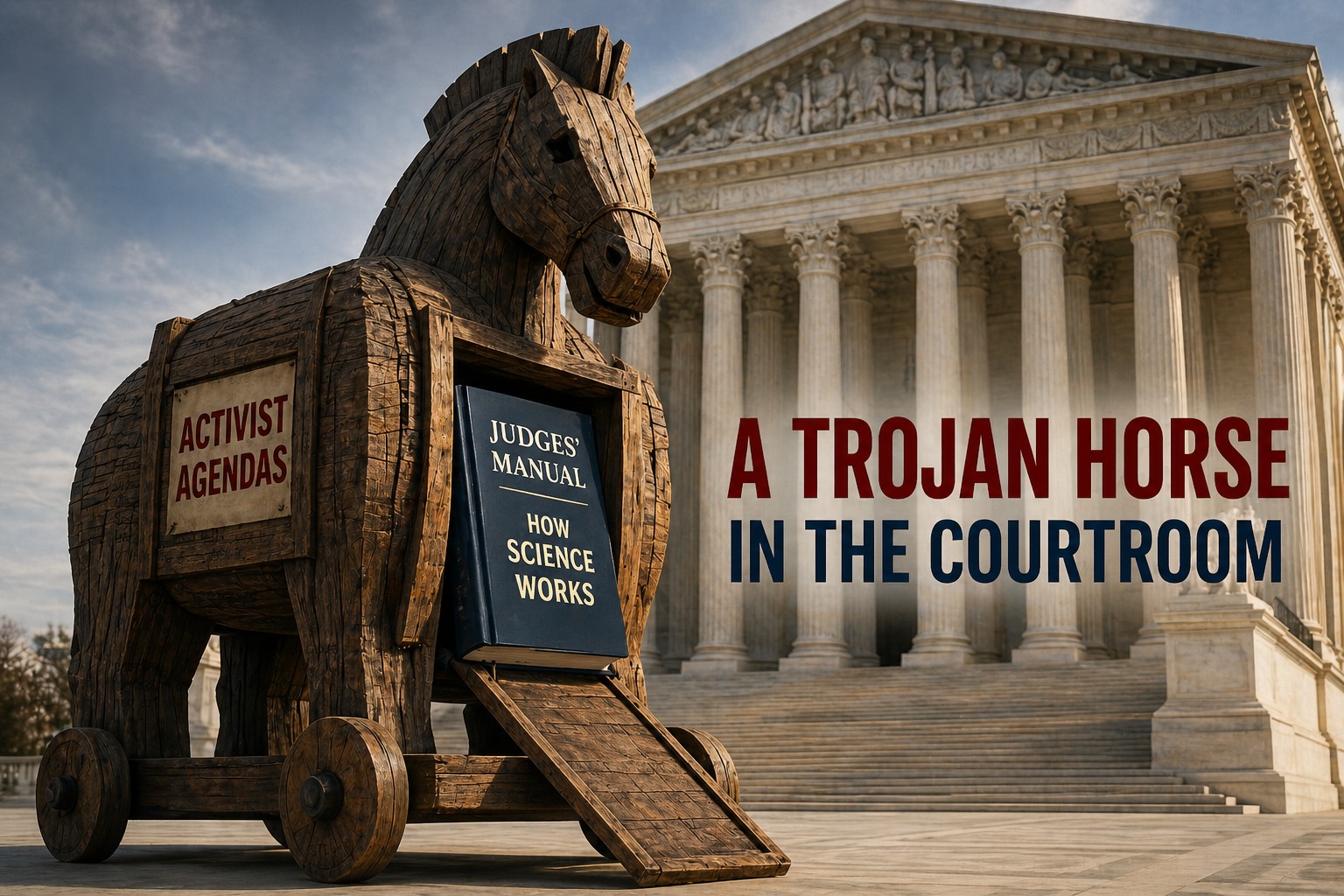
Image created with ChatGPT
Angela Wheeler
Date: 1 May 2026
Writing in an open letter to Justice Roberts were Drs. Richard Lindzen of Massachusetts Institute of Technology, William Happer of Princeton University and Steven Koonin of Stanford University’s Hoover Institution. Roberts is chairman of the Federal Judicial Center, publisher of the Fourth Edition of the Reference Manual on Scientific Evidence, whose new chapter on “How Science Works” the letter writers want to be removed.
For decades, the Reference Manual has served as an essential guide for more than 3,000 federal judges and countless state jurists. Cited in over 1,700 judicial opinions, it has helped courts distinguish reliable science from speculation. Its strength has been a commitment to describing how science operates according to the tenets of the 300-year-old scientific method, avoiding political considerations and a drift into pseudoscience.
The letter’s authors, with more than 600 peer-reviewed publications among them, bring unparalleled expertise to the issue. Their concern centers on the replacement of the late David Goodstein’s respected chapter with an overwritten, intellectually deficient 65-page version.
Weisberg
The new chapter’s lead author is philosopher Michael Weisberg, who had a prominent role as a diplomat at United Nations climate proceedings, where he advocated financial payments to small island nations purportedly threatened by a warming planet. The appearance of conflict with his authoring supposedly neutral guidance on scientific evidence is unmistakable—especially in the context of climate litigation involving trillions of dollars in potential liabilities.
The substantive problems are even more serious. Where Goodstein, once a California Institute of Technology physics professor, emphasized the scientific method—generating hypotheses and testing them with data—the new chapter dismisses the scientific method as a “myth.” It elevates “scientific consensus” and “widespread acceptance” as the highest form of certainty, transforming inquiry into a popularity contest.
This inverts the traditional practice of science. As Nobel laureate Richard Feynman observed, the key to science is comparing predictions directly with observation: “If it disagrees with experiment, it is wrong.”
In Daubert v. Merrell Dow Pharmaceuticals (1993), the Supreme Court made the same point: Scientific knowledge must be derived by testing hypotheses against reality. Goodstein’s earlier edition said, “Data are the coin of the realm in science,” and theories must make new predictions that can be falsified or verified. Consensus, by contrast, is a sociological phenomenon.
Merchants of Doubt
As Michael Crichton famously warned, “If it’s consensus, it isn’t science. If it’s science, it isn’t consensus.” History bears this out. Popular “consensus” on plate tectonics, causes of disease and 20th-century fears of global cooling were overturned by evidence, not votes.
Further revealing the chapter’s activist inclinations is its opening citation of Naomi Oreskes and Erik Conway’s Merchants of Doubt, a book that insists there is “zero argument among actual scientists” about catastrophic climate change—a claim countered by mountains of real-world data.
Labeling credentialed dissenters as outside “actual science” has no place in an educational document for judges. Science advances by challenging prevailing views with data, not by enforcing community norms.
The Federal Judicial Center wisely withdrew a chapter on climate science from the manual after 28 state attorneys general documented its conflicts and unsupported claims. Yet the “How Science Works” chapter, written largely to support that now-removed material, remains.
With more than 1,000 climate-related cases pending in state and federal courts, judges deserve guidance rooted in empirical rigor. Lindzen, Happer and Koonin are correct. The Center should promptly withdraw the new chapter and restore Goodstein’s earlier version, which captured the essence of scientific reasoning in language accessible to readers without the scientific background that most jurists lack.
They should also direct the National Academy of Sciences to withdraw both chapters from its version of the Manual. Maintaining the integrity of judicial guidance on science is not a partisan issue.
Justice Roberts and the Federal Judicial Center have an opportunity to reaffirm their commitment to neutrality and restore confidence in the Manual. In an age when science is increasingly politicized, maintaining rigorous standards for what counts as scientific evidence in court is vital. The credibility of the American judicial system requires nothing less.
This commentary was first published at Daily Caller on April 27.
Angela Wheeler is executive director of the CO2 Coalition in Fairfax, Virginia. She graduated cum laude from Emporia State University, Kansas, with a degree in communication and additional coursework in biology and pre-medicine.

more news

Rationality Returns to Australia as Climate Scare Wanes
Australia’s green energy experiment has left millions of its citizens with a shaky power grid, serving as a case study on how blind allegiance to climate dogma leads to economic and social turmoil.

Former Czech President Václav Klaus appointed President of Clintel
Former Czech President Václav Klaus appointed President of Clintel The Climate Intelligence Group (Clintel) is honoured to announce that Professor Václav Klaus, the former President of the Czech Republic, from today on will be the new president of Clintel, succeeding the current president, Professor Guus Berkhout, who co-founded the Clintel Foundation in [...]

Ignoring EV Pollution for Fake Climate Crisis
The silent, gleaming chassis of an electric vehicle (EV) glides through a pristine forest or a spotless, futuristic city. The message is simple: The driver is saving the planet. It is a narrative built on a convenient, calculated omission.

