
Matt Ridley thinks the Climate Parrot is almost dead
In his recent ICSF/Clintel lecture, Matt Ridley argued that public and political momentum behind the “climate emergency” narrative is weakening, and he explored the reasons for this shift as well as its implications.

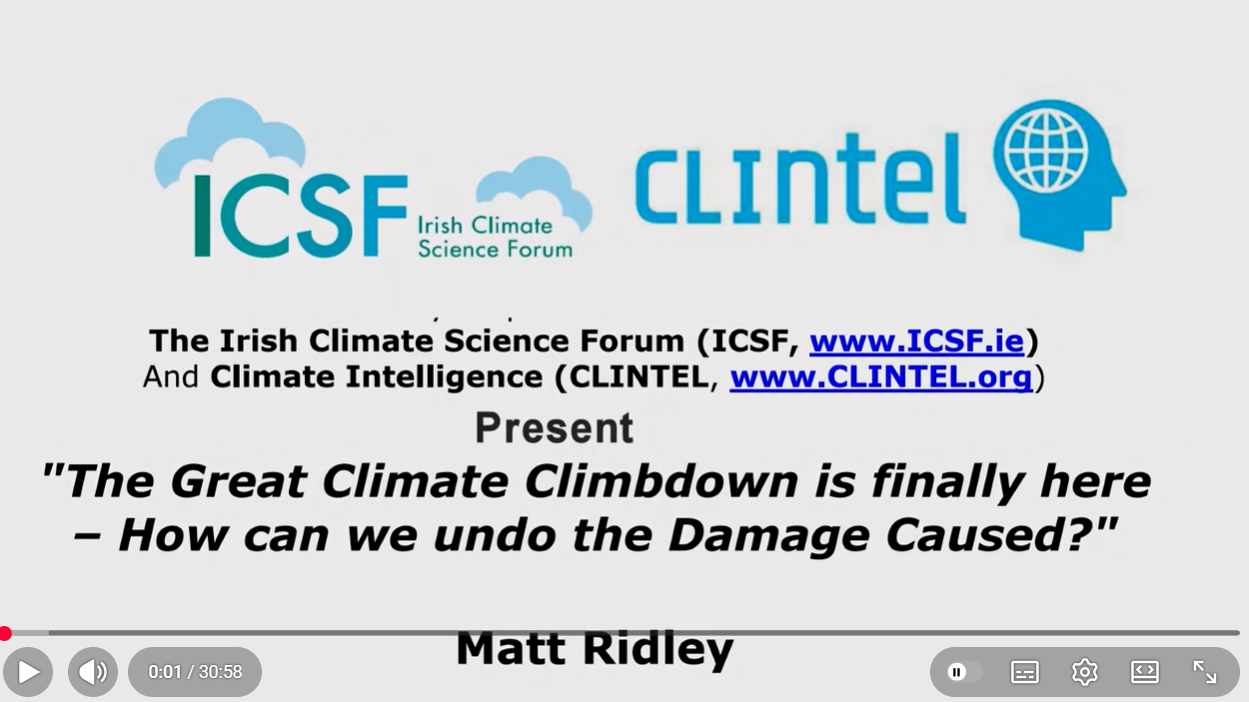
Illustration created using ChatGPT
Peter Baeten
Date: 7 April 2026
In a leader in The Spectator magazine, British science writer, journalist, and businessman Matt Ridley recently declared that “Finally, thankfully, the global warming craze is dying out. To paraphrase Monty Python, the climate parrot may still be nailed to its perch at the COP summit in Belem, Brazil – or at Harvard and on CNN – but elsewhere it’s dead.” He also said that Bill Gates’s apologia, in which he conceded that global warming “will not lead to humanity’s demise” after he closed the policy and advocacy office of his climate philanthropy group, is a further nail in the climate scare coffin. The decline of climate alarmism was the key topic in Ridley’s ICSF/Clintel Lecture: “The Great Climate Climbdown” (1 April).
Fading
Ridley’s lecture explained why, in his view, the climate “alarm” is fading. One major factor is declining public trust in scientific and institutional authority, particularly following the COVID-19 pandemic. According to Ridley, “the COVID pandemic has left people mistrustful of science and of experts,” and this skepticism has spilled over into climate debates. He also argued that exaggerated predictions and high-profile errors have undermined credibility.
However, Ridley identified economic realities as the most decisive factor. He stressed that the promised affordability of decarbonization has not materialized: “It’s proving costly, inconvenient, and regressive.” In his view, rising energy prices disproportionately affect lower-income households, making climate policies politically and socially contentious. This economic pressure has shifted attention toward energy security and affordability, especially in regions such as the United States and parts of Asia.
A central theme in Ridley’s argument is the failure of renewable energy—particularly wind and solar—to deliver reliable and scalable solutions. He described these sources as inherently intermittent and argued that “the transition to them is simply failing to materialize.” While not dismissing renewable energy outright, he questioned why concern about climate change is often equated with strong support for these specific technologies.
Shale revolution
In contrast, Ridley highlighted the transformative impact of the shale revolution, especially in the United States. Advances in extracting oil and gas from shale formations have dramatically increased supply and reduced concerns about resource scarcity. He argued that this development has reshaped global energy markets and undermined earlier assumptions about the inevitability of a rapid transition away from fossil fuels.
Technological trends, particularly the rise of artificial intelligence, further reinforce the demand for reliable energy. Ridley noted that data centers and AI infrastructure require continuous, dependable power, which currently favors fossil fuels and nuclear energy over intermittent renewables. This has led parts of the technology sector to adopt a more pragmatic stance on energy policy.
The Science
On the scientific front, Ridley acknowledged that global temperatures are rising but challenged the severity of projected impacts. He stated, “I’m somebody who thinks it is getting warmer… but I don’t think it’s getting worse.” He argued that many predicted negative outcomes—such as increases in extreme weather—have not materialized to the extent anticipated. In his view, “we’re living in that future and it ain’t too bad,” stating that lived experience does not match earlier dire forecasts.
Ridley also criticized climate models. “The models are still running too hot,” meaning they overestimate warming compared to observed data. He linked this to assumptions about climate sensitivity that are too high. Additionally, he emphasized historical climate variability, arguing that current temperatures are not unprecedented when viewed over longer timescales such as the Holocene (also see: Clintel article here or at andymaypetrophysicist.com).
Maybe the most significant point in Ridley’s lecture is the positive effect of carbon dioxide on plant growth. He highlighted evidence of global “greening,” stating that increased CO2 levels have contributed to a measurable expansion of vegetation worldwide. This effect has substantial benefits for agriculture and ecosystems, and has been underestimated in policy discussions.
Economic analysis also plays a central role in Ridley’s critique. He questioned the justification for large-scale spending on decarbonization by comparing costs and benefits. Referring to estimates of the social cost of carbon, he argued that mitigation efforts may be disproportionately expensive: “It just doesn’t make sense to pay a fortune for something that will save a penny.”
Ridley illustrated this point using long-term economic scenarios, arguing that even with significant warming, future generations are likely to be much wealthier due to continued economic growth. He questioned whether relatively small reductions in projected wealth—caused by climate impacts—constitute an existential threat.
Political dynamics
The lecture also addressed political dynamics. Ridley criticized what he described as a past consensus among major political parties in favor of strong climate policies, arguing that this limited open debate. He suggested that this consensus is beginning to fracture, particularly as economic costs become more apparent.
Economic realities, technological developments, and shifting public attitudes are weakening the dominance of the climate emergency narrative. But Ridley cautioned against extreme positions. He advised that critics of mainstream climate policy should avoid dismissing climate change entirely, noting that such rhetoric can undermine credibility. Instead, he called for more engagement in technical and policy discussions, emphasizing the importance of detailed, evidence-based argumentation. “Those skeptical of prevailing approaches must engage more deeply and rigorously in the debate if they hope to influence its future direction.”
Watch the lecture by Matt Ridley below:


Matt Ridley
Matt Ridley (1958), 5th Viscount Ridley, is a British science writer, journalist and businessman. With BA and DPhil degrees from Oxford University, Matt Ridley worked for the Economist for nine years as science editor, Washington correspondent and American editor, before becoming a self-employed writer and businessman based in Newcastle.
His books, like The Rational Optimist and The Evolution of Everything, have sold nearly two million copies, been translated into 31 languages and won several awards.
He has been a weekly columnist for the Telegraph, The Times (London) and the Wall Street Journal. He writes regularly in The Spectator, The Telegraph, the Daily Mail, Spiked and other publications. His TED talk ‘When Ideas Have Sex’ has been viewed more than two million times.
He served in the House of Lords from 2013 to 2021, sitting on the science and technology select committee and the artificial intelligence select committee.

more news
Democratic Governors Ignore Energy Realities and Cling to Costly Green Policies
As governments and corporations worldwide pivot toward pragmatic energy strategies, Democratic governors in the U.S. Northeast continue to pursue green energy policies that raise costs and undermine energy reliability. The disconnect is becoming increasingly difficult to ignore.

Is Canada Really Warming?
Is Canada really warming at double the global average rate, as the Canadian government says it is? A new scientific report suggests the answer is no, arguing that Canada’s reported warming is largely the result of serious errors in official temperature data.

The Real Environmental Crisis Is Not Climate Change
While governments spend billions on CO₂ reduction, real environmental problems remain unresolved. The real environmental crisis is not climate change, but waste, polluted water and failing governance.

