
The World Comes to Its Senses
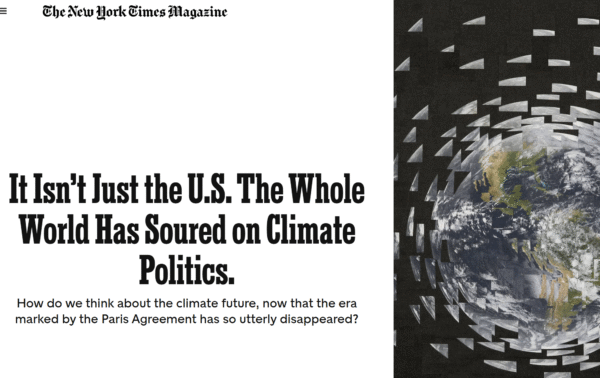
The New York Times heralded the end of climate policy with a lengthy lament by David Wallace-Wells entitled “It’s not just the US—the whole world has had enough of climate policy”. The article seems like an unintended admission that the era of the Paris Agreement is over, writes Fritz Vahrenholt in a reaction on X.

Clintel Foundation
Date: 20 September
David Wallace-Wells:
Ten years ago this fall, scientists and diplomats from 195 countries gathered in Le Bourget, just north of Paris, and hammered out a plan to save the world. They called it, blandly, the Paris Agreement, but it was obviously a climate-politics landmark: a nearly universal global pledge to stave off catastrophic temperature rise and secure a more livable future for all. Barack Obama, applauding the agreement as president, declared that Paris represented “the best chance we have to save the one planet we’ve got.”
A decade later, the Times acknowledges that almost none of these promises have been kept and that voters were not willing to make sacrifices for them either.
At last year’s U.N. Climate Change Conference (COP29), the president of the host country, Azerbaijan’s Ilham Aliyev, praised oil and gas as “gifts from God,” and though the annual conferences since Paris were often high-profile, star-studded affairs, this time there were few world leaders to be found. Joseph R. Biden, then still president, didn’t show. Neither did Vice President Kamala Harris or President Xi Jinping of China or President Ursula von der Leyen of the European Commission. Neither did President Emmanuel Macron of France, often seen as the literal face of Western liberalism, or President Luiz Inácio Lula da Silva of Brazil, often seen as the face of an emergent movement of solidarity across the poor and middle-income world. In the run-up to the conference, an official U.N. report declared that no climate progress at all had been made over the previous year, and several of the most prominent architects of the whole diplomatic process that led to Paris published an open letter declaring the agreement’s architecture out of date and in need of major reforms.
This year’s conference, which takes place in Brazil this November, is meant to be more significant: COP30 marks 10 years since Paris, and all 195 parties to the 2015 agreement are supposed to arrive with updated decarbonization plans, called Nationally Determined Contributions, or N.D.C.s. But when one formal deadline passed this past February, only 15 countries — just 8 percent — had completed the assignment. Months later, more plans have trickled in, but arguably only one is actually compatible with the goals of the Paris Agreement, the climate scientist Piers Forster recently calculated, and more than half of them represent backsliding.
Deadlines are ignored, promises are watered down, and “steps backward” are the norm.
In the north, former central banker Mark Carney became prime minister of Canada in March and, as his first act, repealed the country’s carbon tax before winning a landslide victory in the April elections. In the south, Mexican President Claudia Sheinbaum, a former climate scientist, has asserted the principle of “energy sovereignty” and boasted about her country’s booming oil and gas production — and enjoys one of the highest approval ratings of any elected head of state worldwide.”
When politicians who advocate for oil and gas win landslide victories, while carbon taxes are political suicide, even The New York Times has to admit that global climate policy has failed.
The Times even admits what climate skeptics have been emphasizing for decades: “Polls show that voters do not prioritize decarbonization and, above all, are not willing to pay much for it.” Only the European political elites and the German federal government have not yet realized this.
The era of global promises is over. Gone are the “last chances” and “final warnings.” In their place is the weary realization that the grand Paris project has collapsed under its own weight.


more news
‘Green’ Ideology is a force for African Oppression
After 2030, the number of people in extreme poverty is expected to start rising again, driven largely by Africa. While the rest of the world marches toward prosperity, Africa is being forced into a trajectory of destitution. The data is an indictment of the modern ‘green’ agenda.

Women are speaking out against the climate agenda
In the climate debate, it is mainly older, often retired male scientists who are challenging the prevailing paradigm. Female skeptics are few and far between. However, this has been changing recently. Both in science and the media, women are increasingly speaking out against what they see as a frightening and socially disruptive agenda. This is a positive development.
A review of The Frozen Climate Views of the IPCC, part 2
Clintel has analyzed IPCC’s Assessment Report 6 (AR6) and has published an important report on it, entitled: The Frozen Climate Views of the IPCC. It’s a report that provides many serious criticisms of the work carried out by the IPCC. Here you find the second and last part of a review of this important work by Clintel, recently published by the French website Climat et Vérité.

