Paul Ehrlich (1932-2026): Farewell to the Long-Lived Failed Prophet of Miserablism – The Population Bomb author lived a long, wealthy, healthy life, an opportunity his work denied to countless others
Paul Ehrlich, author of The Population Bomb, became one of the most influential voices behind modern environmental pessimism. His warnings of inevitable resource depletion and societal collapse shaped decades of policy and public thinking. Yet, as history unfolded, many of his most prominent predictions failed to materialize—raising enduring questions about the consequences of alarmist narratives in science and policy.

Paul R. Ehrlich (2010). Image published in PLOS Biology. Licensed under CC BY 2.5.
Ben Pile
Date: 20 maart 2026
Biologist and environmentalist Paul Ralph Ehrlich, born May 29th 1932 died last week, March 13th 2026, aged 93. Ehrlich rose to global fame for his 1968 book The Population Bomb, which argued that there are simply too many people for the Earth’s “systems” to sustain, and that ecological collapse was inevitable. This worldwide best-seller shocked much of the West into a new ‘environmental consciousness’ and turned the grim but charismatic (if you like that sort of thing) scientist into a global celebrity. It paved the way for the Club of Rome’s 1972 report ‘The Limits to Growth’, which used computer simulations similarly to predict our imminent demise. Such hypotheses became the mainstay of the United Nations’ environmental agencies, and set their approach to economic and technological development, including their anti-population-growth policies. Ehrlich’s preoccupation with doom made him the spiritual godfather of the (post) modern green movement, and his scientific and arithmetic claims became its intellectual substance. But because of the predominance of the green movement in global and national politics, Ehrlich is less famous for the most enduring fact about his life’s work: it was completely wrong.
In recent pieces on the Daily Sceptic, including one coincidentally written on the day of his death, I have referred to Ehrlich’s work to show how its errors have cascaded over the years, ultimately even to the detriment of the green movement’s objectives. Nuclear power, argued Ehrlich in the 1970s, is “the moral equivalent of giving an idiot child a machine gun”. Abundance, you see, was the early green movement’s object of contempt: “With cheap, abundant energy, the attempt clearly would be made to pave, develop, industrialise and exploit every last bit of the planet – a trend that would inevitably lead to a collapse of the life-support systems upon which civilisation depends.”
The reverse was true. With abundant energy and the wealth it unleashes, more is made from less. More than half a century later for example, and despite greens discovering that nuclear power is ‘low carbon’, the green movement is yet to realise that a nuclear power plant standing on a site less than a square mile can produce more reliable power than a bird-murdering wind farm 1,000 times its size. Dense energy sources mean that extensive agriculture becomes intensive by a factor of three or more. When Ehrlich was born, the world required approximately 1.5 hectares of agricultural land per person to sustain their diets. In 2023, this had fallen to 0.61 ha.
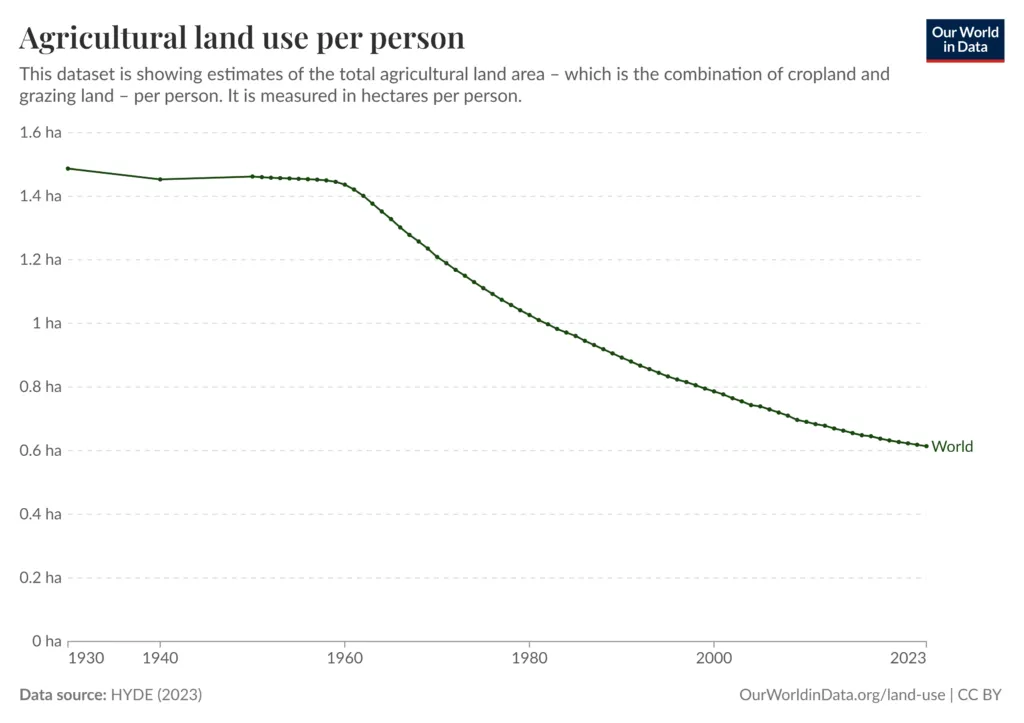
In other words, coal saved the trees, oil saved the whales, and gas, in the form of synthetic fertiliser, saved the humans. The shift from wood to fossil fuels reduced human society’s dependence on the natural environment, while the industries made possible by this actual energy transition created the possibility of immense wealth and great advances in science and medicine. Ehrlich’s supporters interject here that this created the very thing that Ehrlich warned against: population growth, which would outpace the industrial and agricultural development.

more news
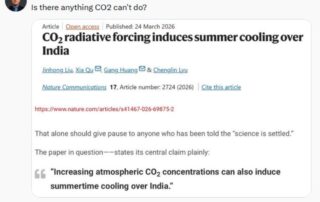
CO₂ Can Cause Cooling Too? Climate Models Say Yes (Sometimes)
As Dr. Matthew Wielicki dryly put it: “Is there anything CO₂ can’t do?” The study behind that remark claims that rising CO₂ levels may even lead to regional cooling under certain conditions—highlighting just how flexible—and uncertain—climate model outcomes can be.
Press release GWPF: Event Attribution Studies are “a blot on science”, says Ralph B. Alexander
Extreme weather attribution studies are based on flawed logic and misleading statistical practices, according to a new report by The Global Warming Policy Foundation (GWPF). Author Ralph B. Alexander argues that these studies, which link individual weather events to climate change, are driven more by political and legal agendas than by robust scientific evidence.

China’s Massive Coal-to-Liquids Expansion
In this article, Australian science writer Jo Nova examines China’s rapidly expanding coal-to-chemicals and coal-to-liquids industry. While much of the West focuses on phasing out fossil fuels, China is quietly transforming coal into fuels, plastics and fertilizers at massive scale—raising important questions about energy security and global climate policy.