
Shameless climate propaganda from the WHO and The Lancet
This week, the WHO tried once again to scare us senseless with fearmongering about climate change. It allegedly poses a catastrophic threat to public health. These claims are easily debunked and raise the question of what the WHO’s real agenda is, says Marcel Crok.

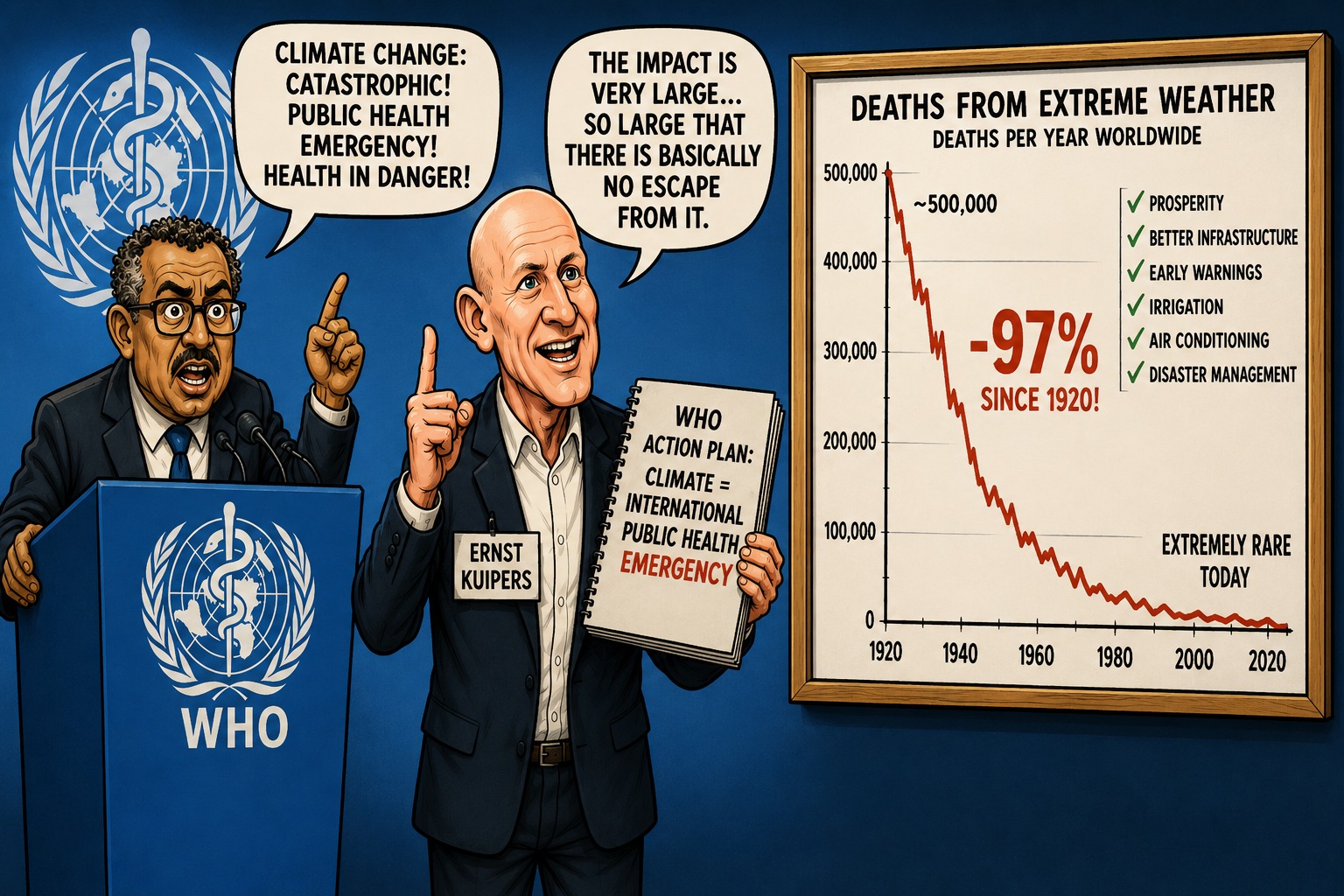
Image created with ChatGPT
Marcel Crok
Date: 23 May 2026
“The impact of climate change is enormous… so enormous that there is really no escaping it.” According to Ernst Kuipers, the former Dutch Minister of Health, Welfare, and Sport, speaking this week in his capacity as a member of a special commission established by the World Health Organization (WHO). In an action plan, that commission states that climate change in Europe must be treated as an international public health emergency.
This is not the first time the WHO has sounded the alarm on climate change. In December 2024, Dr. Tedros, the Director-General of the WHO, stated in a hearing before the International Court of Justice that climate change is, in essence, a health crisis. Since 2023, the WHO has had a webpage on climate change that begins: “Climate change is directly contributing to humanitarian emergencies from heatwaves, wildfires, floods, tropical storms and hurricanes and they are increasing in scale, frequency and intensity.”
The WHO’s focus on climate change has increased since the COVID-19 pandemic. Health is being used to emphasize the urgency of climate change.
Deaths from extreme weather
Catastrophic, health crisis, emergencies—all these terms suggest that humanity—in this case as a result of climate change—is in the midst of a massive crisis resulting in millions of deaths. However, the WHO fails to show the graph depicting deaths from extreme weather. Those deaths have fallen by more than 97 percent since 1920. I already showed that graph by the Danish environmental economist Bjørn Lomborg in a previous article for Indepen and will likely do so again. It is simply the most important graph for putting the climate debate into perspective.
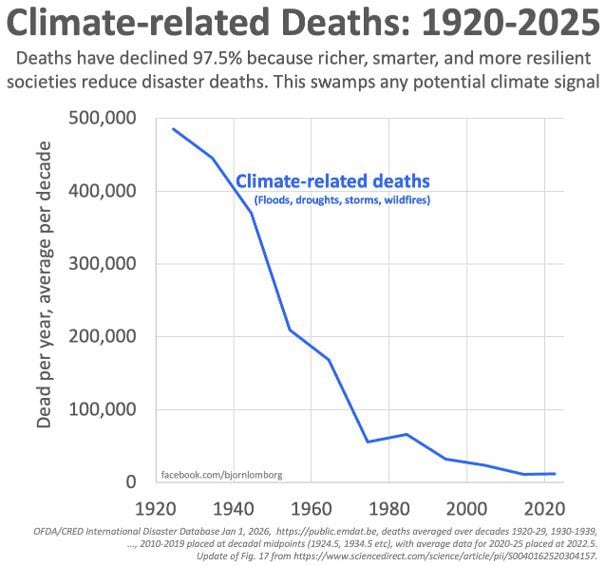
Around 1920, an average of nearly half a million people died each year from hurricanes, floods, and especially from droughts that led to crop failures and famines. Today, deaths from extreme weather are extremely rare. This is mainly due to prosperity, better infrastructure, early warnings, irrigation, air conditioning, and disaster management—in other words: adaptation works.
Consider, too, that the world’s population rose from two to eight billion people during this period. In terms of risk, the likelihood of dying from extreme weather has thus fallen even more sharply—by 99.4 percent. Every death caused by natural disasters is tragic, but let’s keep things in perspective. The chance of dying in a traffic accident is about a hundred times greater today.
Heat-related deaths
The WHO does not share this perspective at all. On the contrary, the WHO acts as if humanity is more vulnerable than ever to extreme weather conditions, focusing primarily on heat-related deaths. According to the WHO document, an increasing number of people in Europe are dying from extreme heat. The WHO refers to an underlying scientific paper that was published in April in the medical journal The Lancet. At first glance, it’s an impressive paper, written by dozens of scientists, including many professors. However, the same Bjørn Lomborg from the graph above tore the new study apart on social media, even calling it “textbook climate deception” and “blatant dishonesty.” According to him, the increase in heat-related deaths observed by The Lancet researchers is almost entirely attributable to Europe’s aging population. Older people are more vulnerable to heat, so more older people means more heat-related deaths, even if temperatures remain the same.
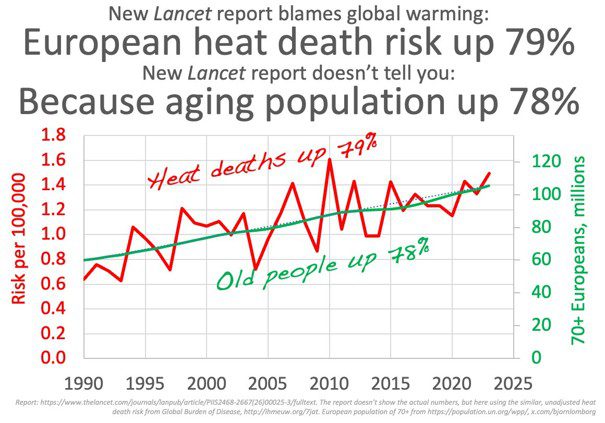
According to Lomborg, The Lancet has been employing this strategy for years. In 2021, Lomborg sent a letter about it to The Lancet, but it seems to have fallen on deaf ears. The fact that this is deliberate deception is further reinforced by the omission of other crucial information about extreme temperatures: far more people worldwide—including in Europe—die from extreme cold than from extreme heat. A 2021 paper in none other than The Lancet makes this important observation. According to that paper, approximately 5 million people worldwide die each year from suboptimal temperatures (no less than over 9 percent of all deaths). However, about 4.6 million of those are related to cold, not heat! The ratio of cold-related deaths to heat-related deaths worldwide is nearly 10 to 1. Incidentally, there are significant regional differences. In Europe and Latin America, the ratio is 4:1. In Africa, surprisingly, this ratio is as high as 46:1. So, in Africa cold is many times more dangerous than heat.
Keep in mind that these are statistical exercises. Of course, it is not the case that the death certificates of those who died list “heat-related death” or “cold-related death.” These are epidemiological estimates of how heat and cold may have contributed to the deaths of mostly already vulnerable older people.
Lomborg regularly points out that a warming world will be beneficial. There will be more heat-related deaths, but this is offset by a much greater decline in cold-related deaths:
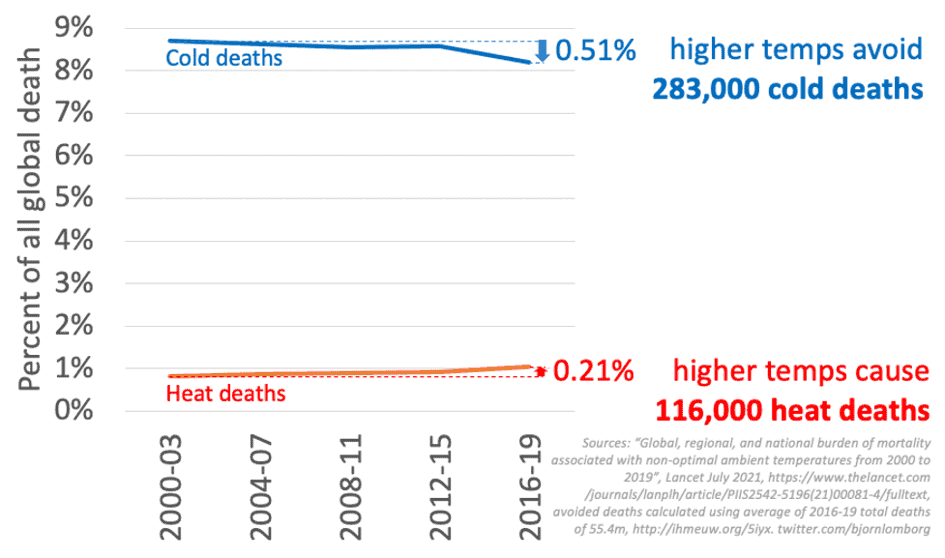
Source: Lomborg
The WHO document makes no mention whatsoever of cold-related deaths. The underlying Lancet paper does, however, attempt to make a contrived argument that heat-related deaths will eventually exceed cold-related deaths. This is highly unlikely when you look at the graph above. Also consider that as prosperity rises, it becomes relatively easy to protect oneself against both cold and heat. The figures from Africa make it clear that this is primarily a matter of poverty and that, for the poor, cold is therefore many times more dangerous and deadly than heat.
You don’t often see Lomborg speculating on why the WHO engages in such shameless climate propaganda. Other researchers do. Two years ago, the Swedish researcher Jacob Nordangård spoke at Clintel. As an academic, he conducts extensive research on the role of the UN and the World Economic Forum and wrote a substantial dissertation on the role of the Rockefellers in, among other things, the international climate agenda.
In the article “Who made WHO? One World, One Health, One Leader”, he describes how the WHO (through the One Health program) integrates health, climate, animals, and ecosystems. This creates a comprehensive framework in which climate change is equated with a health crisis, which is intended to lead to more power for international organizations such as the WHO and the UN in general.
This article was originally published in Dutch on Indepen.eu on 22 May 2026

Marcel Crok
Marcel Crok is a Dutch science journalist who has been writing full-time about the climate debate and climate policy since an award winning article about the notorious hockey stick graph in 2005. He published two books in Dutch (De Staat van het Klimaat (The State of the Climate) and was co-author of the book Ecomodernisme (Ecomodernism)). With the British independent researcher Nic Lewis he wrote an extensive report about climate sensitivity, titled A Sensitive Matter. He was asked by the Dutch government to become expert reviewer of the IPCC AR5 report. Together with the Dutch climate institutes KNMI and PBL, Crok set up an international discussion platform Climate Dialogue.
In 2019, Crok and emeritus professor Guus Berkhout founded the Clintel Foundation. They published the World Climate Declaration, which has now been signed by over 2000 scientists and experts. Together with Andy May and a team of scientists from the Clintel network, Crok contributed to and edited the book The Frozen Climate Views of the IPCC.

more news

Democratic Governors Ignore Energy Realities and Cling to Costly Green Policies
As governments and corporations worldwide pivot toward pragmatic energy strategies, Democratic governors in the U.S. Northeast continue to pursue green energy policies that raise costs and undermine energy reliability. The disconnect is becoming increasingly difficult to ignore.

Is Canada Really Warming?
Is Canada really warming at double the global average rate, as the Canadian government says it is? A new scientific report suggests the answer is no, arguing that Canada’s reported warming is largely the result of serious errors in official temperature data.

The Real Environmental Crisis Is Not Climate Change
While governments spend billions on CO₂ reduction, real environmental problems remain unresolved. The real environmental crisis is not climate change, but waste, polluted water and failing governance.

