
Ross McKitrick on Climate Models, Economic Impacts, and the DOE Report
In this in-depth interview, economist and statistician Ross McKitrick discusses climate models, uncertainty, and whether the public climate debate is as scientifically balanced as often claimed. He also reflects on his role as a co-author of the recent U.S. Department of Energy report.

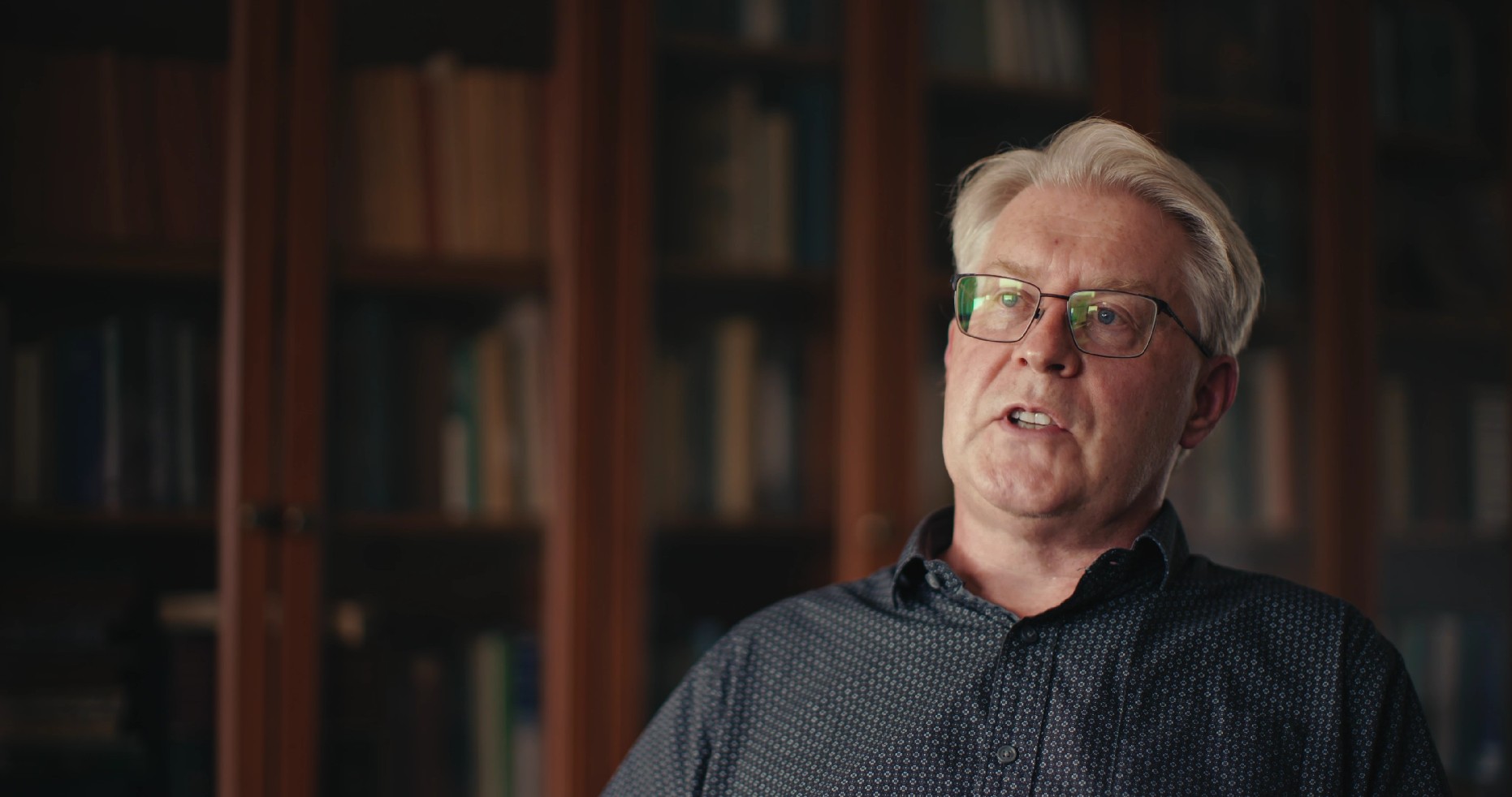
Professor Ross McKitrick, full professor of Economics and Finance
at the University of Guelph in Climate: The Movie
Manish Koirala
Date: 24 January 2026
Ross McKitrick stands out as one of the most well-known critics of mainstream climate science conclusions. He is a Canadian economist and serves as a full professor in the Department of Economics and Finance at the University of Guelph in Ontario, where he has been on faculty since 1996. With a strong background in econometrics and statistical methods, he has directed these skills toward examining climate datasets, temperature records, and the structure of climate models, often generating significant discussion and controversy in scientific circles.
Outside of his university role, McKitrick holds the position of Senior Fellow at the Fraser Institute, a prominent Canadian think tank. He is also affiliated with the Global Warming Policy Foundation (GWPF) in the UK, where he serves as a member of its Academic Advisory Council.
McKitrick first gained widespread attention by disputing the famous “hockey stick” reconstruction of global temperatures. He has consistently questioned whether mainstream climate models may exaggerate warming trends.
In mid-2025, McKitrick served as one of five members of the Climate Working Group (CWG), an independent panel of scientists convened by the U.S. Department of Energy. In July of that year, the group published a comprehensive 150-page report that aimed to review the conventional assumptions about the effects of greenhouse gas emissions on the U.S. climate.
1. How do you respond to the allegations that the recent DOE report in which you are a coauthor was produced to “manufacture a basis to reject” the accepted science on human-caused climate change and its impacts?
Our report overlaps quite a bit with the IPCC, and we don’t actually contest the basic scientific issues. What we were asked for specifically was a report that will look at some important topics that tend to be downplayed or overlooked in the public discussion. But we don’t reject the idea that CO2 is a greenhouse gas, for instance. We don’t reject the idea of there being climate change.
We look at things that go into a bit more detail. For instance, do climate models tend to over-predict warming? And we present evidence that, yeah, that is a pattern that shows up. Is CO2 associated with global greening and improved agricultural productivity? And yes, we present quite a bit of evidence on that point.
We talk about areas of natural variability in the climate that are often ignored in the public discussion and are downplayed by the IPCC. Our aim with the report is to expand the public discussion, not to shut it down or try to disparage climate science.
2. How much autonomy did you have in shaping the report’s key conclusions versus aligning with the collective views of the five-member Climate Working Group?
We had complete autonomy. When we were assembled, at first we thought we might have some role in what was called the endangerment finding process, which was the EPA’s submissions regarding the 2009 endangerment finding. But right away they told us we’re not involved with that. That was a separate team. We didn’t have any contact with that group. We were just told, write a report on whatever you think is important.
So that’s what we did. We just worked as a group. We decided on the topics we wanted to write about. We wrote our report. The first draft then went through an internal review process at the Department of Energy. There were scientists from the Energy Department National Labs who made peer review comments on it. We revised the report in response to those. But we had absolutely no political oversight or direction from anyone in the administration.
3. You’ve said you’re not familiar with the EPA’s legal filings, yet that report is now cited in attempts to overturn the endangerment finding. How comfortable are you with the report being used in regulatory and legal contexts you did not help to shape?
That was a decision of the EPA staff. If they had asked us for input, I suppose we would have offered it. But we put out the report for people to use.
What we wanted to do was make sure that we’re putting forward what we think are valid scientific and economic arguments that should be part of any discussion around climate change. That was our aim, and I think we achieved that.
4. Was there any pushback from you or your co-authors on the scope or wording?
Sure, we exchanged drafts, and sometimes we agreed readily on wording, and other times we disagreed, and we had to argue it out among ourselves. But the final version reflected all five of us going through line by line and coming to an agreement on what it should say.
5. The DOE report has been criticized for allegedly cherry-picking data and omitting broader bodies of research. How did you decide which datasets and studies to include or exclude — and why should the public trust those criteria?
Well, let me say first, the report was put out. It’s a draft report; it was put out for public comment. So we know that there are people on the other side who didn’t like our findings, and we received hundreds of pages, tens of thousands of comments.
Unfortunately, there was a lawsuit that was filed against the Department of Energy by some environmental groups, and there was a procedural error on the administration side. So we weren’t set up in compliance with something called the Federal Advisory Committee Act, which meant they had to close our group down.
Individually, we’ve gone through these responses, including the accusations of cherry-picking or misrepresenting, and we’re preparing notes and responses. I hope that we will eventually be able to present the public with what would have been normally the second round of this, which is full responses to all the criticisms and revision of the report with the corrections where they’re necessary, but also the counterarguments to our critics.
I can give an example. For instance, where the critics were right, which is on the discussion of agricultural productivity: there’s no discussion in our report of the effect of extreme heat episodes on crop productivity. Well, that was an omission; we should have had something in there. I’ve looked through that material and made notes on what should have been said. It doesn’t change the overall conclusion. Historically, the gains in crop productivity due in part to CO2 fertilization are very real. So the overall point still stands, but it still needs to be mentioned that people in the agricultural community need to work on resilience to increased episodes of extreme heat.
Another case where the critics, I believe, are not correct: we argue that it’s the low climate sensitivity models that do the best job of reproducing the last 50 years of the climate record. They said we looked at studies that support that, but they gave us other studies that they said don’t support that. I’ve looked at those other studies, and in fact, they all do support it. I don’t know why the critics seem to think that those other studies said something different. We could have used any one of the studies that they sent us. They all say the same thing. They may phrase the conclusion differently, but they all make the same point: the surface and troposphere warming record of the past 50 years is well reproduced by the low climate sensitivity models. The high sensitivity models project too much warming, and I think that’s a very important piece of information as people consider what to do with these 40 different models that paint very different pictures of the future. I think the fact that the low ECS models are doing the best job of reproducing the recent past is an important piece of information.
6. When is the second, revised report due?
At this point, there isn’t really a schedule to speak of. The situation—and it’ll sound very strange; I’m Canadian, so the U.S. legal proceedings seem very strange to me—is that in response to a ruling from the court, the Department of Energy disbanded the Climate Working Group and has given an undertaking to the court that our work is completed, and we’re respecting that ruling.
What we need to do as individual members: we’re still free to write, speak, and talk about climate change. So we’re just trying to figure out individually how to proceed. My hope is that at some point this year, in the early part of the year, we will be able to complete this work and present a complete response to the main scientific criticisms and responses that we received. I know the other members of the working group were very keen to do this, because obviously we want to defend our work, but also because some people put a great deal of effort into critiquing our report, and so they deserve to see a constructive outcome of that process.
7. Did the group attempt any formal uncertainty quantification that’s comparable to methods used in IPCC or national climate assessments?
Well, looking at precipitation, John Christy and I had previously co-authored a paper using econometric methods to evaluate the uncertainty of trends in averages and extremes, and that publication came out, I think, about five years ago. So we updated the data set, expanded the geographical coverage, and used the same methods that are drawn from the peer-reviewed econometrics literature.
Similarly, looking at the discrepancy between models and observations in the troposphere, that was work that John and I published in the climate literature. We updated those data sets for the purpose of the report so that we could present the most updated possible material. But in those cases, we were using public data sets and standard econometric methods; we weren’t inventing any new methodology.
8. If you could amend one section of the report in response to the widespread scientific critique it has received, what would you change?
Well, I think eventually, when we do get the revised material out in whatever form that comes, let’s see: on the economics material, one of the criticisms there was that in presenting the Nordhaus integrated assessment modelling results, I focused on how close the temperature outcome is between the unregulated and the optimally regulated path. A critic pointed out that that’s true, while the emissions paths diverge more than I had discussed, so that’s something that I should have picked up on and introduced.
Then there are other extensions to integrated assessment modelling that more formally represent uncertainty and risk aversion. I’ve since digested that material and written up summary discussions of it. So that’s, again, an example where the critics made valid points. We covered a lot of material, and we only had about six weeks to do it, so you can’t expect to cover everything. But people have pointed to stuff that should have been in the report, and I think in the end, what we add in response to the critics leads us to a report that does an even better job, in my view, of what we set out to do, which was to expand the discussion around climate change and present people with a more complete picture of what the debates are and what the data is showing.
9. Why was the group given only six weeks to work on a such a substantial issue?
Out of our control. I think what they had in mind—we’d have been happy to have six months to a year to work on it—but that was the remit. Now, like I say, the idea was: draft is going to go out, there’s going to be a public comment period, and then there’d probably be about a four-month period where we’re dealing with the comments and preparing a revised report and a set of responses to all the criticism. So the whole process would have ended up taking upwards of a year. The lawsuit threw all that off the rails, and so that’s why things seem to come to an abrupt end. But I think originally the idea was the whole process—draft, comments, revisions—would have been a much longer and slower process had the group been given about six months or a year of time.
Professor Ross McKitrick in Martin Durkin’s award winning documentary Climate: The Movie
10. How do you think the report would have turned out if the group had been given six months or more to prepare it?
We would probably have still had the same table of contents, in the sense that these were the topics we wanted to talk about. More time would have given us the opportunity to consult with other people, including people who eventually became critics. Also, bear in mind, we heard from a lot of people who were quite supportive of our report and endorsed our treatment of these issues.
Personally, if the lawsuit hadn’t come along, we were looking forward to the comment, review, and revision stage. When you do a big project like this, you can’t expect to cover everything. It’s a huge field, there are many experts, and of course, there are going to be people out there who know a great deal more about a specific topic than any of us do. So they’re the ones we wanted to address a topic and then get their feedback, whether supportive or critical.
When I got involved in it, I knew that putting the initial report out is actually a small part of the whole project. The big part is going to be processing all the responses, dealing with the public comment pùeriod, and the professional criticisms. That would really be where we come up with the final work product that we’re aiming for. So if we’d been given more time, that wouldn’t necessarily have resulted in the ideal outcome. The key really was the comment process and the revision process—the whole peer review process.
Ironically, the environmental groups that sued the Department of Energy, their complaint was that our report didn’t go through a type of peer review they thought we should have. But it was a lawsuit that has so far prevented that process from being completed. It’s one of these unintended consequences of the court system.
I do think, in those areas where I’ve gone through the criticisms and looked at the literature they said we should have covered, that our basic message still holds up quite clearly and, in some cases, is even stronger. Now we can say that this represents not just the five of us, but the wisdom of a larger community, including the whole peer review community.
11. What’s the most common misunderstanding among your critics about what the report actually claims — and what’s the most common misunderstanding among your supporters?
That it’s an attack on climate science—it’s a ridiculous thing to say. I think anyone who spent any time reading the report would realize that it’s not an attack on climate science. We rely heavily throughout the report on the IPCC reports. We cite the National Climate Assessment reports. But we also believe that there are important topics and discussions that are downplayed or ignored that really should be put on the table for discussion. That’s what we’re trying to do: we’re trying to make the discussion more complete and comprehensive, not attack it.
12. Why do you claim that the U.S. Clean Air Act is not a good framework for greenhouse gas policies?
It was set up to deal with local urban air pollution issues. The framework of the Clean Air Act divides the country into attainment and non-attainment zones and authorizes the EPA administrator to prescribe local emission requirements on power plants and motor vehicles in order to get non-attainment zones into attainment, meaning get specific types of air pollution down to a criterion level. That whole framework doesn’t make any sense at all for a globally mixed greenhouse gas like carbon dioxide.
There’s no such thing as a non-attainment or attainment zone for carbon dioxide. You’re looking at a uniform level that’s mixed into the troposphere, and there’s no rule that you can prescribe for motor vehicles or power plants in the United States that’s going to unilaterally change the global CO2 concentration, much less change the local climate. So if your concern is that there’s too much warming in the city of Philadelphia, that doesn’t tie to cars and power plants in the Philadelphia area. That’s a local effect of a globally mixed phenomenon.
For that reason, it was the Clean Air Act—which, clearly in my view, I’m not a lawyer—was set up to deal with urban air pollution issues and has been very effective for that. But it’s just the wrong framework for thinking about carbon dioxide and global climate issues.
13. Climate models are central to the IPCC’s projections, but you’ve raised concerns about their limitations. How well do you think these models, and the IPCC’s methods for quantifying uncertainty, reflect the true risks of future climate change—and are there alternative empirical approaches or data sources you believe should play a larger role?
I don’t put a lot of weight on the IPCC’s statements about confidence. They tend to be very subjective, and some of them don’t make a lot of sense. For instance, we pointed out that the IPCC has accepted that it’s very clear that climate models as a group put way too much warming in the troposphere, and they cite lots of papers, including papers I’ve co-authored that show that, and yet they assign it only medium confidence. And yet, they assign very high confidence to other issues where the evidence basis is quite weak. Some of those statements, it seems to me, tend to be subjective and put in there for rhetorical purposes—to try to emphasize messages rather than communicate the actual strength of quantitative information.
Now, I don’t know what the alternative would be; it’s difficult to summarize large, complex topics in a meaningful way. But I think specifically the IPCC has used a very poor methodology for attribution. I think the optimal fingerprinting methodology is extremely flawed, and I’ve published papers explaining why. I think it tends to miss the role of natural variability in a systematic way and overstate the role of anthropogenic forcing, and they’ve assigned way too much confidence to the results of that.
Also, the IPCC—and this goes back 20 years now—tends to put out families of emission scenarios that include an upper tail that should not be there, that historically don’t validate against the data, and just in terms of the storyline behind them, doesn’t make sense. They get very cagey when pressed on why they have these emission scenarios that are just not credible. I think it’s because it gives them the rhetorical advantage of being able to put out a range of warming projections and then say it’s going to be six degrees or something like that. By the time that appears in a newspaper or a public setting, people lose the subtlety that this is an extreme upper end, and they think the IPCC is actually projecting that much warming.
That’s a case where I think the way they handle the range of uncertainty around emission scenarios ends up serving to mislead the public discussion rather than center it on the most realistic and plausible outcomes.
14. How do you assess the cost-effectiveness of current climate policies, and are there specific approaches you believe could achieve emissions reductions more efficiently?
Well, that’s a big topic. Cost-effectiveness, I would say, is not achieved in general by most of the climate policies we’re familiar with, especially things like renewables—solar and wind. It’s just, in my mind, a terrible tragedy how much the world has spent on those power systems, and we get almost no useful electricity, or a tiny amount, at an extremely high cost.
Then things like the EV mandate: these issues are playing out in Canada the way they’re playing out in so many other countries around the world. Governments seem too willing to allow corporate interests that see this as an opportunity for making a lot of money by selling the government on a technology that requires the government to back it up with regulatory force. EVs would have a presence in the automobile market, the technology is improving, and there will be people who want EVs and prefer them to gas-powered cars. But these mandates are trying to force that through way ahead of schedule. It’s very profitable for certain automakers and the industries that support them, but it’s very costly for consumers and harmful to the traditional auto sector.
So that is not a cost-effective approach, and it doesn’t even reduce emissions very much. EV mandates have minimal effect on greenhouse gas emissions for all the costs.
The economic approach—and one of the points I tried to get across in the economics chapter—is more concerned with sending a price signal into the market as best we can concerning the social cost of CO2 emissions, and then stepping back and letting the market respond to that price signal. Because of the role fossil fuels play around the world, and the necessity of energy, there won’t be a big response in terms of emissions. It’s very expensive to reduce fossil fuel use, and with current technology, we just don’t expect to see a lot of short-term reduction in emissions.
Down the road, it might get cheaper. There might be a way to decouple CO2 emissions from fossil fuel use. There isn’t at present, but there might be. We have decoupled particulates, sulfur, and carbon monoxide from fossil fuel use, but we haven’t figured out how to do that with carbon dioxide yet. Once we do, lower-cost options will appear, and that’s when you would see much more cost-effective approaches to dealing with CO2 emissions.
So the economic reasoning here has always been: for the time being, we’re just going to have to learn to live with it, hope it doesn’t become a crisis, and assume that there will be technological improvements, maybe in the latter half of the century, that make the problem easier to solve.
15. What are your thoughts on the net-zero mandate?
On the net-zero mandate, I think it’s, at best, a very misguided attempt by politicians to look like they’re doing something heroic, even though they have no idea how they would actually implement it. At worst, I think geopolitically it is causing Western countries to seriously weaken their industries and capacities. It’s creating an opening for some hostile governments, including Beijing, to establish a presence around the world in other countries that weren’t able to get financing for their own power plants and fossil fuel development, because the net-zero agenda in the West caused the money to disappear for those projects. This allowed the government of China to take control of a lot of developing countries in a way that I think is hostile to those countries’ interests.
16. Do you think economists are systematically better or worse than physical scientists at reasoning about deep uncertainty—and what blind spots does your own discipline bring to climate questions?
Economists, I will say, have an advantage in that the average economist has a lot more training in quantitative methods, econometrics, and statistics than the average physical scientist. One of the reasons I got into publishing in climate science journals was that there were a lot of issues where the methods being used are really drawn from economics and econometrics, but they weren’t being used very competently in physical science journals. I think economists do a better job of statistical reasoning and statistical analysis.
As far as reasoning about deep uncertainty, everybody grapples with issues around trying to say something sensible about things that might or might not happen 100 years from now. Economists are used to studying something—namely the global economy—that has changed really dramatically, so we know that today’s technology isn’t necessarily going to be the same as tomorrow’s technology. We know that incomes and standards of living can change dramatically over 100 years. Physical scientists, on the other hand, are studying systems that tend to be very stable and not change a whole lot, so they are very alert to anything that looks like it has changed appreciably over the last 50 years or so.
For economists, I suppose our blind spot would be that if you tell us the world could warm a couple of degrees and that could have a lot of big effects, we would, in the first instance at least, just shrug and say, okay, well, we can live with that. The progress of income and technology means that we probably won’t really notice the change very much when we think about everything else that’s going to change over the next 100 years. Physical scientists, by contrast, would be a lot more alert to the potential for harmful surprises and unprecedented changes.
17. How do you distinguish between methodological skepticism and motivated skepticism in your own decision-making—especially when results align with your priors?
I am not entirely familiar with the terms, but I think what you’re getting at would be: methodological skepticism is just what you expect scientists all to have—they want to challenge conventional wisdom and test how strong the evidence is. I guess motivated skepticism would refer to more of a partisan attitude—that you want to score points for your side and downgrade the other side. I would assume that everybody is susceptible to the latter.
Everybody involved, including in the physical sciences and the hard sciences, gets wedded to their paradigm and preferred way of looking at things. In some cases, you have people who have built their whole career on a certain theory, and so if data comes out that seems to contradict their theory, they’ll be the ones who try to attack it. To my mind, there’s nothing wrong with that as long as everybody’s analysis is transparent.
I think the real key in the end is: when you put out your work, do you release your data, do you release your methods, do you write it up in such a way that readers can see exactly what you did? That gives the reader the chance to evaluate your work. Motivated reasoning on its own is not necessarily a problem if it leads you to the right answer. It becomes a problem if it leads to deceptive practices—if you’re trying to hide it by not releasing your data, or you’re fabricating things.
That’s where we have to be on guard. In my case, I try to be very conscientious about releasing my own data. I would say that things have improved in climate science, but there’s still a lot of papers out there where I read a paper and want to check the author’s work, and it’s very hard to find their data, or they’ve posted it in a way that you can’t really use it, or you need to ask them for special software to make it workable. I think that’s still a problem in a lot of scientific areas, including climate.
18. What institutional incentives most distort climate research today: funding structures, publication bias, media framing, or political demand for certainty?
My observation is that here in Canada, the grant funding agencies have moved away from just open-ended, curiosity-driven grants. They’re much more prescriptive. There’ll be specific topics that they want to see studied, and the announcement will tend to build the conclusions right into the research design.
For instance, it’s fairly common now to see federally funded research grant competitions centered around how to reduce greenhouse gas emissions or measuring the harmful impacts of climate change on society. When you announce a grant like that, you’ve presupposed the kind of work that you’re willing to support, rather than just letting scientists propose the topic and get funding based on the quality of the proposed research. So, granting agencies are a problem.
Journals: you can still get stuff published, even if it goes against the narrative. But I have, over the years, including in recent times, had experiences where the journal editors—even if your results point very strongly to, for instance, carbon dioxide not being a dominant role in temperature change—some journal editors just say, “Don’t phrase it like that; try to downplay that.” They don’t want to—one just said, “This is settled physics; I don’t want to open that can of worms.” Even though the results said what they said, that was the editor putting limits on how we could describe the results.
At the same time, there are enough journals and editors out there that, if you keep at it, you can find editors that will let you publish your results, if they are solid and pass peer review. So, I don’t accept the view that there’s nothing but gatekeeping out there in climate science. There’s some, but I don’t think it’s any worse than other disciplines.
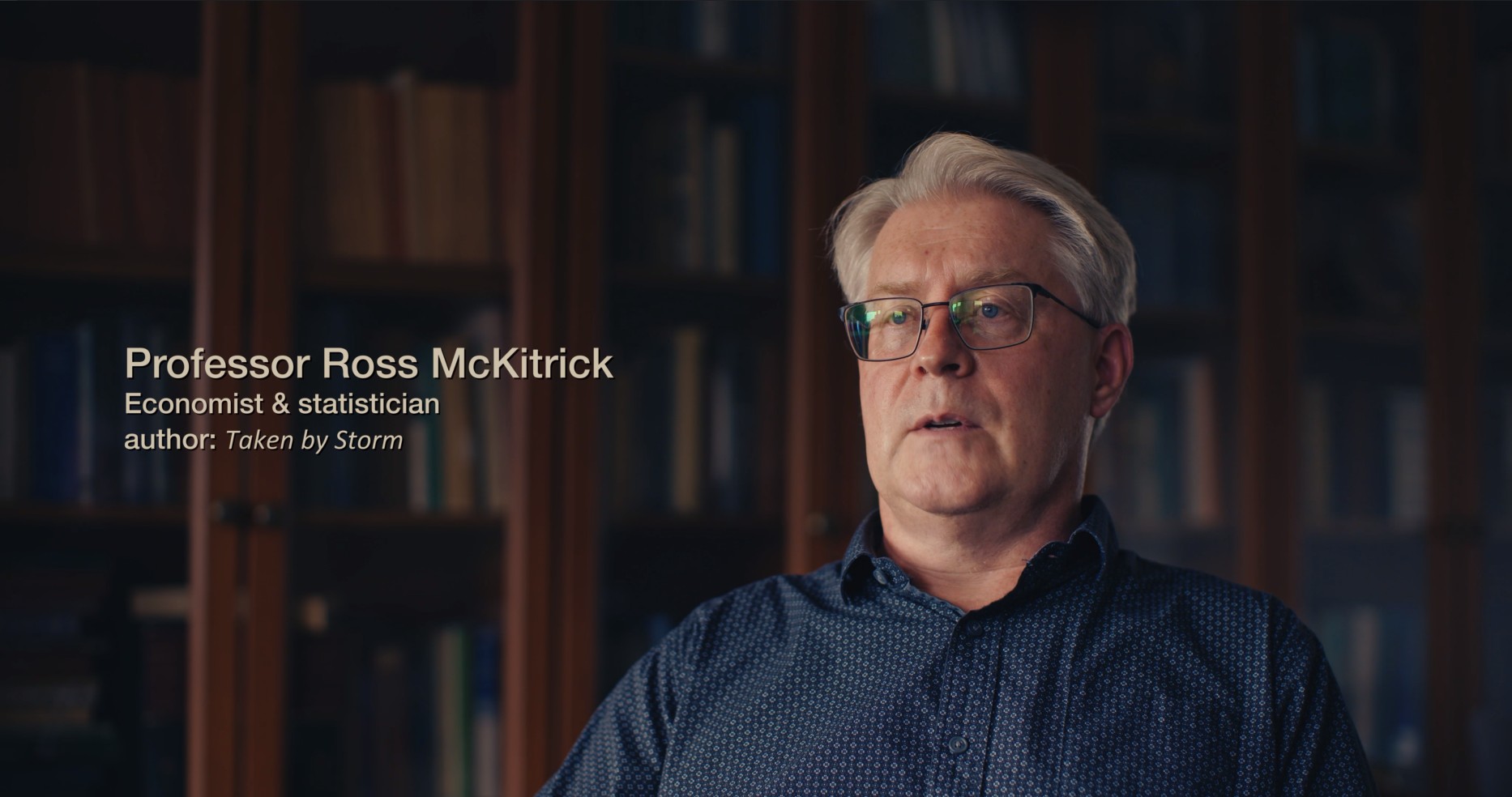
Professor Ross McKitrick (Climate: The Movie)
19. Do you believe think tanks—on either side of the climate debate—have made it harder for the public to understand uncertainty honestly? Please include organizations you’ve worked with in your answer.
There are different types of think tanks. I mean, advocacy organizations, like environmental groups, for instance, that don’t really aspire to be called a think tank—they’re more lobbyists and advocacy activist groups. I think they have done a lot to muddy the waters with extreme language.
I would also point out the Secretary-General of the United Nations. I think he’s the most irresponsible voice on this issue in the world. He makes absolutely crazy statements. When the IPCC-6 assessment report came out, he said it was a “code red” alarm and all these things that the report supposedly was warning people about, and it didn’t say any of that. He was just making it up. I would begin with him—Guterres. I think he’s highly irresponsible.
When he does things like that, and climate scientists don’t step up and correct the record, I guess they’re in a difficult spot, but that’s where I think they should be more active in policing that side of the issue.
The think tanks that I’ve been involved with tend to be focused on economic policy issues. There’s a strong overlap between the economics work that comes out of think tanks and what’s in the economics literature. Here, I think it can come as a surprise for people to realize that the mainstream economics profession, over my lifetime—I’ve been at this since the early ’90s—has never really endorsed aggressive climate policy. I’ve never seen much interest in economics in the net-zero agenda, just because the costs and benefits don’t line up that way. So the economic analysis that I’ve done through think tanks tends to follow very closely what’s going on in the peer-reviewed economics journals.
The think tank world, especially in the United States, is huge. There’s an awful lot of them, and some are very focused on science issues, some are focused more on energy and the power grid. If you’re in a country that doesn’t have a lot of think tanks, it looks like these are big, powerful groups with a lot of influence. But in reality, there’s so many of them that no one think tank tends to drive the whole process—they’re all kind of countering each other.
20. Is there a climate policy you oppose not because it’s ineffective, but because it violates a principle you believe economists should defend—even if emissions fall?
Well, this would apply more broadly than just climate policy. The economic mode of thinking about public policy, which I support, is that we should look for policy options that interfere as little as possible with people’s autonomy. Especially if you have a case where two policies will achieve the same outcome—one through voluntary market measures, and one that requires the government to dictate consumption decisions and daily activities of the population—we would far prefer the first one. Even if they achieve the same outcome, just allowing people autonomy is an end in itself.
In the case of climate change, this is a very vivid issue, because economists have long been drawn to the idea that you can address this issue with pricing, with a market mechanism, preferably a carbon tax. Once it’s there, you stand back and let people make their own decisions about how they respond. Some people may respond by cutting their fossil fuel use a lot, and some people may not cut their fossil fuel use much at all, and instead pay a higher fee. But you let them make that decision.
Unfortunately, policymakers—even in Canada, where in principle they supported a carbon tax—as soon as the carbon tax was in place, decided they weren’t willing to keep their hands off the economy. They brought in over 100 other policies that try to prescribe daily decisions down to what kind of light bulb you can buy, what kind of washing machine you can buy, what kind of car you can buy, and rules around the insulation you need in your house—the list goes on and on.
Economists don’t like that because it tends to be very inefficient. The cost ends up going through the roof, and you don’t accomplish much more. But intuitively, most people also realize at a certain point that we don’t like this because it’s intrusive and feels like social control. And if it’s not actually accomplishing anything, then it’s even more objectionable.
21. What do you think mainstream climate scientists misunderstand most about economists’ critiques—and what do economists misunderstand most about climate scientists’ constraints?
In my experience, climate scientists just don’t appreciate the downside of limiting access to fossil fuels. Or maybe they think that somehow we could easily replace them or sustain our standard of living without them—but that is not the case.
As far as what economists perhaps don’t understand about the physical sciences, well, there’s a long list. Most economists don’t really know a whole lot about meteorology, climatology, climate modeling, or what the basic data sets are. If there is one particular issue that climate scientists probably wish economists knew more about, it would be the possibility for nonlinearities and certain unexpected changes in the climate system due to its chaotic nature.
22. Are there aspects of mainstream climate science you now think deserve more serious re-evaluation?
Yes—attribution, optimal fingerprinting. I think there’s a lot of just wrong results in the literature. The IPCC embraced a methodology that even a lot of its practitioners didn’t understand, and they just liked the fact that it kept generating positive results without looking into whether it was a valid statistical method. I think that needs serious re-evaluation. We said that in the DOE report. The responses—hardly anyone commented on that. The one person who filed some responses didn’t try to defend it; they said, “Well, we have some other methods that we use now.” But I’ve looked at the other methods, and I think they’re just as bad, and in some ways worse. They get into some more complex time series econometrics issues that I don’t think climate science journals are really equipped to deal with at this point.
Another issue is extreme weather attribution. That’s somehow become a mainstream topic. Here again, it’s a methodology that got embraced right away without any serious look at its deficiencies, and the fact that it keeps generating what look like positive results rather than the practitioners asking whether they like it because it keeps telling them what they want to hear. I think they should be much more cautious.
Now, there are some people in the extreme event field who are very cautious. One of the criticisms we got in the DOE report was that we were critical about the focus on the World Weather Attribution group—they’re a huge public relations machine and get a lot of media attention. Some of our critics said, “We don’t paint us all with the same brush. We’re not all like that.” And they’re right: there are a lot of people in the extreme weather analysis field who are very cautious and don’t rush to conclusions in that way.
But I think the dominant players now in the extreme event attribution field are going to make a similar mistake—similar to the hockey stick graph, similar to optimal fingerprinting—grabbing hold of a methodology they don’t really understand because they like the results it gives them.
23. In your experience, how much of U.S. climate policy is driven by scientific evidence versus political or economic considerations?
Very little. I think if this were a situation where you could fully address the problem at a very low cost, people would just defer to the scientific advice and go with that. In the case of chlorofluorocarbons, when it emerged that they were destroying the ozone layer, there was also an inexpensive solution. There were substitute products that addressed the issue. There was no real commercial interest in the old CFCs, so it didn’t really cost anything to say, “All right, we’ll just take a precautionary approach, ban these CFCs, and mandate that you have to use the alternative.” There were some costs, but really pretty small, and no one really noticed. That would be a case where the scientific findings, for all their uncertainty, were used to guide the outcome.
The problem with climate, though, is that it really ties into the use of fossil fuels. Whether you’re an oil-producing country or not doesn’t really matter—every country is using oil, gas, and coal, and is dependent on fossil fuels for their economic standard of living. It’s inevitable that people are going to dispute the policy decisions intensely, and there will be a lot of politics in that.
It’s also the case that the science is just a lot more uncertain. The debate isn’t whether carbon dioxide is a greenhouse gas; the debate is how big an effect it has on the climate and how much harm it would really do if it does happen. Those are much more difficult questions, and those gaps of uncertainty are going to get filled in with a lot of politics.
24. Looking back, what did Climategate reveal about the norms of climate science—like data sharing or peer review—that genuinely needed reform?
People put way too much stock in the term “peer reviewed.” I think it might have been a public perception that if something appeared in a peer-reviewed journal, that meant a whole team of reviewers had gone over it and made sure there were no errors. Part of the surprise for people with ClimateGate was to realize that no, that’s actually not how peer review works. Very rarely do peer reviewers actually look at the data or try to replicate the analysis. It can be quite a cursory review.
Another surprise for people, I think, was that the Intergovernmental Panel on Climate Change—up to that point—the rhetoric had been that this is thousands of the world’s top scientists, and they all go very carefully over the evidence and come to an agreement on what it all means. What you could see was, no, it’s little pockets of scientists that work on different parts of the report, and they just decide among themselves what they want to say. If there’s counter-evidence, they have a lot of authority to just ignore the stuff they don’t like. I think it gave people, in that sense, a more realistic look at how large reports like that actually come together.
25. Have you ever received funding from the petroleum industry to support your research?
No. Most of my research—I don’t get funding at all. I’m at a point now where I just use public data sets and R, which is free software, so it doesn’t cost anything to do it. I don’t have to hire research associates or assistants.
The funding I’ve received over the years came from the federal government, the Social Sciences and Humanities Research Council. I did actually once get a grant from a George Soros–funded group, surprisingly enough. It was the Institute for New Economic Thought, and they liked a project proposal I submitted, so I got funding from them—but that was just the one time.
No, I haven’t had external research funding for a long time, because, as I said, I don’t run a lab, I don’t have employees, and I don’t need any funding.
26. Stripping away the politics, what does the hockey stick episode show about the strengths and limits of paleoclimate reconstruction?
A point that Steve and I tried to make was that the methodology was flawed. It was just wrong, and yet a lot of scientists used it. They reused Mann’s flawed principal component algorithm, and I think because they liked the results, it generated a nice-looking hockey stick for them. The IPCC took that result, even though there were other reconstructions in the literature at the same time that didn’t show the same result, but they ignored those. They emphasized the hockey stick and promoted it heavily.
That whole episode, I think, revealed—well, you used the term motivated reasoning earlier—and I think it revealed that in the leadership of the IPCC, there is motivated reasoning going on. They have a narrative they want to promote, and they are very alert for studies that support the story they want to tell. Sometimes motivated reasoning leads you to the right answer, but that was a case where they ignored counter-evidence and used a flawed study where the data didn’t really support the conclusion, so it led them astray.
27. Your research has often questioned higher estimates of climate sensitivity. Based on current evidence, what do you consider the most robust range for climate sensitivity, and why?
Well, on sensitivity, I defer to someone like Nic Lewis, who is much more knowledgeable about the statistical analysis. In the work that John Christy and I have done, we framed it more in terms of which models can reproduce the observed climate changes. The answer is the models that have the lowest sensitivity. Even there, if you look at the mid-troposphere, there’s still too much warming and too much amplification with altitude.
Based on that analysis, I would say the models with the lowest climate sensitivity—right now in the range of about 1.8 to 2.5 °C—are the ones that seem to get the right answer. That’s where I think we should be looking in terms of understanding the overall sensitivity of the climate system.
In the DOE report, we discussed various arguments about why the climate system may be more sensitive than the models show, because future pattern effects could emerge that amplify sensitivity. I think that’s an important line of research, but we also pointed out that the main pattern effect being discussed is a temperature gradient in the tropical Pacific. There, the historical data runs opposite to what the models show—the gradient isn’t strengthening the way the models say it should. Going through the responses, critics conceded that this is what the data show, but argued it might change in the future. I think, okay, I’m open to that, but it’s a pretty weak argument at this point.

This interview was previously published on Dungeons of Science, the website of science journalist Manish Koirala.

more news
Right, New York Times, Scientists Do Disagree on The Polar Vortex
A recent New York Times article explores claims that climate change may be worsening winter cold extremes. While some scientists argue that Arctic warming destabilizes the polar vortex, long-term data show a clear decline in extreme cold events, challenging that narrative.
The Endangerment Finding Was Pre-Cooked
In this analysis, Dr. Matthew Wielicki examines the EPA’s 2009 Endangerment Finding, contending that the ruling was effectively decided in advance and later justified through a structured scientific review, with far-reaching consequences for climate regulation.

Why Climate Science Is Not Settled
Claims that climate science is “settled” are frequently used to justify far-reaching policy decisions. In this article, Vijay Jayaraj examines how model uncertainties, conflicting evidence and real-world observations challenge the idea of certainty in the climate debate.

