
Steven Koonin now also believes that the worst of the climate hysteria is behind us
In a recent ICSF/Clintel lecture, Professor Steven Koonin argued that global climate and energy policy is at a tipping point. After decades of emphasis on rapid and far-reaching emission reductions, he sees clear signs of a shift toward greater realism and pragmatism, including in climate reporting. After all, economic, technological, and social realities are becoming increasingly difficult to ignore.

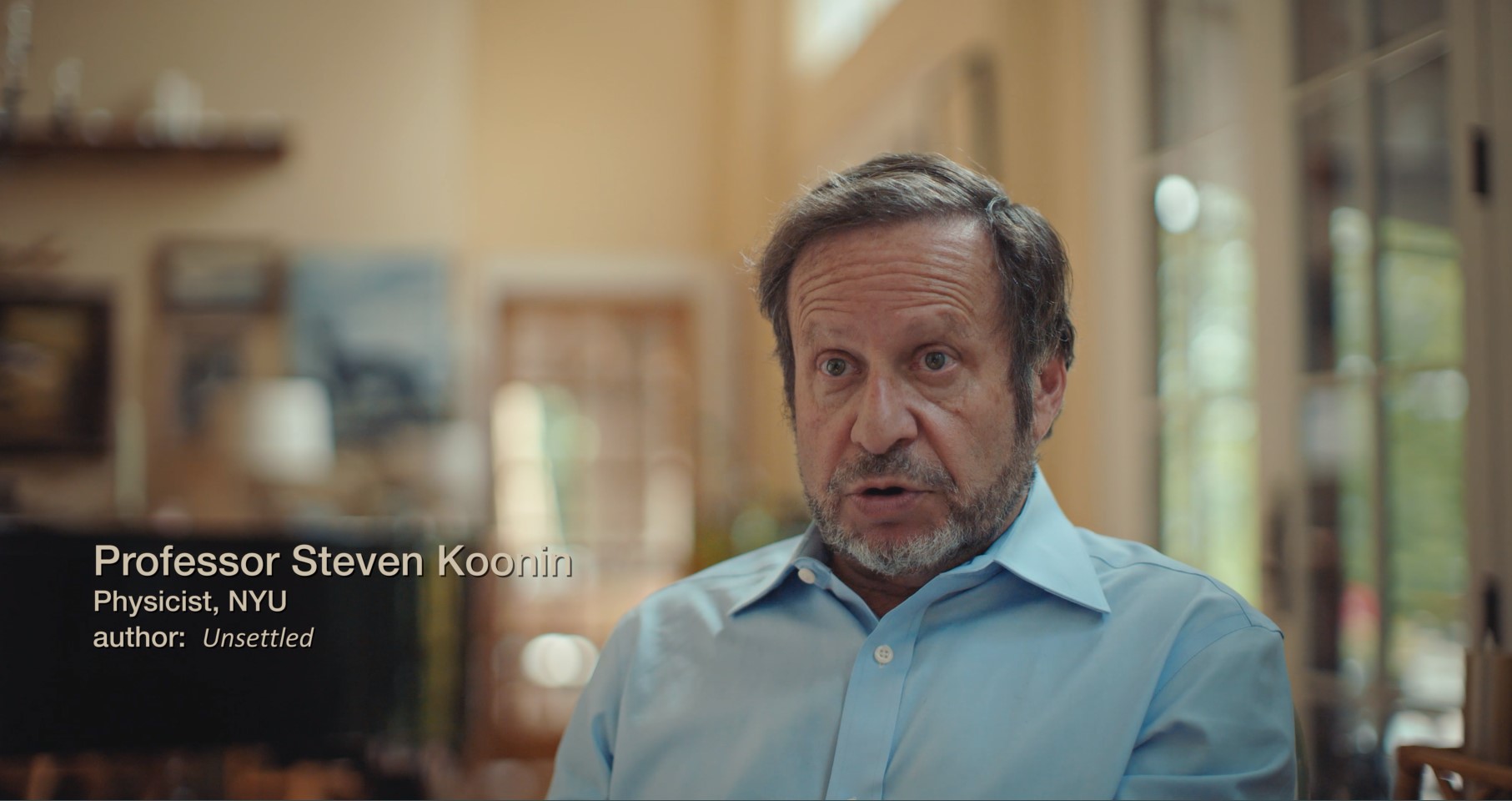
Professor Steven Koonin in Martin Durkin’s award winning documentary Climate: The Movie
Peter Baeten
Date: 25 January 2026
Koonin was Energy Undersecretary for Science in the Obama administration and author of the critical climate bestseller Unsettled. He opened the presentation with the observation that the dominant climate narrative of the past forty years—that rapid decarbonization is both necessary and easily achievable—is losing credibility. This narrative argued that political will was the only real obstacle and that costs, reliability, and social consequences would not pose a fundamental problem. In practice, however, these assumptions have proven to take insufficient account of the complexity of the energy system and of human and economic behaviour.
Koonin points to numerous signs that indicate a strategic retreat from strict reduction targets. In Europe and the United States, plans to phase out combustion engines are being watered down or postponed. Research also shows that only a very small percentage of the climate measures introduced have actually resulted in measurable emission reductions. At the same time, high energy prices and increasing regulation are leading to deindustrialization, especially in Europe.
More broadly, he also sees declining support for large-scale climate financing. Many promises made to developing countries have not been kept, while global emissions continue to rise and fossil fuels still provide more than 80% of the world’s energy supply. Coal and oil consumption are at record highs. Furthermore, electricity grids in the West are becoming less reliable and more expensive, partly due to the rapid integration of weather-dependent energy sources. The market for electric vehicles is stagnating, except in China.
Cultural shift
In addition to the signs mentioned above, Koonin also sees a cultural shift. According to him, the media are less quick to link extreme weather events to climate change, and influential institutions and opinion makers are increasingly talking about ‘climate realism’.
Koonin distinguishes between two forms of realism: energy realism and scientific realism. Energy realism—the awareness of the actual costs, scale, and complexity of emission reduction—is rapidly gaining ground. The tension between affordability, reliability, and sustainability has become increasingly visible. Scientific realism, however, is developing more slowly because climate science is complex, uncertain, and emotionally charged.
Koonin argues, as he does in his book, that the scientific literature itself is less alarming than is often suggested in policy and media frameworks. According to him, IPCC reports show that many extreme weather phenomena do not exhibit clear long-term trends, that societies are adapting extremely well to climate change, and that the economic damage caused by global warming is relatively limited. He believes that catastrophic scenarios have played a disproportionate role in the public debate.
Issue attention cycle
To explain this dynamic, Koonin refers to the ‘issue attention cycle’ developed by researcher Anthony Downs in the 1970s. According to this model, public issues go through five phases: discovery, euphoria, awareness of the (social) costs, declining attention, and finally a prolonged lull. Koonin now clearly places climate change in the fourth (and first downward) phase: declining public interest, with the high costs of the proposed solutions becoming increasingly apparent and new themes (AI, pandemics?) demanding attention.
He cites the consequences of the mitigation-first approach (focusing strongly on emission reduction) as significant: economic disruption, geopolitical dependence, psychological pressure on young people, and damage to the integrity and reputation of science and policy. According to Koonin, doubt and debate were too often marginalized, and consensus had become more important than open debate.
For the future, he therefore advocates a mature climate policy based on realistic risk assessments, technological innovation, and adaptation, rather than forced and costly mitigation. In his view, emission reduction should be a long-term innovation project, not an immediate political crusade.
Watch Dr. Steven Koonin’s lecture below:


more news

Shock New Report Lays Out the Full Scale of Environmental Damage Caused by Onshore Wind Turbines
Environment Editor Chris Morrison of The Daily Sceptic examines a new study uncovering the wide-ranging and often unexpected environmental damage caused by onshore wind turbines.
The Big Five – the worst Scandals of IPCC
In his new paper, Erik Bye, a Norwegian signatory of Clintel’s World Climate Declaration, takes a hard look at what he calls “The Big Five Scandals of the IPCC” — the core issues undermining the credibility of the UN’s climate panel.

Europe’s Terminal Decline: The Philosopher Queens and Their Ruinous Rule
In this hard-hitting essay, Tilak Doshi exposes how Angela Merkel and Ursula von der Leyen’s misguided leadership has driven Europe to the brink of decline.

