
Sustainability is the problem, not the solution
In recent weeks, a common refrain in Europe has been that if we had only focused more aggressively on ‘renewable’ energy sources, we would not find ourselves in such a vulnerable position because of the war in Iran. But is this claim true? Dutch science journalist and Clintel director Marcel Crok argues the opposite: it is precisely Europe’s fixation on climate policy and CO2 reduction that has left us exposed and contributed to the current energy mess.

(Source: Shutterstock)
Marcel Crok
Date: 22 april 2026
“The green nutcases were right”—that was the title of the column that NPO (the Dutch ‘BBC’) chief economist Mathijs Bouman published in the Dutch newspaper FD (Financial Daily) in response to the war in Iran. “It was precisely the green nutcases and sustainable dreamers who were right. We should have electrified much faster, using solar, wind, hydrogen, and batteries, exactly as they said. Then the Netherlands would have been less vulnerable now”, wrote Bouman.
Similar sentiments have been heard in the Netherlands frequently in recent weeks. From politicians like Prime Minister Rob Jetten and Henri Bontenbal (leader of the Christian Democratic Party), and from Kim Putters, chair of the SER (Social and Economic Council).
Dutch weatherman Gerrit Hiemstra went overboard on his Bluesky account recently. “Let them just bomb the entire oil industry flat. That will massively accelerate the transition to renewable energy,” he posted. When someone pointed out that this would cause many deaths, Hiemstra replied coolly: “That will be the result of climate change anyway.”
They all say the same thing: if only we had made our energy supply sustainable sooner, we wouldn’t be so dependent on oil and gas from the Middle East today. It’s the predictable reflex of what Bouman himself calls the “green nutcases.” On the public TV program Ongehoord Nieuws, I was invited to respond to this claim. My main point was simple: the Netherlands and Europe have landed in this mess precisely because we became fixated on climate change, treating CO2 as the chief villain and solar and wind as the only acceptable solution.
Largely as a result of this climate obsession, The Netherlands completely halted gas extraction from the giant Groningen field (mild earthquakes in the region causing damage to houses also played a role). England shut down all its coal-fired power plants, Germany phased out its entire nuclear fleet, and Belgium closed several of its nuclear reactors. Fracking for shale gas was banned across virtually the whole of Europe. Today, the EU produces just 5% of its own natural gas and a mere 10% of its own oil. As a direct consequence, Europe has become dangerously dependent on imports from Norway, Russia, the Middle East, and the United States.
China
Incidentally, it is an illusion to believe that solar and wind will make Europe less dependent on foreign powers. The raw materials and components for wind turbines and solar panels come overwhelmingly from China, meaning that by embracing renewables, Europe is simply swapping one form of strategic dependence for another.
A third, often overlooked problem is that manufacturing wind turbines and solar panels requires vast amounts of fossil fuels — particularly coal. In a compelling analysis titled “Renewables Are Not Renewable,” American researcher Roger Pielke Jr. demonstrates that under ambitious Net Zero policies heavily reliant on solar and wind expansion, greenhouse gas emissions associated with their production and supply chains could surge to 1,540 megatons by 2030 — roughly equivalent to the combined annual emissions of Germany, France, and the United Kingdom. By 2050, these emissions could reach 4,000 megatons, comparable to today’s total fossil fuel CO2 emissions from the United States, or about 10% of current global energy-related CO2 emissions.
Shale gas
The United States is one of the few countries in the world that has been largely unaffected by the war in Iran. Thanks to the shale gas revolution that began there in 2010, America has become completely self-sufficient and even has surplus production to export. A clip from RTL Nieuws (a commercial Dutch tv station) from 2013 includes the following commentary: “In the Netherlands, we haven’t decided yet: whether or not to drill for shale gas. Water companies warn of potential environmental damage. But in America, there is a major push for new ways of drilling for gas or oil. There, they say: it makes our country richer and safer. Because in a few years, the U.S. will no longer import a single drop of oil from the Middle East. And that has consequences for global politics.” Those were truly prescient words!
Thirteen years later, America is indeed richer and safer than Europe. Not only have we become heavily dependent on imports, but the energy system we’ve built ourselves — with a strong emphasis on electricity from solar and wind — is expensive and inefficient. The “green nutcases” emphasize that the cost of a solar panel has continued to fall. Perhaps, and in part, this is due to the relocation of production to China. But it’s not about the cost of a panel; it’s about the total cost of the electricity grid. And those costs are astronomical. The well-known Danish environmental economist Bjorn Lomborg regularly shows the following chart, which demonstrates that countries with abundant sun and wind always have high electricity prices. Cheap solar and wind power simply do not exist.
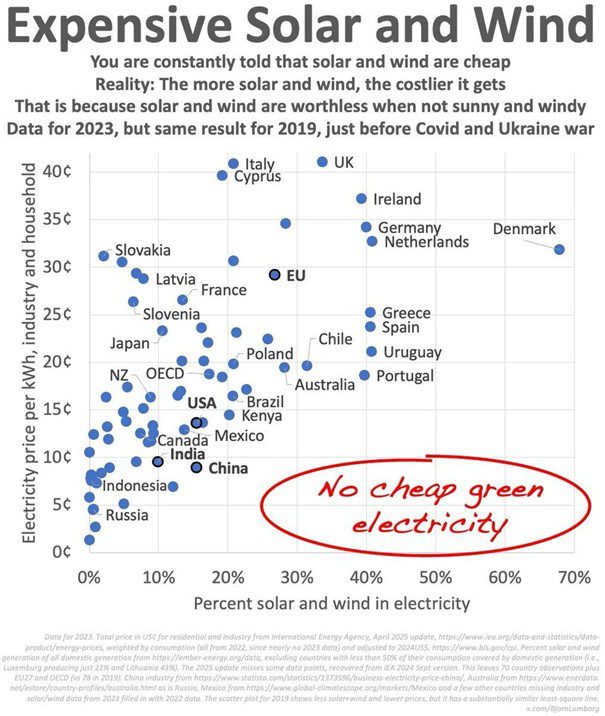
The main reason is that with a high percentage of electricity from solar and wind, supply and demand cannot be properly balanced. When there is sufficient wind and sunshine, countries like the Netherlands, Germany, England, and Denmark already produce far too much electricity. Wind turbines must be shut down, and operators receive compensation for this. In Germany this already amounts to a few billion euros per year. But the most important point is that grid operators must drastically expand the grid to accommodate the peaks in solar and wind power.
This involves astronomical costs. In the Netherlands, TenneT (the national grid operator) admitted last year that this would require approximately 200 billion (!) euros. Recently, however, a report from Netbeheer Nederland was published stating that the costs (they euphemistically refer to them as “investments”) for the period 2026–2040 could even reach 269 billion euros. That is 32,000 euros per household (there are 8.4 million households in the Netherlands). These are exclusively the costs for the infrastructure, and those costs are primarily the result of the enormous surges of solar and wind power that must be fed into the grid. As a citizen, you don’t even get a single kWh of electricity in return. No politician speaks openly about these costs, which are impossible for the vast majority of households to cover.
Germany
Ironically, in Germany — the country where the Energiewende has been implemented in an almost religious manner — prominent politicians are beginning to shift their positions. In recent weeks, Energy Minister Katherina Reiche in particular has made remarkable statements, first during a conference in the U.S. and then in a fiery op-ed in the Frankfurter Allgemeine Zeitung (FAZ). She said during an oil and gas conference in Houston (CERAWeek) that the EU should not rigidly cling to “100-percent solutions.” This is the first time a prominent European politician has called the climate targets themselves into question.
Not long after, she published a detailed op-ed in the FAZ with the unmistakable headline “Stop the self-deception in energy policy!”. “Yes, wind and solar are free. But the overall system certainly isn’t: EEG (renewable energy subsidy) costs, capacity reserves, grid reserves, redispatch costs, grid subsidies, subsidies to lower energy prices — all of that adds up to system costs of more than 36 billion euros per year. That amounts to 430 euros for every German,” Reiche said. And: “An important fact has been concealed for too long: An energy transition that ignores system costs will ruin the country it claims to be saving.” I don’t see our Dutch Minister of Climate and Energy, Stientje van Veldhoven, admitting this anytime soon in Dutch newspapers like the progressive de Volkskrant or NRC.
At the end of her argument, Reiche summarized it as follows: “Let me make this clear: I fully support the energy transition. Renewable sources will become the backbone of our electricity supply. To a large extent, they already are today. But I remain realistic. Climate protection without affordability is politically unsustainable. And climate protection without security of supply is strategically short-sighted. We are decarbonizing — but not at the expense of deindustrialization. We are modernizing — but not by placing an excessive burden on households and businesses.”
Here we hear a true politician speaking. Saying out loud that she opposes the Energiewende would earn her too many enemies. But her analysis is sharp and watertight: the path Germany has chosen is a dead end. These are small rays of hope in a period when Europe, with its climate and energy policies, is doing nothing but committing economic suicide. Europe does not need more sustainability but less, and, just as the U.S. has been doing since 2010, it will have to quickly start working on its own oil and gas production.
This article was published first in Dutch on the platform Indepen on 20 april 2026.
Marcel Crok
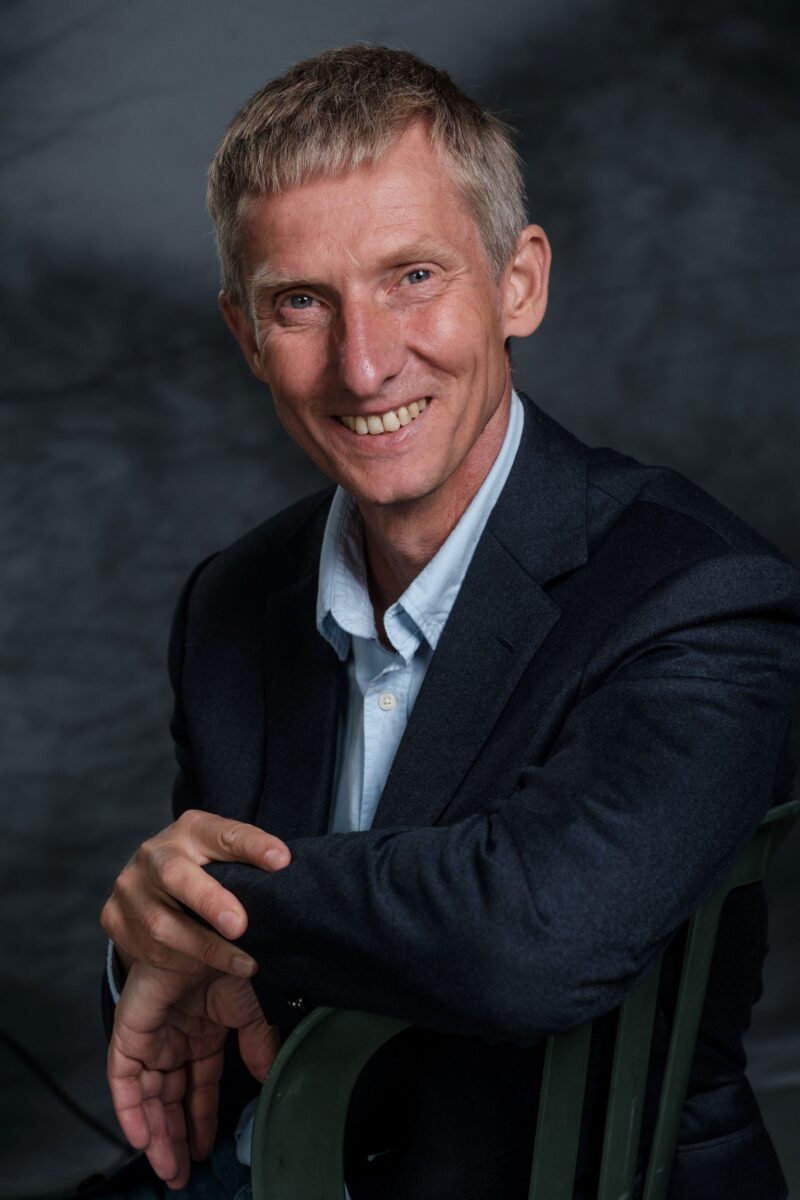
Marcel Crok is a Dutch science journalist who has been writing full-time about the climate debate and climate policy since an award winning article about the notorious hockey stick graph in 2005. He published two books in Dutch (De Staat van het Klimaat (The State of the Climate) and was co-author of the book Ecomodernisme (Ecomodernism)). With the British independent researcher Nic Lewis he wrote an extensive report about climate sensitivity, titled A Sensitive Matter. He was asked by the Dutch government to become expert reviewer of the IPCC AR5 report. Together with the Dutch climate institutes KNMI and PBL, Crok set up an international discussion platform Climate Dialogue.
In 2019, Crok and emeritus professor Guus Berkhout founded the Clintel Foundation. They published the World Climate Declaration, which has now been signed by over 2000 scientists and experts. Together with Andy May and a team of scientists from the Clintel network, Crok contributed to and edited the book The Frozen Climate Views of the IPCC.

more news
In the run-up to Belém: the climate circus COP has had its day
This book review looks at The Truth About the COPs, in which Samuel Furfari dissects the history, failures, and political theatre of the UN’s climate conferences.
Open letter to Bill Gates by Franco Battaglia
Franco Battaglia, wrote an open letter to Bill Gates in response to Gates’s note, “Three solid truths about climate.” In it, Battaglia challenges Gates’s views on climate change and energy policy, offering a contrasting perspective on the role of energy in human prosperity.
The Climate Grift Unravels
Bill Gates' stunning reversal sparks infighting among alarmists.

