The Forced EV Revolution — the Big-government Boom that Busted and Ford alone blew $20b US
Jo Nova about the EV bubble, or what’s left of it, that popped this week.
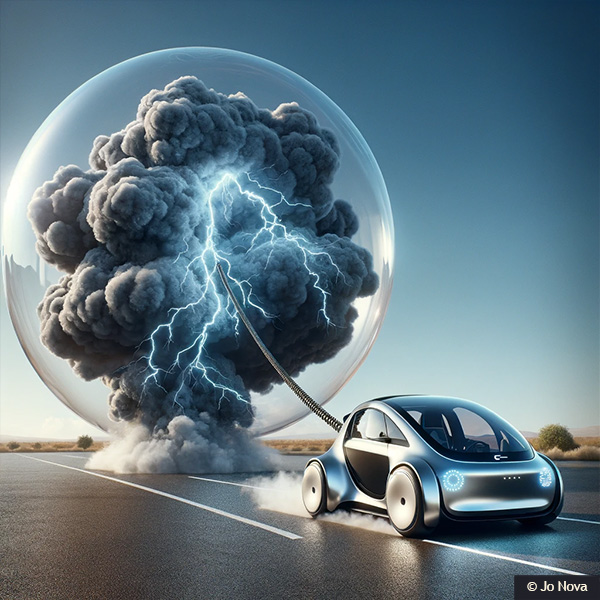
After carmakers invested billions into EV designs, and the EU and UK vowed to ban internal combustion engines, it’s all come undone. Donald Trump pulled the pin on subsidies for EVs and eased the strict emissions rules that punished petrol and diesel cars. US sales of electric cars promptly fell 40% in November. Ford’s fell by nearly 60%.
In response, Ford has killed off several electric cars, and will swallow a bitter pill of a $19.5 billion US dollar write down. That’s a lot of cars it will have to sell to make that money back. Gone is the fully electric F-150, the next generation electric truck, and any plan to make electric commercial vans. Instead Ford says it will shift into gas and hybrid models.
General Motors laid off 3,300 workers at EV plants in the US.
On the other side of the Pacific, shares of Korean battery makers “slumped across the board” this week after the news.
The day after the Ford announcement the European Commission let the world know it would wind back the total ban on internal combustion engines which was supposed to come into effect in 2035. Theoretically they’re only dropping the 100% ban to a 90% one. But the ideology has cracked, largely due to the uproar from European car makers who were not selling enough EV’s to make it work.
There are already calls to drop the 90% rule. It will mean that only the rich will be able to afford the few new petrol and diesel cars available for sale. Presumably the unwashed masses will just keep driving their old cars,.
The car maker takes a $19.5 billion write-down on its electric-vehicle business.
The Wall Street Journal
Not long ago, auto makers were touting electric cars as the future. Well, now they are slamming the brakes hard on that future as market reality has hit them like a 16-wheeler. See Ford Motor’s stunning announcement Monday that it will take a $19.5 billion charge on its electric-vehicle business.
“Instead of plowing billions into the future knowing these large EVs will never make money, we are pivoting,” Ford CEO Jim Farley said as he explained the company’s plan to boost its lineup of gas-powered cars and hybrids. Ford will also scrap its all-electric F-150 Lightning pickup, which has been a favorite of the EV-loving press.
Ford has lost $13 billion on its EV business since 2023, with bigger losses expected in years to come. Last year Ford lost about $50,000 for each EV sold. The truth is that the business case for EVs has always rested largely on government subsidies and mandates. Now that this combination of government favoritism and coercion is mostly going away, most car makers have much less reason to make EVs.
The same week as CSIRO decided 90% renewable was near enough, the EU did a similar thing:
EU drops 2035 combustion engine ban as global EV shift faces reset
The lesson, yet again, is that in trying to artificially make EV’s cheaper, Big Government has made all cars more expensive. Ford and everyone else will have to make up those losses somehow. And in trying to reduce emissions, the bureaucrats have almost certainly increased them. By denying the poor a chance to own a new car, they’re undoubtedly kept older, higher emission cars on the road. Not that emissions matter — the point is that whatever it was that the geniuses with the magic wand wanted, the free market would have done it better.
This article was previously published on joannenova.com.au.

Jo Nova
Jo Nova is science presenter, writer, speaker & former TV host; author of The Skeptic’s Handbook.

more news

Clearing up some misconceptions about the DoE report
After environmental groups sued to halt a critical Department of Energy climate report, accusations of secrecy and political bias quickly followed. Ross McKitrick responds by challenging what he calls widespread misconceptions about the project, defending its transparency, scientific grounding and editorial independence.
India Builds a ‘Fossil Future’
While Western governments continue to speak the language of net zero, India is rapidly expanding coal, oil and natural gas production to secure long-term energy security and economic growth. By strengthening hydrocarbon trade with the United States and other partners, India is building what the author calls a “fossil future,” prioritizing reliable and affordable energy over climate pledges.

Interview with Dr. Guus Berkhout: A Different Perspective on Climate Science and Energy Policy
The big problem today is that climate models are not fit-for-purpose, says Clintel co-founder dr. Guus Berkhout. They do not reflect the real world. That is the reason why the Net Zero policy does not work. We need fundamental changes in climate science and climate policies. We now see that this message gets more and more support.