2025 global tropical cyclone season debunks climate hysteria
Looking at the full global tropical cyclone picture for 2025, the season’s trends undercut the exaggerated claims of “worsening storms” and remind us that climate hysteria too often outpaces the facts.


Tropical cyclones have become a pawn in the man-made climate change game. If you ever want to gauge deception and ignorance as a metric, you can find it here. I aim to show the GLOBAL reality of this season in the tropics to counter the propaganda, sadly, on both sides, much more though on the alarmist side. President Trump did not stop the hurricanes this year, as I have seen some social media comments on. In this day and age, I can never tell who is kidding. And the lack of hurricane hits is no more a sign of climate change as years with multiple hits. I did not use “climate change” as a reason for the Dec 7, 2023 forecast for a season from hell for the U.S for 2024, nor was it used for this years much less forecast than last year ( and of course it wound up well under even that idea)
First of all, and I reviewed this earlier, the centering of the ACTUAL HIGHEST ACE RELATIVE TO AVERAGE this year, wound up about 350 miles east northeast of what we had as our idea. I have stated that the whole numbers game adds up to nothing; it’s who gets hit that really counts. But the numbers game is what everyone focuses on. It’s like pickleball to real tennis to me. So our impact forecast was overdone for the US, unlike last year, which was issued further out. The reason is simple. I thought the congregation of tracks would be further west. Even with that, the amount of damage from non-named storms and the ones offshore to the beaches was quite high. North Carolina had 16 houses fall into the sea. In 2011, when Category 2 Irene hit the NC coast, only 6 houses fell into the sea. So the unnamed storms, one of them that should have been named, did their dirty work this year
Of course, man-made climate change, people would point to that as a sign they are right about sea level rise. And the counter is that they all stayed out at sea, and you build a house on a sand bar, there are bound to be problems.
But look at this chart below and see how you can play the game. Skeptics can say, less than the average, all out at sea. Alarmists say more major hurricanes than average and higher than average ACE/storm. Which, by the way, is where we were in the 1950s, as ACE storm has fallen because we name so many storms now. ACE overall is above normal, but named storm days, Hurricanes, and hurricane days are all below normal
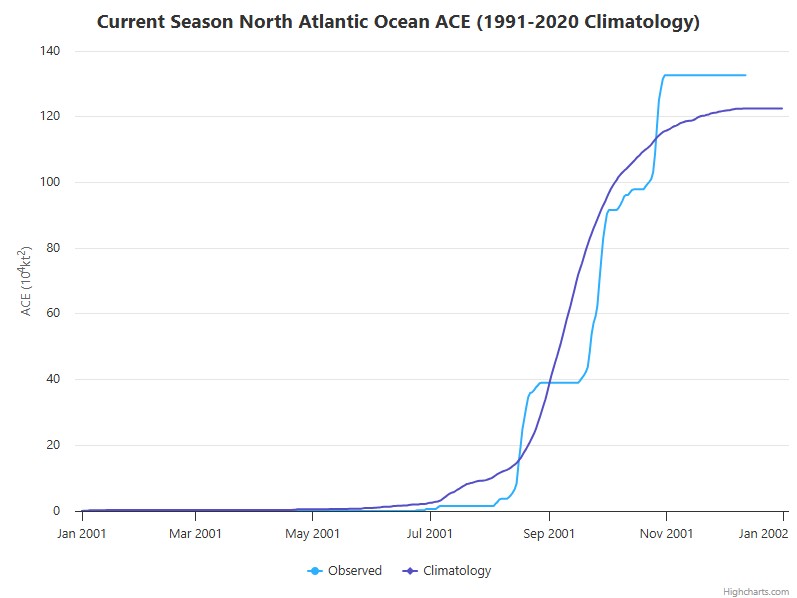
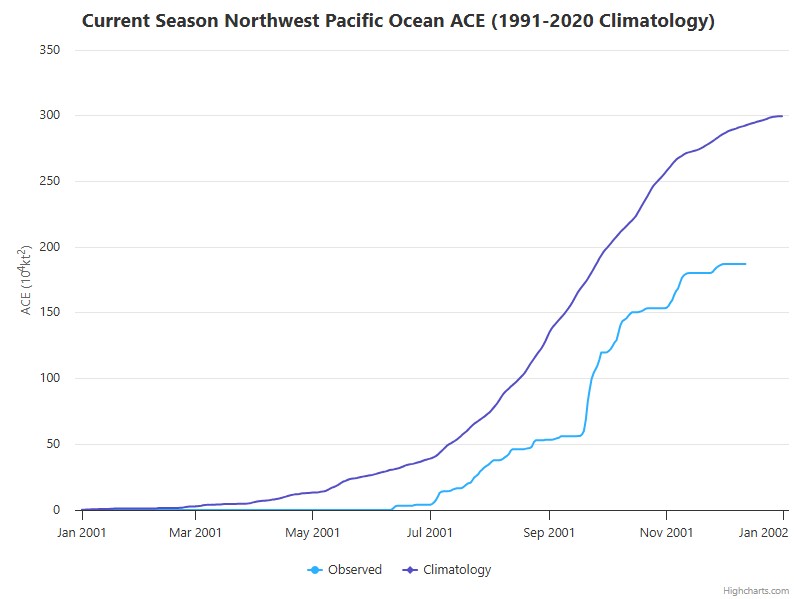
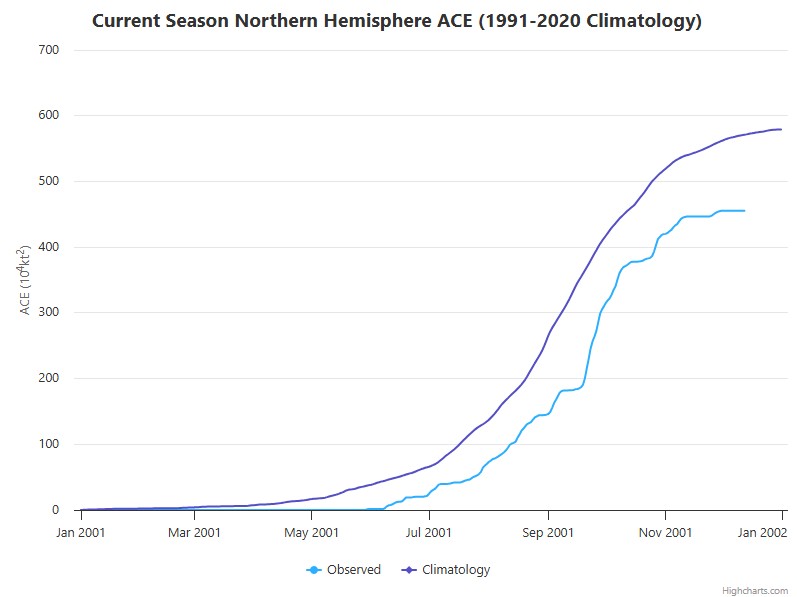
The charts below are National Hurricane Center/Joint Typhoon Warning Center data as tabulated by Colorado State University.
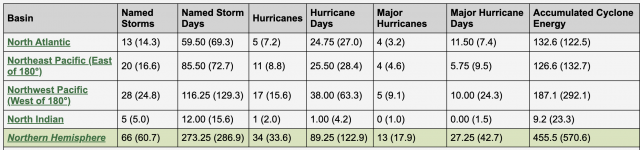
So you can play a game like this, one way or the other, and try to get sound bites, but in the end its much ado about nothing. And that the vast majority of the meteo media talks about the Atlantic, and TRIES TO EQUATE THAT TO CLIMATE CHANGE, it’s the western Pacific that is the Canary in the coal mine and gets no attention unless there is a Super typhoon.
So when we look at the Atlantic with the highest 10 year period ace index wise, it leads to the hysteria over climate change. The Atlantic ACE averages 122.5 per year, so this is an impressive stat as a stand-alone. Problem is the average ACE/storm is over 2 per storm under the 1950s, which means the average storm is weaker. Fewer storms were named in the 1950s, but on average were stronger. So when a dime-sized feedback storm goes wild, the screams of them getting stronger should be muffled by a look at past years ( and adapting our power and impact scale where size matters)
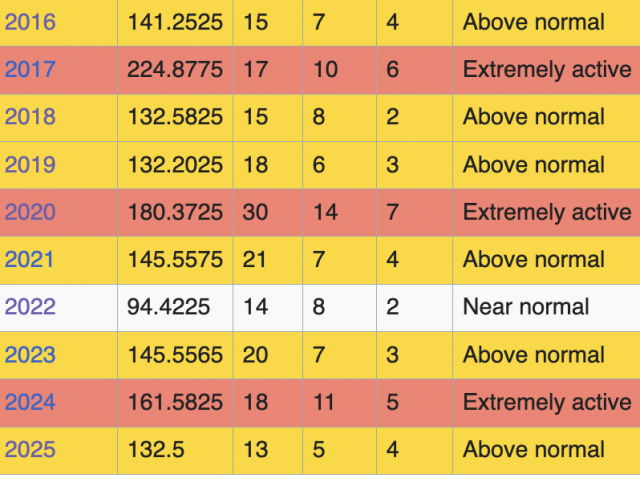
But look at the western Pacific in the 1950s, keeping in mind their average ACE is 2.5 times of the Atlantic
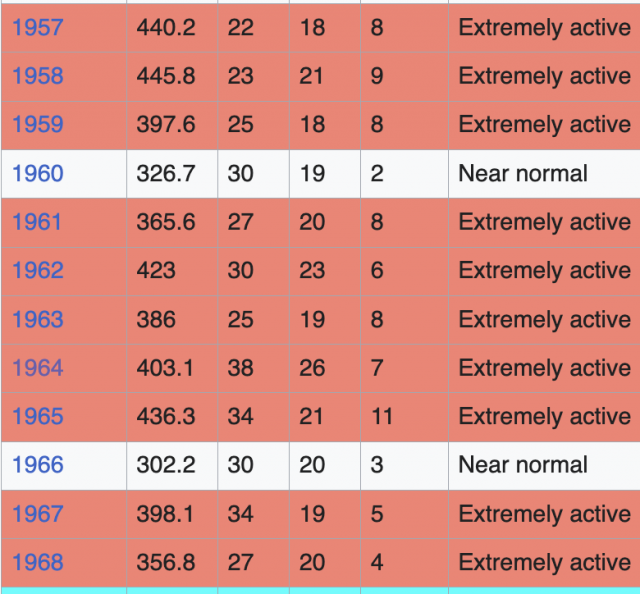
That is nuts
But look at the last 20 years
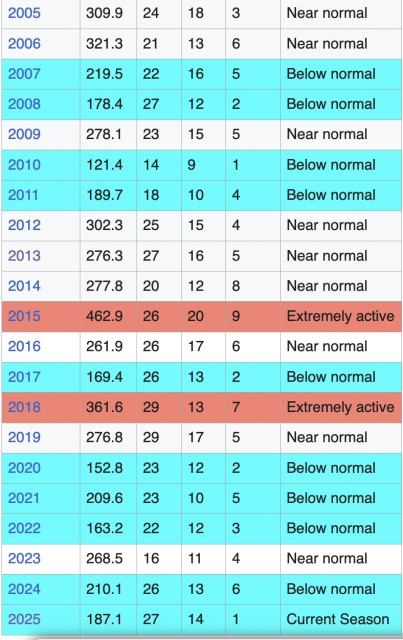
This is wild, and if you are trying to make some kind of climate statement, it should be heavily weighted on what is going on in the Western Pacific. And it impacts global activity, so global activity is below normal
The Atlantic was the only basin above average
tropical.atmos.colostate.edu/Realtime/
The west pac way below average
tropical.atmos.colostate.edu/Realtime/
And there you are, globally
tropical.atmos.colostate.edu/Realtime/
So all this hysteria about storms getting worse is cherry picking and not showing the big picture. Which is exactly what someone wanting to hide the whole truth would do. Besides, given the “we are the world” mentality that is prevalent in the climate community, is it not better that a more populated area of the planet is not being hit as badly?
But if you want to make a climate statement on tropical activity its where the biggest, strongest ones are that should be front and center. The Atlantic, puny as it is compared to the western Pacific, is trying to take up the slack but falls short.
There are reasons I have put forth involving the distorted warming spreading out energy, so there is less focusing of the energy in the tropics, leading to reduced upward motion ( as shown by fewer clouds), but that is not what the mission of this blog is. It’s to point out that yelling no hits, Hoorah for my team, and then someone saying, more rapid feedback, see the world is going to hell in a handbasket, is all trivializing the big picture, which I look at since the Indo Pacific is so important. There is no magic co2 fairy in charge of all this. The actual result globally as the world warms is either no change or less. In the western Pacific, its down, in fact, way down. Combine that with no US hits this year, and all I can say to the climate alarmists is, Better luck next year (OH, wait an El Niño is coming on… maybe the west pac will come up and you get use that)
The only way to rise above all this is to make sure if you love the weather, you enjoy the weather, cause its the only weather you got.
This article was previously published on cfact.org.

About Joe Bastardi
Joe Bastardi is a pioneer in extreme weather and long-range forecasting. He is the author of “The Climate Chronicles: Inconvenient Revelations You Won’t Hear From Al Gore — and Others” which you can purchase at the CFACT bookstore. His new book The Weaponization of Weather in the Phony Climate war can be found here.

more news

The Strait of Hormuz Crisis Shows the World Still Runs on Fossil Fuels
The Strait of Hormuz, one of the world’s most critical energy chokepoints, highlights the continued global dependence on oil and gas. Recent geopolitical tensions have disrupted energy flows, exposing vulnerabilities in global supply chains and triggering emergency responses across Asia. Despite decades of rhetoric about an energy transition, fossil fuels remain indispensable for modern economies, not only for energy but also for agriculture, plastics and pharmaceuticals. The crisis underscores that energy systems are shaped by geography and economics, and that a full transition away from hydrocarbons will be far slower and more complex than often assumed.

The EU’s Nuclear Phase-Out Was a Blunder
Following Friedrich Merz in January, Ursula von der Leyen has now also admitted that the phase-out of nuclear energy was a major ‘strategic mistake’, not only for Germany but for the EU as well. American researcher Roger Pielke Jr. uses some simple calculations to demonstrate the magnitude of the EU’s strategic blunder.

Paul Ehrlich (1932-2026): Farewell to the Long-Lived Failed Prophet of Miserablism – The Population Bomb author lived a long, wealthy, healthy life, an opportunity his work denied to countless others
Paul Ehrlich, author of The Population Bomb, became one of the most influential voices behind modern environmental pessimism. His warnings of inevitable resource depletion and societal collapse shaped decades of policy and public thinking. Yet, as history unfolded, many of his most prominent predictions failed to materialize—raising enduring questions about the consequences of alarmist narratives in science and policy.