Kathryn Porter: Iberian blackout was a warning
Britain’s energy system is becoming increasingly expensive and difficult to keep stable, according to energy analyst Kathryn Porter. In an interview with GWPF’s Harry Wilkinson, Porter also discussed the Iberian blackout of 2025. “It was completely because of renewables”.
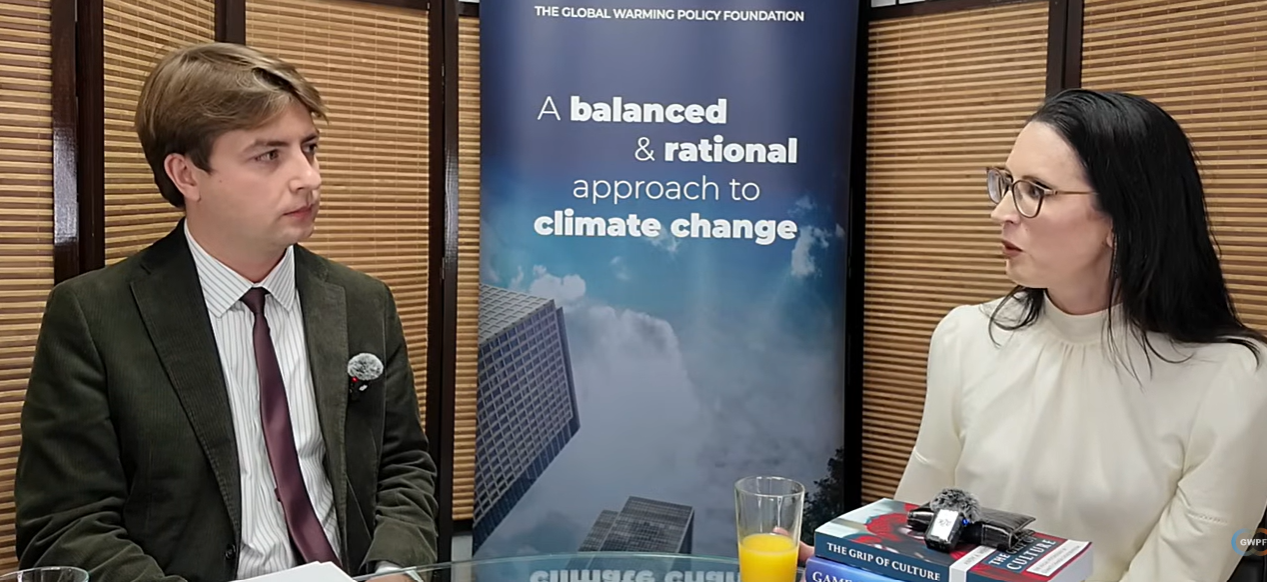
Porter, who recently joined the Global Warming Policy Foundation (GWPF) as a trustee, argued in the interview that the public has been repeatedly promised that renewable energy would make electricity cheaper, while the opposite has happened. Balancing costs are rising, major investments in grid infrastructure are required, and Britain still needs gas-fired generation to provide backup when wind and solar output is low. The result, she says, is a system that is both more expensive and less resilient. “We’ve been sold an awful lot of untruths about how renewables are cheap, how they’re going to save us money,” Porter said.
You can see the entire interview below:
The hidden cost of Britain’s energy transition
One of Porter’s main concerns is that the apparent cost reductions associated with renewable generation often ignore the wider costs imposed on the electricity system. Wind and solar require backup capacity, extensive transmission investment and increasingly complex balancing arrangements. Even if balancing costs eventually decline, Porter argues, consumers will still have to pay for the infrastructure needed to make a renewable-heavy system work.
The consequences are visible in the operation of the British grid. Electricity Margin Notices, which warn that there may not be sufficient generation to meet demand, have traditionally been associated with winter. Yet Britain has recently experienced such warnings during summer and the autumn shoulder months. Porter regards this as evidence that the system is operating with increasingly narrow margins.
A prolonged period of low wind can be particularly problematic. During one recent four-day lull, wind generation reportedly fell to around 250 MW against an installed capacity of approximately 34 GW. At the same time, Britain was increasingly dependent on imports. But if neighbouring countries experience similar weather conditions, they may have little electricity available to sell.
The system can also become expensive when there is too much wind. Transmission constraints mean that electricity generated in Scotland cannot always reach consumers in southern England. Porter says that on some days as much as 10 GW of wind generation has had to be curtailed, after which gas-fired generators are brought in at short notice.
In her view, these problems demonstrate the limitations of a system increasingly built around intermittent generation without sufficient attention to the physical requirements of the grid.
Oil refineries and energy security
Porter also discussed her recent report on Britain’s oil-refining industry. The UK has gone from roughly 12 refineries in 2000 to just four today, and Britain now imports the majority of its diesel.
She argues that the UK Emissions Trading Scheme (ETS) places domestic refineries at a competitive disadvantage because they compete with refineries outside Europe that do not face comparable carbon costs. Unlike electricity generators, refineries cannot easily pass these costs on to consumers because refined petroleum products are traded internationally.
Porter stresses that this is not merely an industrial issue. Diesel is fundamental to agriculture, transport, logistics and food distribution, while oil-derived products are also essential to petrochemicals, plastics, medicines and electrical equipment. Closing domestic refineries therefore creates both economic and strategic vulnerabilities.
She is equally sceptical about proposals to solve the problem through carbon border adjustment mechanisms. Rather than adding further costs to imports, she argues, Britain should reduce the costs imposed on its own industry. A broader application of carbon border taxes, she warns, would be highly inflationary.
Is Labour changing course?
The conversation also touched on signs that affordability may be gaining greater political importance within the Labour government. Porter points to the decision to move some energy levies from electricity bills into general taxation. She believes this creates greater pressure on government to examine the cost-effectiveness of energy policies because the costs become visible on the government’s own balance sheet.
She also points to the government’s decision to move away from the “connect and manage” approach, under which renewable projects could be connected to the grid before sufficient network capacity existed. Porter regards the previous policy as a major contributor to Britain’s growing grid constraints.
Nevertheless, she does not believe the political conflict between net zero and affordability has been resolved. Energy security, she predicts, could ultimately become the issue that forces a change in direction.
Questions about the NESO control room
A particularly serious part of the discussion concerned allegations surrounding Britain’s National Energy System Operator (NESO) control room and the events of 23 June. A preliminary investigation confirmed that five grid constraints had been breached. Porter says that one of them involved a very substantial amount of electricity.
She is especially concerned about evidence that NESO’s forecasts for wind generation and electricity demand were significantly wrong during the same period. In one instance, a forecast was reportedly out by about 2 GW at the time of peak demand.
More fundamentally, Porter questions whether NESO had sufficient reserve to meet its own security requirements. She says that even months later, engineers appeared unable to establish whether the system had been capable of covering the largest potential loss.
For Porter, this is not an abstract technical issue. It raises questions about whether the people responsible for keeping the lights on actually have sufficient information and tools to assess the security of the system in real time.
Lessons from the Iberian blackout
The most dramatic part of the interview concerned the major blackout in Spain and Portugal. Porter strongly rejects the idea that the event can be dismissed as an “inertia” problem, unrelated to renewable energy.
According to her account, voltage oscillations had already been detected early that day, indicating that the grid was in a fragile state. Around midday, substantial amounts of distribution-connected solar generation disconnected because electricity prices had become negative. With demand unchanged, the sudden reduction in generation caused grid frequency to fall.
That frequency drop triggered further disconnections. A number of wind and solar installations disconnected because they did not meet the relevant grid-code requirements for surviving the frequency disturbance. This caused frequency to fall further, eventually causing conventional generators and interconnectors to trip as well.
Porter’s central point is that the system had become too dependent on intermittent generation while lacking sufficient conventional generation to provide what she describes as a “stiff” grid. She therefore considers the blackout a warning about the physical stability of highly renewable electricity systems.
“It was completely because of renewables,” Porter said. “It wasn’t a conventional inertia problem which is what the report said.” The contrast with France was particularly significant in her analysis. The disturbance propagated towards France, but France’s predominantly nuclear and hydro-based system was able to isolate and correct the fault quickly. Within Iberia, by contrast, the consequences were far more severe.
Porter sees parallels with Britain, particularly in Scotland, where she says frequency excursions outside the normal operating limits are becoming increasingly common. She regards these oscillations as signs that the British grid is becoming more fragile and harder to control.
The human consequences of the Iberian blackout were also severe. Porter says 11 people died directly, including people dependent on mechanical ventilators whose backup generators failed, while a subsequent study estimated 165 excess deaths over the two days affected by the blackout. Crucially, the blackout occurred under relatively benign weather conditions—not during an extreme heatwave or cold spell. Porter warns that a prolonged winter blackout in Britain could therefore have much more serious consequences.
A system facing multiple risks
Porter argues that Britain should not wait for a major blackout before taking these risks seriously. She lists numerous vulnerabilities, including forecasting errors, ageing infrastructure, problems with control-room software and communications, the retirement of conventional generation, transmission constraints, dependence on imports and the increasingly high cost of balancing the system.
Her concern is not that any single problem will necessarily cause a blackout. Rather, several relatively small weaknesses can overlap and leave the system vulnerable when something unexpected happens.
“The absence of a blackout is proof that the grid is secure, but that’s not necessarily the case,” she argues, comparing the current situation to repeatedly running into traffic without being hit.
Porter is also sceptical of proposed reforms such as zonal electricity pricing. She points to Texas, where a similar geographical mismatch exists between large amounts of wind generation and major centres of demand. In her view, changing the pricing system does not solve the underlying physical problem of insufficient transmission capacity.
Ultimately, Porter’s message is that Britain needs to think more seriously about energy security, system resilience and cost, rather than assuming that ever greater quantities of wind and solar generation will automatically produce a cheaper or safer electricity system. The Iberian blackout, she argues, demonstrates what can happen when a fragile grid encounters a relatively modest disturbance—and should therefore be treated as a warning rather than an isolated event.
The article you have just read was made possible by our donors.
Every day, Clintel publishes articles on climate, energy and science. We also translate and share international analyses in multiple languages, produce videos, publish reports and organize conferences and events around the world.
We receive no government funding and rely entirely on the support of our donors. Your support helps us promote independent research and contribute to a more open and balanced debate on climate and energy issues.
Would you like to support our work? Choose the option that suits you best:
• Become a Friend of Clintel – support us with an annual contribution
• Make a recurring donation – provide ongoing support and help us plan ahead
• Make a one-time donation – every contribution helps
Thank you for your support.
more news

Lomborg: Enormous Costs for Minimal Climate Benefit
Bjorn Lomborg recently discussed (the results of) his new website netzerocostbenefit.com. On The Andrew Neil Report, the Danish political scientist gave Britain as an example: it would have to spend £695 billion to get to net zero in 2050, which would result in a global temperature reduction of 0.00376°C (also see this Clintel article).

Clintel President Václav Klaus speaks in Paris on freedom and climate
The French Association des climato-réalistes is organising a conference on Thursday 3 December featuring Václav Klaus, former President of the Czech Republic and current President of Clintel (see the bottom of the article for registration details). Our esteemed colleagues at the Association des climato-réalistes and at climategate.nl recalled the following prescient commentary by Klaus from 2007 in connection with this event.
A tribute to Bill Nordhaus
William Nordhaus was an American economist, best known for his work in economic modelling and climate change, and a co-recipient of the 2018 Nobel Memorial Prize in Economic Sciences. He passed away on 30 October, aged 85.