Absurd Climate Attribution ‘Science’: 0.00072 °C Kills 30 Million Corals?
Scientist Peter Ridd has taken aim at the “last frontier of climate pseudoscience”: attribution science. Questionable data are being used to build legal cases against fossil-fuel projects, like the proposed $100 billion Browse gas project (Woodside). The legal case rests on a claim that the Great Barrier Reef data have already disproved. The crucial question is whether Woodside will actually have the courage to defend the case on scientific grounds.
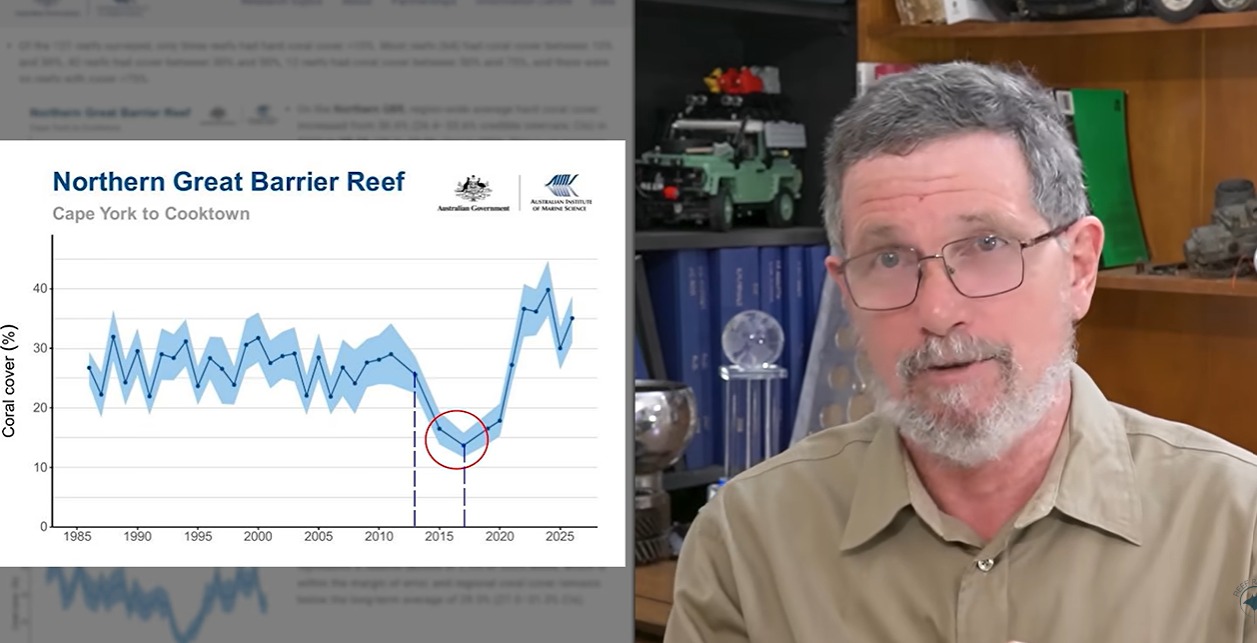
Peter Ridd during his presentation for Reef Rebels.
Clintel Foundation
Date: 23 November 2026
Australian marine scientist Peter Ridd has launched a sharp attack on attribution science, arguing that the emerging field is being used to turn uncertain climate predictions into legal arguments against fossil-fuel projects. In a recent presentation, Ridd focused on the proposed Browse gas development on Australia’s North West Shelf and its alleged impact on the Great Barrier Reef.
You can watch the full presentation on the Reef Rebels YouTube channel below:
According to Ridd, the case illustrates how climate models, assumptions about extreme weather and questionable coral data can be combined to produce highly specific claims about environmental damage.
New stage
Ridd argues that attribution science represents a new stage in climate litigation. Unlike traditional scientific research, he says, it is explicitly designed to establish a causal connection between a particular source of greenhouse-gas emissions and a specific instance of damage. That makes it potentially useful in court, where general statements about climate change are insufficient. “To take a matter to court, things have to be very specific,” Ridd explains. There must be a person, place or identifiable environmental or economic loss that can allegedly be linked to a particular project.
The Browse gas field provides a striking example. The project is worth more than $100 billion to Australia, according to Ridd, but environmental campaigners are using attribution science to argue that its emissions would have a measurable impact on the Great Barrier Reef. The calculation starts with the claim that burning the gas would raise global temperatures by just 0.00072 °C. That apparently tiny temperature increase is then translated into a specific prediction of coral mortality.
According to the argument Ridd describes, the additional warming would cause an ocean heatwave to kill around 30 million corals on the Great Barrier Reef. Because damage to corals is subject to environmental protection laws, this supposedly creates a direct legal connection between the gas project and an illegal environmental impact.
Ridd does not even challenge the initial temperature calculation in his presentation. Instead, he accepts the 0.00072°C figure for the sake of argument and concentrates on the next step: the attempt to translate such a tiny temperature increase into a precise estimate of coral mortality.
Bleaching
That calculation relies on a study, referred to by Ridd as H18, which estimated coral mortality following the 2016 bleaching event on the Great Barrier Reef. The study produced a relationship between heat stress and coral cover. In principle, a small increase in temperature could therefore be translated into a corresponding decline in coral cover. The Browse attribution analysis uses this relationship to estimate the additional coral mortality supposedly caused by the gas project’s emissions.
But Ridd argues that the underlying coral-mortality data have subsequently been shown to be badly misleading. The most important evidence, he says, comes from what happened to the reef after the 2016 bleaching event.
Rather than continuing to decline, coral cover subsequently increased. Indeed, Ridd points to Australian Institute of Marine Science (AIMS) data showing that the Great Barrier Reef had more coral in the years following 2016, despite several additional bleaching events. “In fact, after the bleaching event in 2016, we ended up with not less but more coral,” he says. According to Ridd, the reef has experienced five or six bleaching events since 2016, yet coral cover has reached record levels in parts of the reef.
This creates a fundamental problem for the attribution analysis. The H18 study was based on estimates of coral mortality following the 2016 event, but subsequent observations did not show the kind of long-term decline that its interpretation implied. Instead, coral cover recovered strongly.
Ridd argues that one reason for the discrepancy lies in the way the original data were collected. H18 relied largely on aerial surveys. Researchers observing the reef from an aircraft, Ridd points out, cannot see deep into the water. Coral reefs, however, extend well below the surface. During a marine heatwave, the surface water can also become considerably hotter than the water deeper down.
According to Ridd, this means that aerial surveys may disproportionately capture shallow corals that are exposed to the highest temperatures, while missing deeper corals that experience less heat stress. He contrasts this approach with AIMS surveys, which use divers to collect measurements underwater, typically around 10 metres deep and in some cases considerably deeper.
Recovery
The difference is significant because the AIMS measurements show much stronger recovery than the data used in the attribution analysis. Ridd argues that the 2016 event itself was also less exceptional than suggested by H18. According to the AIMS data he presents, coral losses in 2014 and 2015 were greater than those associated with the 2016 heatwave, and those earlier declines were not caused by the same bleaching event.
The longer-term picture is particularly damaging to the catastrophic interpretation. AIMS has surveyed approximately 100 reefs every year for decades. Its 2022 report recorded the highest coral cover ever measured in the northern and central parts of the Great Barrier Reef. The increase was driven largely by Acropora corals, including fast-growing staghorn and tabular varieties
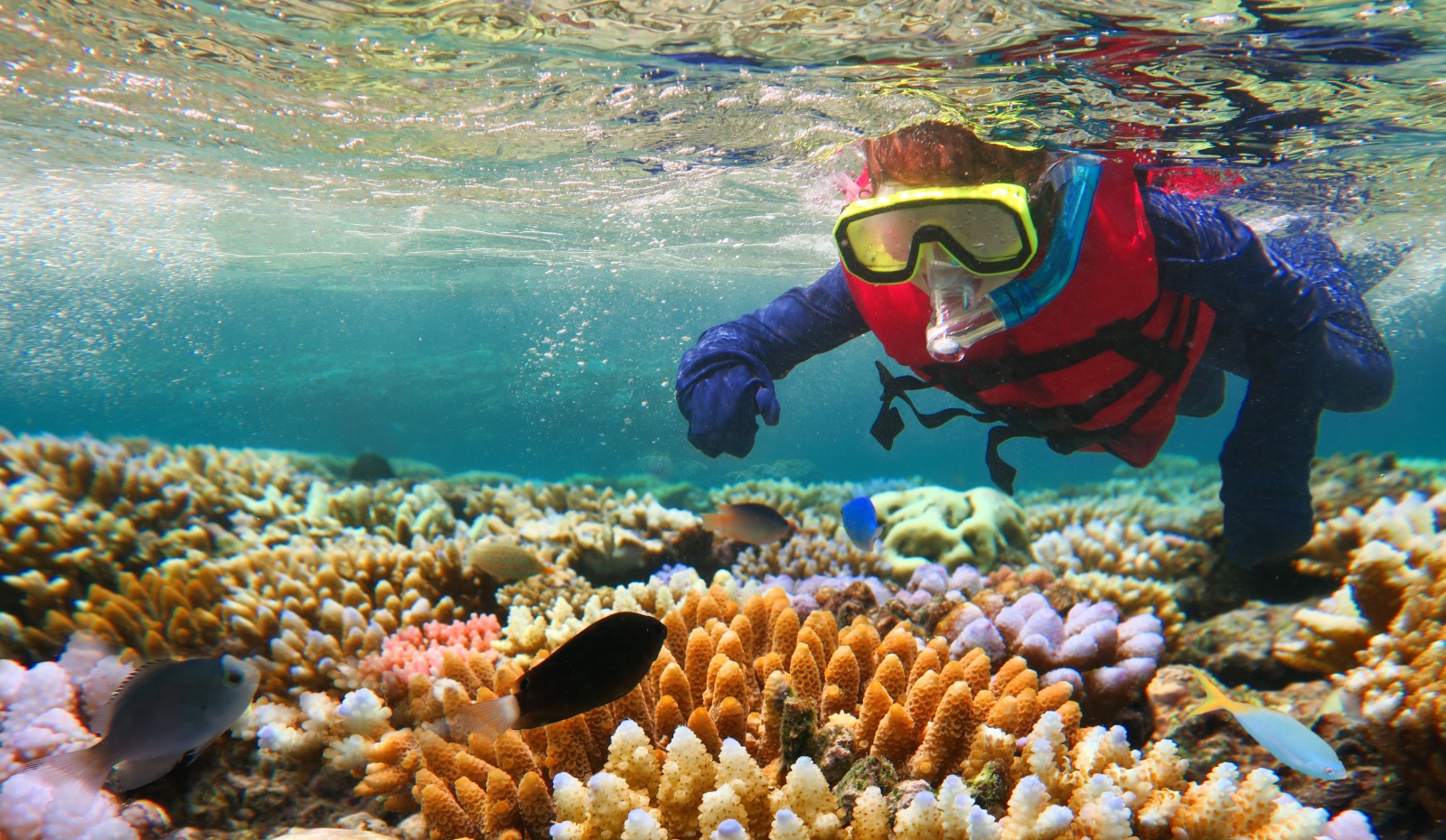
This directly contradicts another claim in the H18 study, Ridd argues. The paper had suggested that these Acropora corals suffered catastrophic die-off after the 2016 bleaching event. Yet subsequent AIMS measurements showed that these corals had not only recovered but had become a major driver of the increase in coral cover.
Ridd therefore describes the original study as fundamentally unreliable. “Rather than suffering a catastrophic die off the Acropora has exploded,” he says, concluding that “the paper by H18 has been proven to be demonstrably false.”
For Ridd, the significance extends far beyond an academic disagreement over coral measurements. The H18 paper, he stresses, forms a key part of the argument against the Browse gas project. If the scientific evidence used to establish the alleged environmental damage is wrong, then the legal argument built upon it becomes much harder to sustain.
Ridd also makes a broader point about the way attribution science selects its assumptions. Climate impacts are not necessarily one-directional, he argues. If higher temperatures can harm corals under some circumstances, temperature can also increase coral growth rates. Corals generally grow faster in warmer tropical waters than in colder regions.
Applying the same attribution logic in the opposite direction, Ridd says, produces a striking result. If the Browse project really did cause 0.00072°C of additional warming, and if the relationship between temperature and coral growth is used instead of the relationship between temperature and coral mortality, the project could theoretically be credited with producing an additional 10,000 tonnes of coral every year.
His point is not that the gas project should actually be credited with creating coral. Rather, it illustrates what he sees as a fundamental weakness in attribution science: depending on which relationship and dataset are selected, an extremely small temperature change can be converted into a highly specific prediction of either environmental damage or environmental benefit.
Litigation
Ridd believes this methodology could become increasingly important in climate litigation. He expects similar attribution cases to emerge whenever governments approve new fossil-fuel developments. Such lawsuits could create major legal obstacles for projects in Australia, the United States, Britain and other countries where environmental litigation can be brought.
Yet he also sees an opportunity. For years, Ridd says, scientists who challenge mainstream interpretations of climate and environmental data have had little opportunity to confront those claims directly. A courtroom could be different because the underlying evidence would have to be examined and challenged.
“I’ve been itching to do this for a decade,” he says, arguing that a legal case could force both sides to defend their scientific claims publicly.
The crucial question, however, is whether Woodside, the company behind the Browse development, will actually fight the case on scientific grounds. Ridd is openly sceptical about the willingness of fossil-fuel companies to challenge the broader climate narrative. He notes that major oil and gas companies have generally accepted the basic premise that carbon dioxide emissions cause dangerous climate change rather than aggressively disputing it.
He points to BP’s decision to rebrand itself as “Beyond Petroleum” as emblematic of this broader approach. Despite accusations that fossil-fuel companies fund climate sceptics, Ridd argues that the companies themselves have often been reluctant to defend scientists who challenge climate-policy assumptions.
If Woodside does not fight, Ridd warns, the implications could extend beyond the Browse project. Climate litigation could make fossil-fuel development increasingly difficult in countries where such cases can be brought, while production simply shifts elsewhere. In that scenario, he argues, restricting Australian gas production would not necessarily reduce global fossil-fuel consumption. Instead, it could move investment and production to countries where similar legal restrictions do not apply.
Ridd therefore sees the Browse case as a potential turning point. For environmental campaigners, attribution science offers a way of translating global climate change into a concrete legal claim against an individual project. For Ridd, however, the case demonstrates precisely why that approach needs to be subjected to much tougher scientific scrutiny.
At the heart of his argument is a simple question: can a chain of calculations built on climate models and disputed ecological data legitimately establish that one particular gas project will kill a precisely estimated number of corals?
Ridd’s answer is emphatically no. And he believes the subsequent recovery of the Great Barrier Reef provides an unusually powerful test of the attribution methodology. If the reef has continued to grow despite repeated bleaching events, he argues, then predictions of irreversible coral destruction based on the 2016 event cannot simply be treated as established scientific fact.
For Ridd, the Browse case could therefore become more than another dispute over a fossil-fuel project. It could become a test of whether attribution science can withstand scrutiny when its predictions have real legal and economic consequences.
The article you have just read was made possible by our donors.
Every day, Clintel publishes articles on climate, energy and science. We also translate and share international analyses in multiple languages, produce videos, publish reports and organize conferences and events around the world.
We receive no government funding and rely entirely on the support of our donors. Your support helps us promote independent research and contribute to a more open and balanced debate on climate and energy issues.
Would you like to support our work? Choose the option that suits you best:
• Become a Friend of Clintel – support us with an annual contribution
• Make a recurring donation – provide ongoing support and help us plan ahead
• Make a one-time donation – every contribution helps
Thank you for your support.
more news

A World Without Hydrocarbons is a Past We Escaped
No one who looks honestly at the early 1800s would want to go back. A hydrocarbon-free economy is not a cleaner future. It is a past we have already lived: shorter lives, children lost before the age of five, and constant pressure on forests and wildlife, say Ronald Stein and Yoshihiro Muronaka.
Climate Mania Has Made the World Bank Stupid
The World Bank was founded to promote economic growth in developing countries but has joined the brigade fulminating against the weather gods. The world’s poor deserve better than that, says Tilak Doshi.
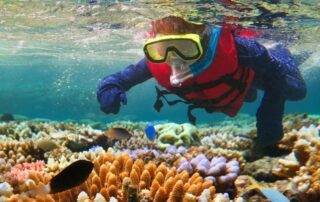
Great Barrier Reef doing fine, but now has the “wrong coral”
In a recent interview with Tom Nelson, Australian coral reef researcher Peter Ridd once again showed that the Great Barrier Reef is doing fine. But alarmist scientists have now adopted a new strategy. Corals that should have disappeared but have instead become abundant are now being presented as the “wrong coral”.