
A review of The Frozen Climate Views of the IPCC, part 1
Clintel has analyzed IPCC’s Assessment Report 6 (AR6) and has published an important report on it, entitled: The Frozen Climate Views of the IPCC. It’s a report that provides many serious criticisms of the work carried out by the IPCC. Here you find part 1 (of 2) of a review of this important work by Clintel recently published by the French website: Climat et Vérité.

Clintel: The Frozen Climate Views of the IPCC – An analysis of AR6
See our webshop at: https://clintel.shop/product/the-frozen-climate-views-of-the-ipcc/
Clintel Foundation
Date: 2 March 2026
Introduction:
The preparation of this Clintel report was carried out under the direction of Marcel Crok, science journalist, co-founder and Director of Clintel (Netherlands), and Andy May, scientific author and retired petro-physicist (USA), as well as six other contributors, who are:
- Javier Vinos (molecular biologist – writer – Spain)
- Ross McKitrick (Professor of Economics – University of Guelph – Canada)
- Nicola Scafetta (Professor of Atmospheric Physics. Frederico II University – Naples, Italy)
- Kip Hansen (science journalist – USA)
- Fritz Vahrenholt (Professor – University of Hamburg – Germany)
- Ole Humlum (Professor Emeritus – University of Oslo – Norway)
This Clintel report has been peer reviewed, i.e. its content has been verified by independent scientists, which represents a seal of quality. This report was written by scientists and experts who were not directly involved in the drafting of the IPCC report. They examined whether the IPCC follows its own principles of scientific rigor. Are the IPCC reports, and in particular the ‘Summary for Policymakers’, really based on a comprehensive review of the literature? Are the conclusions unbiased and objective, and the procedures for inferring them transparent? In one word, the answer to these questions is unfortunately very clear, it’s no.
In summary, Clintel highlighted in its report many biases, a tendency for ‘cherry picking’, i.e. the selective choice of scientific publications favorable to the IPCC’s theses, and the omission or underestimation of unfavorable publications, incomplete analyses, numerous errors and important omissions. Clintel shows that many of the IPCC’s important claims are questionable, for example: “That the current warming is unprecedented, that it is 100% man-made, or that it is dangerous.”
The following items, commented on in the Clintel report, are all criticisms of the analyses made by the IPCC:
- A tendency to erase the history of the climate: there is no certainty that the present is warmer than the middle Holocene.
- The resurrection of the hockey stick, which aims to erase the Medieval Climate Optimum and the Little Ice Age.
- The measurement of the global surface temperature which is a poor indicator for measuring the planet’s climate.
- Controversial snow trends.
- Contestation of the acceleration of sea level rise.
- Why does the IPCC downplay the role of the sun?
- Unclear climate sensitivity to CO₂.
- Climate models are not reliable, but the IPCC has high confidence in their results.
- Extreme climate change scenarios are questionable.
- A tendency to hide good news about extremes.
- Losses due to disasters must be put into perspective. They must take into account the increase in populations and constructions.
- Climate-related deaths have dropped significantly.
This set of observations makes it more necessary than ever for an open and pluralistic scientific debate, with the participation of opponents of the IPCC. But the latter maintains its hegemonic position and has never responded to the requests for debate addressed to it by Clintel and many other climate actors.
Point 1: A tendency to erase the history of the climate: no certainty that the present is warmer than the Middle Holocene
In AR6, the IPCC surprisingly states that “it is more likely than not that global surface temperatures will be unprecedented in the last 125,000 years.”
This statement erases what is known as the Holocene Thermal Maximum, also known as the ‘Holocene Climatic Optimum’ (names avoided by the IPCC). By leveling our climate history in this way, the IPCC makes the current warming unprecedented and therefore unique, but is it correct? The Holocene Thermal Maximum is well documented in the literature. It refers to a period extending from 9800 to 5700 years before our time when temperatures varied considerably in many regions of the globe, with maximums reached in many areas, but often at different times.
But the Spanish scientist Vinos points out in Chapter 1 the difficulties in obtaining precise measurements:
“Multi-proxy rebuilds are useful. But biases and the inevitable limitations of this technique result in their inability to answer the IPCC’s question: was the last decade the warmest the planet has experienced during the Holocene?”
Attempting to measure the average temperature of the planet with a few hundred uncalibrated and low-precision proxies providing an indication only once a decade or once a century in the best cases, is a preposterous task, and to compare it with the global average obtained with our current daily measurements, which include satellites and thousands of calibrated and high-precision thermometers spread all over the world, including in the oceans, to declare finally that we can consider that it is more likely than not that the last decade will be warmer than any century in the last 12,000 years, is indefensible.
Point 2: The Resurrection of the Hockey Stick
The big surprise of the AR6 report was the publication in the resounding ‘Summary for Policy-makers’ of a new hockey stick curve:
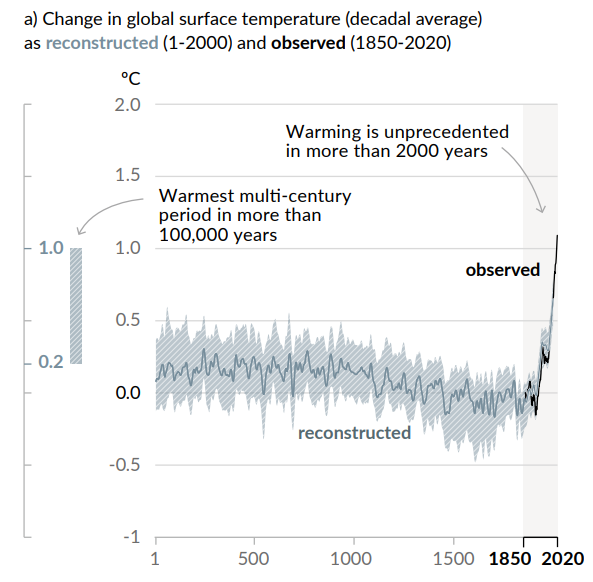
The first curve was published by M. Mann et al in 1998 and 1999. It received enormous publicity in the 3rd IPCC report in 2001.
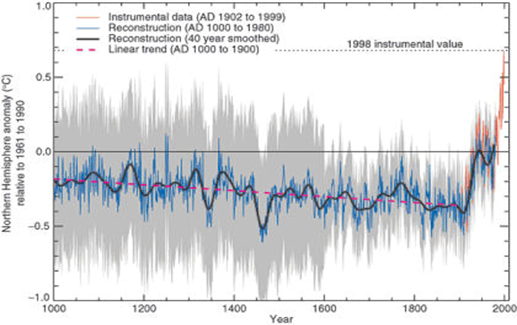
Hockey stick curves were used by the IPCC to argue that the current warming of the climate is unprecedented in the last 1,000 or 2,000 years.
Mr. Mann’s last and first hockey stick curve in 1998 was both aimed at erasing the well-documented historical periods of the Medieval Climate Optimum and the Little Ice Age. They try to impose the idea that these were only regional phenomena with a low overall impact. The first Mann curve has been criticized because of major flaws in its paleoclimatic proxies and the statistical methods used in its construction.
Once again, the IPCC has resorted to ‘cherry picking’ and the manipulation of proxies to manufacture its new curve.
According to Stephen McIntyre, a Canadian scientist, host of the blog ‘Climate Audit’ and author of numerous scientific publications:
The problem with all these reconstructions is more or less always the same. The authors select proxies from the thousands of series available in international databases. Most proxies show little more than a noise that casts doubt on their quality as a temperature proxy. The authors therefore pick their proxy, then apply one or more statistical methods to them to obtain their hockey stick, the relevance of which is questionable.
In summary, the IPCC’s claims that current warming is unprecedented in the last 2,000 years or even the last 125,000 years are very unconvincing, to say the least. There is good evidence in the last 2000 years as well as during the Holocene Thermal Maximum, showing that the temperature was largely comparable to, or even higher than, current warming.
In this case, the IPCC seems to be behaving like George Orwell’s Ministry of Truth in rewriting climate history. In addition, the IPCC has not addressed these issues in a comprehensive and transparent manner. This bias is betrayed by the choice of studies which were considered in their report and those that they ignore.
The resurrection of the hockey stick in AR6 shows how vulnerable the IPCC’s operation is to scientific biases. Cherry picking, misuse of the peer review process, lack of transparency and likely political interference have resulted in a gross distortion of pre-industrial temperature trends.
Point 3: Measuring global surface temperature
The global average surface temperature (GMST) has become the iconic parameter of the climate change debate. How reliable are these temperature measurements? And are there any better alternatives? This is the preferred parameter for deciding on international climate policy, for example whether we are going to exceed the +1.5°C or +2°C target. even if these objectives are rather political than scientific. Is this justified? How reliable are these temperature measurements and are there any better alternatives?
Every year, the planet experiences temperature fluctuations that are much greater than the one-degree increase in the average annual temperature observed over the past 170 years.
The average temperature of the earth varies by more than 3°C each year. It is just above 12°C in January and just below 16°C in July.
The average temperature of the Northern Hemisphere fluctuates more widely. It goes from 8°C in January to 21°C in July. A considerable change of 13° in 6 months.
The IPCC seems to admit that this average temperature is a poor indicator of climate change. And it presents as an alternative measure a graph of the evolution of the ocean’s thermal content on page 350 of AR6. We see a variation that represents an increase of +0.03% in the overall energy content of the ocean. In another graph provided by the IPCC, we see a rate of increase of about +0.4°C per century of the ocean. Not really an alarming change. However, the IPCC avoids communicating this fundamental fact.
Ocean temperature change is a more meaningful and understandable way to illustrate recent changes in the climate system. When we are interested in global warming or cooling, we should consider the thermal content of the oceans. Are estimates of global temperature variations since 1850 sufficiently accurate and exhaustive to indicate the rate of warming of the earth’s surface, including the oceans? The answer is No! Is global mean surface temperature a key indicator of climate change? No!
Point 4: Controversial snow trends
It’s tempting to think that global warming means less snow. But there is no necessary relationship between the global average temperature and snowfall.
Indeed, warming can mean more evaporation and precipitation, including in the form of snow. The IPCC introduced a brand new set of data that was not yet published at the time of the second draft, the final version presented to the reviewers. The author of this dataset, Lawrence Mudryck, was also a contributor to this chapter of the IPCC report. This new data set is what is known as a hybrid series. It consists of seven different data sets. We have never been able to download the different data collections that make up this new series. This new set of data presented by the IPCC indicates that snow cover is declining every month of the year. This is surprising, because until now, well-known data from the Rutgers Global Snow Lab showed an increase in snow cover during the fall and winter.
The IPCC does mention an important paper by Connoly et al, but without mentioning its main conclusion, namely that climate models are unable to simulate the upward trend in snow cover in autumn and winter.
The change in snow cover in the northern hemisphere is just one of the many examples of the biased presentations in IPCC’s AR6 report.
Point 5: Accelerating sea level rise: not so fast…
The 6th Assessment Report states that sea level rise is accelerating. However, the evidence for this acceleration is rather thin.
As Kip Hansen pointed out:
The best available information on long-term sea level change comes from tide gauge records. In general, these records show a remarkably linear evolution for more than a century.
The IPCC prefers to use satellite measurements combined with an assortment of tide gauge measurements in order to show that sea level rise is accelerating and ignores the fact that sea level rise has multi-decadal variability likely related to the Atlantic Multi-Decadal Oscillation. It is likely that the IPCC confuses the recent acceleration of sea level rise with this multi-decadal variation.
For the time being, it is premature to say that there is an acceleration in sea level rise. Only time will tell if the IPCC’s sea level projections are correct, but they stand in stark contrast to recent observations.
Point 6: Why does the IPCC minimize the role of the sun?
Authors Nicola Scafetta and Fritz Vahenholt point out that the Medieval Climatic Optimum (WCO) and the Little Ice Age (LIA) are historically well-documented climate anomalies in peer-reviewed literature around the world. Historical records of sunspots, the Northern Lights, and other solar proxies also attest to significant changes in solar activity.
Climate change and solar activity are well correlated. Temperatures were relatively higher during the Medieval Climatic Optimum and solar activity was greater. Temperatures were lower during the Little Ice Age and solar activity was lower. Common sense suggests that there is probably a connection between the two.
As Nicola Scafetta and Fritz Vahenholt point out:
These two well-documented periods provide an excellent blind test of the sun-climate link. They list a number of ‘peer-reviewed’ studies showing a very strong connection between climate change and solar activity. The correlation is good in many countries.
Similar data show that the Medieval Climatic Optimum, which coincided with a solar maximum, was unusually warm over the entire planet.
In addition, historical records and climate proxies show that solar minimums and maximums are correlated with worldwide precipitation.
The first page of Chapter 6 contains a quote from a peer-reviewed publication by Connolly et al. (including Scafeta) concluding what the data on past solar activity and climate change as a whole suggest:
Ranging from a zero role of the sun in recent decades (implying that recent warming is mainly caused by humans) – to a preponderant role of variations in solar activity on recent warming (i.e. that recent warming is mainly of natural origin).
It therefore appears that the conclusions presented in AR6 of the IPCC are consistent with only part of the published scientific literature. This part minimizes the role of the sun to maximize the anthropogenic component. The precise mechanisms of the climate/sun correlation are not yet elucidated. However, this correlation exists and it is unacceptable that the IPCC selectively ignores it while claiming that recent climate change is 100% anthropogenic, simply because the link to the sun cannot be explained.
General Note
The neutrality, scientific rigor and reliability of the IPCC, as well as all the quality assurance processes of this body, must be questioned.

A series of five articles on ‘The Frozen Climate Views of the IPCC’ was published in French from January 17 to February 21 on the Climat et Vérité website. This is part 1 (of 2) of a summary of that series.
Translation: Eric Vieira

more news
Swiss television tries to refute climate sceptics and fails
The editorial team of the Swiss weather program SRF Meteo has attempted to expose ‘arguments of climate sceptics’ as false. However, what they present as the alleged ‘state of science’ does not stand up to fact-checking.
A review of The Frozen Climate Views of the IPCC, part 1
Clintel has analyzed IPCC’s Assessment Report 6 (AR6) and has published an important report on it, entitled: The Frozen Climate Views of the IPCC. It’s a report that provides many serious criticisms of the work carried out by the IPCC. Here you find part 1 (of 2) of a review of this important work by Clintel recently published by the French website: Climat et Vérité.

Yet more proof that Mother Nature is far worse than man-made climate change
New research suggests that prolonged natural drought — not ecological self-destruction — played a decisive role in the cultural transformation of Easter Island. Using hydrogen isotopes preserved in leaf wax, scientists reconstructed centuries of rainfall data, revealing a severe 16th-century drought that challenges the popular narrative of human-driven collapse.

