A review of The Frozen Climate Views of the IPCC, part 2
Clintel has analyzed IPCC’s Assessment Report 6 (AR6) and has published an important report on it, entitled: The Frozen Climate Views of the IPCC. It’s a report that provides many serious criticisms of the work carried out by the IPCC. Here you find the second and last part of a review of this important work by Clintel, recently published by the French website: Climat et Vérité.
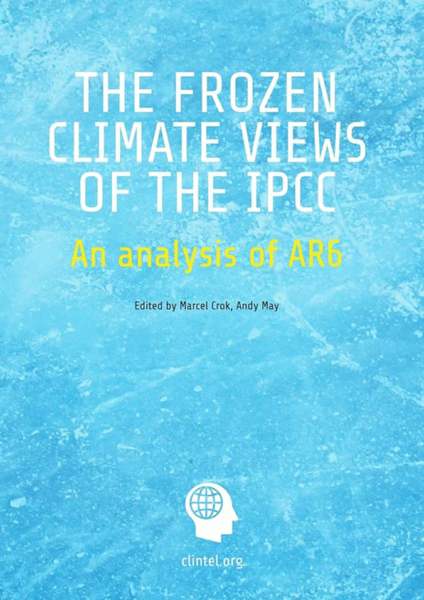
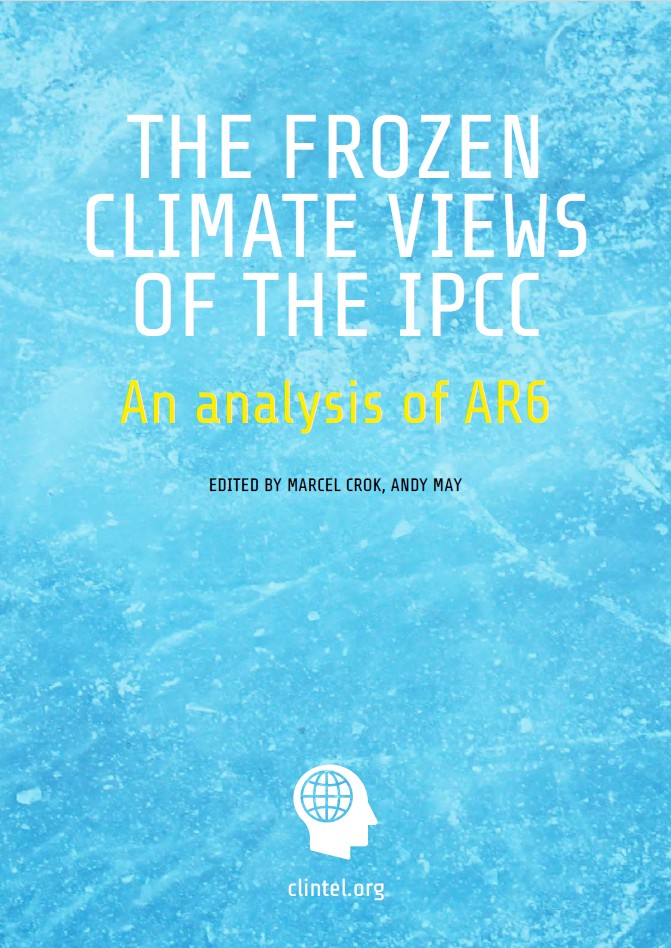
Clintel: The Frozen Climate Views of the IPCC – An analysis of AR6
See our webshop at: https://clintel.shop/product/the-frozen-climate-views-of-the-ipcc/
Clintel Foundation
Date: 5 March 2026
Introduction:
This is the second part of the analysis by Climat et Vérité of The Frozen Climate Views of the IPCC. The first article mainly dealt with the first six subthemes from the book. This second article, here, will now deal with points 7-12, as well as a general conclusion.
Point 7: Climate sensitivity to CO₂ ‘nebulous’
One of the most important conclusions of the report AR6 was to reduce the uncertainty in estimating the sensitivity of climate to the doubling of carbon dioxide content in the atmosphere. Since the Charney report of 1979, the probability interval (66% chance for this sensitivity) has been between 1.5 °C and 4.5 °C, a difference reduced by AR 6 from 2.5 °C to 4.5 °C. This is where our report discusses the estimation of climate sensitivity to CO₂. We explain that AR6 relies heavily on the publication of Sherwood et al (2020) which is an important study.
In previous reports, estimates of climate sensitivity were largely based on model results. The good news is that this is no longer the case with the Sherwood study. It reduced the probability interval to between 2.5°C and 4°C.
The bad news is that researcher Nick Lewis discovered errors in the statistics and gaps in the original data, and he corrected them:
The results of the Lewis analysis led to a probability range of +1.75°C to +2.7°C of climate sensitivity. This is well below the probability interval of the AR6 report.
This reduction is significant. It shows how sensitive climate sensitivity estimates are to initial data. Lewis’ lower estimate of climate sensitivity has profound implications for climate models and warming projections for the 21st century.
Lewis’ analysis shows that a majority of AR6 climate models use values above those of the probability interval.
Our report presents new evidence that the IPCC’s climate sensitivity is too high. And it hypothesizes that this is due to incorrect assumptions about cloud cover. The IPCC admits that a multitude of studies suggest that climate sensitivity is too high, but it ignores this multiplicity of studies without explaining why. Or rather the explanation is, that the IPCC is right against all the others who are wrong.
Point 8: AR6 climate models are unreliable, but the IPCC gives them high confidence
Our review shows that global and tropical tropospheric air temperatures, as calculated by IPCC climate models, are too high compared to observations.
This error affects the results of all models to a statistically significant degree, which invalidates the climate models. Since the projections made by these models are used to calculate the future impact of climate change, this also invalidates future projections.
McKitrick found that if the impact of anthropogenic greenhouse gas emissions is removed from climate models, the results are much more consistent with observations in the tropical troposphere. He also found that the results of the AR6 models are higher than the previous AR5 models, which consistently overestimate the global mean temperature for the lower troposphere.
In the AR6 report, there is only excessive warming. At present, the CMIP6 models show too much warming over the entire lower and mid troposphere. That’s a double bias, not an uncertainty. And until the modelling community finds a way to correct it, economic and political circles will be justified in considering that future warming projections are exaggerated, and sometimes by a lot, depending on the model.
Point 9: Extreme climate change scenarios
Marcel Crok takes a close look at the anthropogenic CO₂ emission scenarios used by the IPCC to predict future temperatures and climate.
He notes the IPCC’s admission that the highest emission scenarios, SSP5-8.5 and SSP3-7.0 are unlikely, is drowned in the abyss of the report and thus unlikely to be read by policymakers.
In addition, one notes that important and significant chapters still highlight these very unlikely scenarios, which risk invalidating these sections of the report.
This has serious consequences from a political point of view.
Crok clearly illustrates that the IPCC’s extreme emissions scenarios are unlikely and should be considered academic and unrealistic extremes. By publishing them, the AR6 report loses its credibility.
Point 10: Hiding the good news about the extremes?
The final part of the report focuses on the impacts of climate change on humanity. Marcel Crok analyses the concealment of good news. He points out that AR6 claims that climate becomes more extreme with time, but that data suggests that this is not the case in many categories of climate phenomena, or more specifically, weather.
For example, the IPCC acknowledges in the depths of the report, that there is no trend for tropical cyclones or floods. These kinds of extreme events are responsible for about 90% of the damage caused by disasters worldwide. So we should consider this good news, as there is no upward trend.
The longest time-series about hurricanes reaching the coast comes from the USA. It is not included in any of the IPCC’s materials. Cyclones around the world and hurricanes in the United States are not increasing but decreasing in frequency and violence in recent decades. When it comes to drought, Crok finds that the authors have little confidence in the idea that human activities may have contributed to these droughts on a regional scale.
Crok concludes that heat waves have increased since 1950, but the hottest years in the U.S. were the 1930s. So, things could depend on the choice of the period considered. Crok points to serious contradictions between different parts of the AR6, in particular between the reports of WG1 and WG2.
WG1 as a whole, states that the IPCC has low confidence in the human contribution to flooding, while the Summary for Policymakers states the opposite. Crok concludes that all the good news is drowned in the depths of the report and only the bad news is highlighted in the Summary for Policymakers. In WG2, things are much worse, with the IPCC contradicting many of its claims from the WG1 report.
Point 11: Losses due to disasters
Marcel Crok continues to discuss weather disasters and their possible attribution (if any) to human activities or emissions.
The dollar-by-dollar comparison of the nominal cost of destruction between now and the past makes
no sense because of the increase in population.
Crok reviews the peer-reviewed literature on normalizing catastrophe costs starting from Roger Pielke Junior’s 1998 seminal paper.
The AR5 report considered Pielke’s conclusions by reformulating them:
“The increasing exposure of people and economic assets has been the main cause of long-term increases in economic losses”.
Crok concludes with regard to the literature on disaster losses:
“The latest WG2 report is neither exhaustive, nor open, nor transparent. It ignores the majority of the literature published on the subject. It is also not objective. This is a very poor performance by the IPCC.”
It is clear that Pielke is sidelined by the IPCC. The IPCC goes out of its way to ignore Pielke’s work, even when it is relevant. The IPCC also ignored another of Pielke’s publications that presents an important graph of normalized global costs.
Point 12: Climate-related deaths
Marcel Crok analyses the statement of the UN Secretary General, António Guterres, that “we are on the highway to climate hell with our foot on the accelerator”, a statement made to COP 27 delegates in Egypt.
Is there an ounce of truth in this statement? It seems like there’s not.
Lomborg showed that climate-related deaths, more precisely weather-related deaths, have fallen over the past 100 years from nearly half a million per year in 1920 to a few thousand per year today.
However, this good news does not appear in AR6 where this publication by Lomborg is not mentioned. Other IPCC reports have continued to worsen in quality and multiply biases over time. The first report (FAR) in 1990 was a relatively correct assessment of the climate science of the time, but subsequent reports have proven to be increasingly biased with each passing year.
No honest assessment of AR6 will conclude that it is correct and unbiased. Rather, it will conclude with the opposite.
The problems appear to be considerably more serious in the WG2 Working Group Report than in the WG1 Working Group Report.
Overall conclusion and summary of Clintel
We have shown that many of the IPCC’s important claims are questionable:
“That the current warming is unprecedented, that it is 100% man-made, that it is dangerous”
Based on the same available data, the Clintel team would propose a summary with the following content:
“Warming during the Holocene likely peaked during the Holocene Thermal Maximum, when global temperatures on a century-scale were likely similar, with uncertainties, to those observed over the past decade.
We do not have decadal average temperatures of the Holocene Thermal Maximum and the temperatures from the proxies reduce the extremes when they are averaged.
After that, a long cooling began, that follows the Milankovitch cycles.
This cooling reached its peak during the Little Ice Age, which was probably the coldest period of the Holocene. Greenhouse gases have likely contributed to the modest warming since 1850.
It is impossible to determine with reasonable precision what percentage of warming is due to greenhouse gases.
Sea levels began to rise in the nineteenth century and there is no visible acceleration after 1950, when the climate is supposed to be dominated by greenhouse gases. In addition, most extreme weather events have not become more frequent or severe. This is especially true for cyclones and floods in the tropics, which are the phenomena that cause the most damage overall.
Losses caused by disasters, when normalized to economic growth, have been declining slightly since the 1990s. Climate-related deaths have fallen by more than 95% since the 1920s.
This reflects growing prosperity and the availability of technologies that better prepare humanity for
disasters. In short, a prosperous humanity is largely prepared for and can easily cope with climate change.”
A series of five articles on ‘The Frozen Climate Views of the IPCC’ was published in French from January 17 to February 21 on the Climat et Vérité website. This is the second and last part of a summary of that series.
Translation: Eric Vieira.
more news
Why the CO₂ theory can’t be allowed to fall down
Director Martin Durkin and producer and podcaster Tom Nelson, both known for the award-winning documentary “Climate: The Movie“, launched the initiative GorillaScience last year.
Professor Norman Fenton: An Anatomy of Cancellation
a highly distinguished university professor was persecuted for merely doing his scientific work: founded on evidence and proper reasoning, questioning scientific theories
Blackout
Blackout It seems that the Spanish government has no intention of revealing the true cause of the blackout of April 28. That is why we share the article below by Fernando del Pino Calvo Sotelo, which he published on his website on May 9. publications [...]