
American-Japanese Pact Signals Ascent of Energy Realism
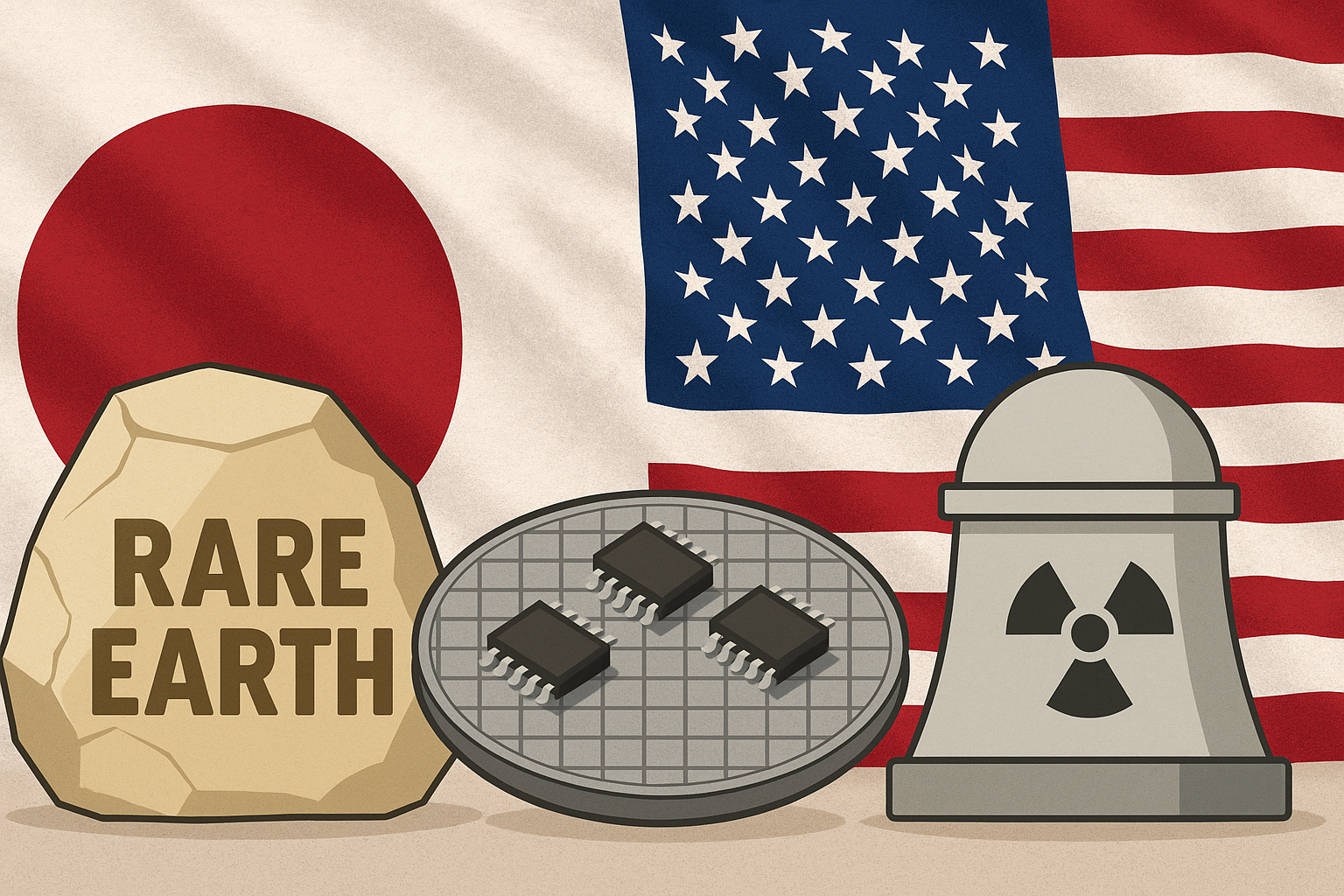
The U.S. and Japan are shedding the paralysis of irrational climate policies with a strategic pact covering rare-earth minerals, critical components for semiconductors and next-generation nuclear reactors.

Vijay Jayaraj
Date: 19 November 2025
The U.S. and Japan are shedding the paralysis of irrational climate policies with a strategic pact covering rare-earth minerals, critical components for semiconductors and next-generation nuclear reactors.
Forged through the leadership of two no-nonsense politicians – President Donald Trump and Japanese Prime Minister Sanae Takaichi – the clear-eyed agreement abandons more than a decade of energy uncertainty that was marked by unpredictable supply chains, unrealistic net-zero pledges and overreliance on unreliable wind and solar energy. This rightly places energy and industrial strategy at the heart of protecting national sovereignty.
Facing the weaponization of supply chains by Beijing, which controls over 90% of processed rare earths, America’s deal with Japan makes priorities of access to materials and technology, strategic resilience and economic growth and leverages an existing $550 billion investment package between the two countries.
According to a White House fact sheet, Japan and various Japanese companies will invest up to $332 billion in U.S. energy infrastructure, including nuclear reactors, plus up to $50 billion in power equipment through deals involving both U.S. and Japanese companies. Japan reportedly is to have increased access to U.S. markets for technology sales and favorable tariff treatment.
These investments are not for more bird-slicing wind turbines or desert-smothering solar panels, but for practical, reliable electric-generating capability.
The U.S. is to spend $75 billion on data-center infrastructure from three Japanese companies: Mitsubishi Electric, for supply power station systems and equipment; TDK Corp., advanced electronic power components; and Fujikura, Ltd., optical fiber cables.
The U.S.-Japan agreement also includes a multi-year deal valued at over $100 million between Global Coal Sales Group and Tohoku Electric Power for American thermal coal. This is a rational decision by an advanced industrial nation to secure affordable, reliable electricity for its people. Coal remains an indispensable energy source for nations that refuse to sacrifice economic growth at the altar of “decarbonization” dogma.
The deal calls for a Japanese investment of up to $3 billion to construct an ammonia and urea fertilizer manufacturing facility in the United States and another $2 billion to construct a copper smelting and refining plant in the American West.
On the other side of the Pacific, Japan will bolster energy supplies by importing 66 million metric tons of U.S. liquefied natural gas (LNG) each year, making it the second-largest LNG buyer after China.
Still, Japan would be well served to add further to provisions of the deal – such as JERA Co.’s $1.5 billion stake in natural gas assets in Louisiana’s Haynesville shale deposits and Tokyo Gas’s purchase of Alaska LNG – which help to replace strategically risky Russian supplies that account for 9% of Japan’s gas needs.
As for nuclear power, Japan’s political cowardice following the Fukushima disaster in 2011 has left it with only 14 of the country’s 54 pre-accident nuclear reactors restarted. Japan needs to exorcise the Fukushima ghosts that have frozen policymakers for 14 years and reclaim its edge in a field now dominated by China, France, South Korea and Russia.
Fortunately for Japan and others, America’s Trump administration has bulldozed a path for vigorous development of resources by ditching the Paris Accord’s chains and axing funds for global climate polices that enforce energy poverty.
The U.S.-Japanese framework hammers home strategic resilience through partnerships with major firms like Mitsubishi and Toshiba embedding in American projects, engendering employment and trade and defying minimalist “green” delusions.
Both powers now stand armored against disruptions, their economies roaring on a bedrock of hydrocarbons and atomic might, proving that real strength comes from embracing what works, not cowering before fabricated crises.
What Washington and Tokyo have accomplished is more than a trade agreement. It is a declaration of independence from the climate catastrophism that has paralyzed rational policymaking for a generation. Other nations will follow. The tide is turning. Energy realism is ascendant.


Vijay Jayaraj
Vijay Jayaraj is a Science and Research Associate at the CO2 Coalition, Fairfax, Virginia. He holds an M.S. in environmental sciences from the University of East Anglia and a postgraduate degree in energy management from Robert Gordon University, both in the U.K., and a bachelor’s in engineering from Anna University, India.
This commentary was first published at RealClear Markets November 17.

more news

Groundbreaking New Paper Challenges Foundation of Climate Change Assessments, Revealing Fatal Flaws in Ocean Heat Content Measurements
An international team of scientists has published groundbreaking research revealing that the primary measurement used to support claims of planetary “warming” is fundamentally flawed and scientifically invalid.

The Frontier of Climate Science: Solar Variability, Natural Cycles and Model Uncertainty
Climate scientist Nicola Scafetta has published a new book examining the complex interplay between solar variability, natural climate cycles, and the limits of current climate models. The Frontier of Climate Science explores how natural variability, observational uncertainties, and model limitations shape our understanding of past and future climate change.

Absurd new study: hair salons can be a secret weapon for climate action
Great news! Researchers from several British universities have discovered that ‘hairdressers could be a secret weapon in tackling climate change’. Jo Nova reflects on this absurd finding.

