
Book Review – Politics & Climate Change: A History
Andy May’s 2020 book, Politics & Climate Change: A History, is picking up renewed attention — and for good reason. Dr. Patrice Poyet has released a freshly updated, in-depth review that’s now available on ResearchGate.

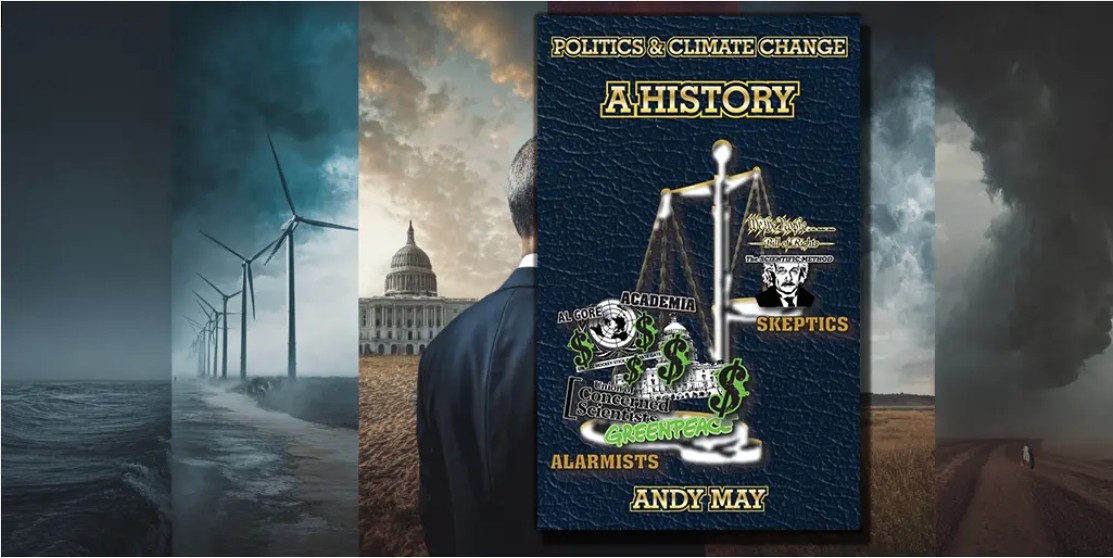
The reason for the uptick in interest? The wheels have finally come off the “dangerous climate change” myth. As that narrative collapses, people are hungry to understand the decades of corruption that fueled it — and to hear the stories of the men and women who stood their ground. The usual suspects? Greenpeace, Sen. Sheldon Whitehouse, Al Gore, Raúl Grijalva, Tom Steyer, Naomi Oreskes, Peter Frumhoff — all deeply entangled in this multi-billion dollar machine. But now that the playing field is leveling, their tactics and motives are under a brighter light.
Poyet’s review pays particular attention to the business of climate alarmism — and yes, it is a business. Billions have been shoveled into the myth by Steyer, Bloomberg, and the rest of the so-called “Billionaires Club,” backed by organizations like the Rockefeller Brothers Fund, the Hewlett Foundation, the Packard Foundation, the Schmidt Family Foundation, Sea Change, Park Foundation, and the Marisla Foundation. The House Science Committee has even linked Sea Change to Russian funding, aimed at stopping fracking in America by laundering influence through environmental groups.
Greenpeace, meanwhile, didn’t miss a beat. They adapted to the new funding ecosystem, crafting “activism” campaigns that smeared reputable scientists like Will Happer and Willie Soon, spinning up outright fabrications and handing them off to sympathetic media allies.
The review also reminds us of the price paid by those who stood for scientific integrity: Willie Soon, Scott Pruitt, Judith Curry, David Legates, John Christy, Roy Spencer, Robert Balling, Roger Pielke Jr., Roger Pielke Sr., Steven Hayward, Will Happer, Richard Lindzen, Anthony Watts, Steve McIntyre, Ross McKitrick, Greg Wrightstone, Marcel Crok, the late, great Tim Ball — and many others who’ve taken more than their fair share of slings and arrows for daring to speak the truth.
Take a look at Poyet’s review. If it resonates, grab the book — it’s available on Amazon, Kobo, and Barnes & Noble. It’s well worth your time.


more news

The Strait of Hormuz Crisis Shows the World Still Runs on Fossil Fuels
The Strait of Hormuz, one of the world’s most critical energy chokepoints, highlights the continued global dependence on oil and gas. Recent geopolitical tensions have disrupted energy flows, exposing vulnerabilities in global supply chains and triggering emergency responses across Asia. Despite decades of rhetoric about an energy transition, fossil fuels remain indispensable for modern economies, not only for energy but also for agriculture, plastics and pharmaceuticals. The crisis underscores that energy systems are shaped by geography and economics, and that a full transition away from hydrocarbons will be far slower and more complex than often assumed.

The EU’s Nuclear Phase-Out Was a Blunder
Following Friedrich Merz in January, Ursula von der Leyen has now also admitted that the phase-out of nuclear energy was a major ‘strategic mistake’, not only for Germany but for the EU as well. American researcher Roger Pielke Jr. uses some simple calculations to demonstrate the magnitude of the EU’s strategic blunder.

Paul Ehrlich (1932-2026): Farewell to the Long-Lived Failed Prophet of Miserablism – The Population Bomb author lived a long, wealthy, healthy life, an opportunity his work denied to countless others
Paul Ehrlich, author of The Population Bomb, became one of the most influential voices behind modern environmental pessimism. His warnings of inevitable resource depletion and societal collapse shaped decades of policy and public thinking. Yet, as history unfolded, many of his most prominent predictions failed to materialize—raising enduring questions about the consequences of alarmist narratives in science and policy.

