
Chill Out: Refrigerants Are No Global Warming Threat
A federal rule mandating the use of certain refrigerants has substantially boosted the price of air conditioning and increased the risk of fire – only to reduce global temperature by an amount too small to measure.


Imposed by the Biden administration’s Environmental Protection Agency (EPA), beginning this year, the rule forced the replacement of a hydrofluorocarbon refrigerant known as R-410A with others that are less potent as greenhouse gases, which climate alarmists falsely claim will overheat Earth.
However, a report by the CO2 Coalition, Fairfax, Virginia, calculated the atmospheric warming from continued use of R-410A to be “0.044 degrees Celsius in 100 years, which is … absurdly small” and too little to be measured or felt. The amount of warming averted by replacing the refrigerant with other greenhouse-gas hydrofluorocarbons was calculated to be an infinitesimal 0.03 degrees Celsius, according to the report titled “Chill Out: AC Refrigerants Cause Negligible Warming.”
Widely used in heating, ventilation and air conditioning systems since 2010, R-410A was considered an economical, nonflammable refrigerant that posed less of a threat to damaging Earth’s ozone layer than hydrofluorocarbons it had replaced – itself a concern advanced by alarmists with dubious scientific support.
It turns out that the chemicals replacing R-410A are more expensive and flammable, raising issues of both cost and safety. Writing in the Wall Street Journal, Ben Lieberman of the Competitive Enterprise Institute quotes an industry source:
“This (Biden administration) mandate has increased costs by $1,500 per system on average, says Martin Hoover, president of Atlanta-based Empire Heating & Air Conditioning. Mr. Hoover says the higher price is due to both increased equipment prices – systems had to be redesigned for the new refrigerants – and higher labor costs, since these refrigerants are more flammable and require additional precautions during installation. To make matters worse, an EPA-compliant green refrigerant that many equipment makers use … is in short supply, and prices have risen substantially.”
Regulations, “combined with nonregulatory factors such as higher materials costs and rising wages for service technicians, have dramatically increased the cost of buying and installing a new system,” Lieberman reports. Replacing 15-year-old heating and air-conditioning equipment costing around $5,000 at the time of installation would cost today as much as $14,000, according to his industry source.
In issuing the replacement order, the Biden EPA made much of the fact that hydrofluorocarbons, at a molecular level, are more potent greenhouse gases than carbon dioxide (CO2), the primary bogeyman of the climate industrial complex. But compared to CO2, hydrofluorocarbons are orders of magnitude less prevalent in the atmosphere, their concentration being measured in parts per trillion rather than per million for carbon dioxide.
The upshot is that amount of hydrofluorocarbon in the air is too small to matter, irrespective of its warming potential – molecule for molecule – relative to CO2, which itself has only a minor influence on global warming.
A bright spot in this is that the Trump EPA has proposed an extension for using R-410A beyond the end of this year as long as supplies last. Some have suggested repealing the Biden administration ban on the refrigerant to give relief to the estimated 5 million to 6 million American homeowners who purchase air conditioners each year.
In comments prepared for the EPA, the Competitive Enterprise Institute urged the agency “to do as much as possible to mitigate … consumer damage.”
In his analysis of the refrigerants’ warming effect, the CO2 Coalition’s Dr. Frits Byron Soepyan concluded: “(T)he selection of the refrigerants for air conditioning systems should be based on both the safety and the needs of the consumers, rather than on a purported environmental benefit.”
This is especially true when the supposed “benefit” has proven to be nonexistent.

This commentary was first published at Daily Caller Dec. 6.

Gregory Wrightstone
Gregory Wrightstone is a geologist; executive director of the CO2 Coalition, Fairfax, Virginia; and author of “Inconvenient Facts: The science that Al Gore doesn’t want you to know” and “A Very Convenient Warming: How modest warming and more CO2 are benefiting humanity.”

more news
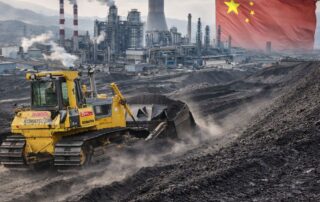
China’s Massive Coal-to-Liquids Expansion
In this article, Australian science writer Jo Nova examines China’s rapidly expanding coal-to-chemicals and coal-to-liquids industry. While much of the West focuses on phasing out fossil fuels, China is quietly transforming coal into fuels, plastics and fertilizers at massive scale—raising important questions about energy security and global climate policy.

New Ice Core Study Finds No Clear CO₂–Temperature Link
New research from ancient Antarctic ice cores is challenging long-held assumptions about the role of carbon dioxide in Earth’s climate history. Evidence suggests that CO₂ and methane levels remained remarkably stable over millions of years—even as the planet experienced dramatic temperature shifts. These findings raise fresh questions about the extent to which greenhouse gases alone can explain past and present climate change.
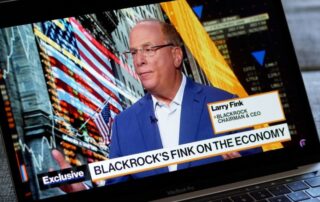
BlackRock CEO Abandons Climate Delusion for Investor Needs
BlackRock CEO Larry Fink has publicly shifted toward what he calls energy pragmatism, admitting that society now demands a balanced approach to meeting power needs rather than adherence to rigid climate agendas. This could be a pivotal moment for global energy policy, as one of the planet's most powerful financial players steps back from decades of ill-advised “green” mandates.

