
China’s Massive Coal-to-Liquids Expansion
In this article, Australian science writer Jo Nova examines China’s rapidly expanding coal-to-chemicals and coal-to-liquids industry. While much of the West focuses on phasing out fossil fuels, China is quietly transforming coal into fuels, plastics and fertilizers at massive scale—raising important questions about energy security and global climate policy.

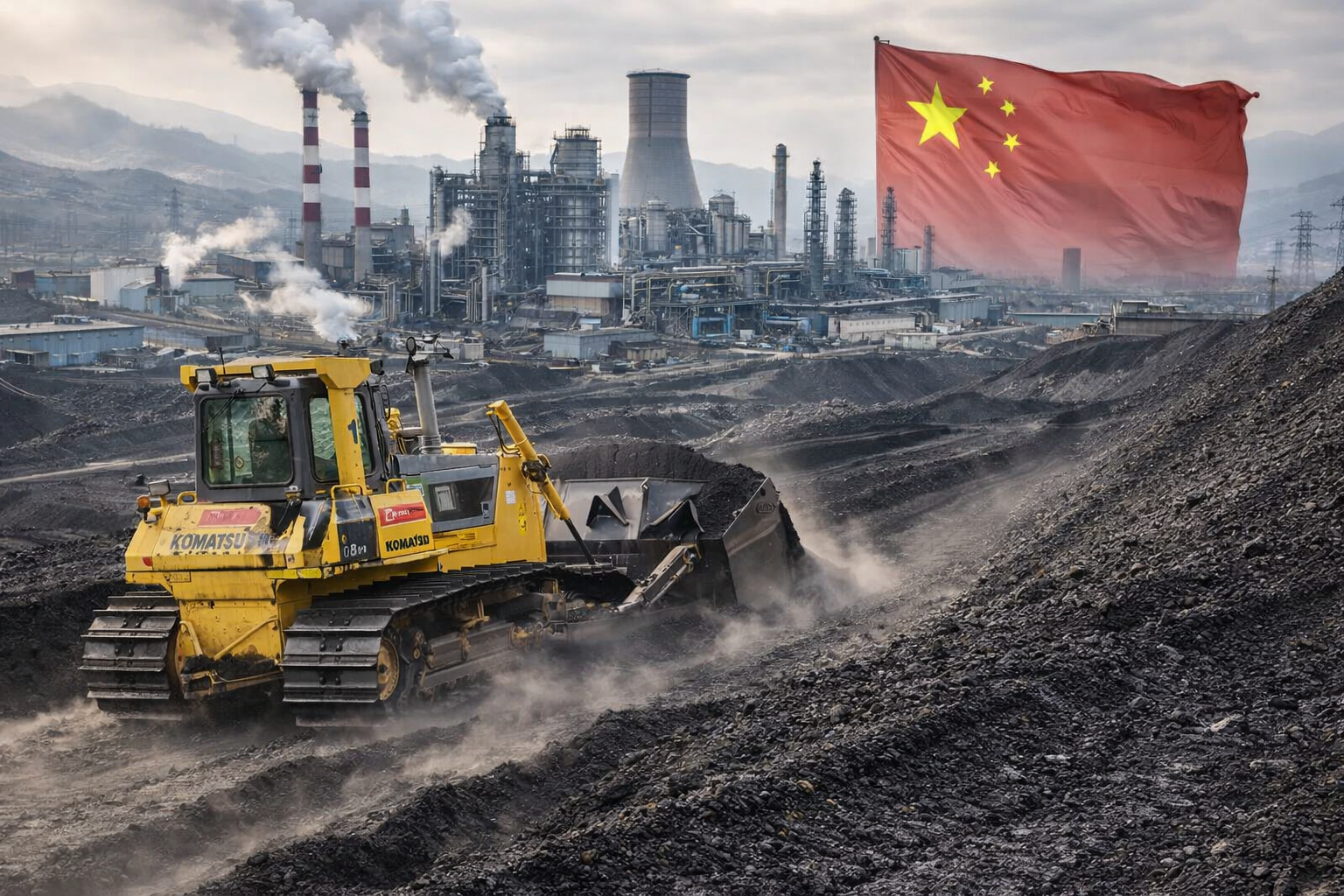
Image created using ChatGPT
Jo Nova
Date: 28 March 2026
Coal, it turns out, is an infinite chemical wellspring, being converted into everything from plastic, to diesel, jet fuel, gas, methanol and fertilizer. There is no way, just no chance, that China will leave this bounty locked underground. And why are we?
The idea of converting coal to liquid fuel sounds like an expensive exotic chemical reaction that is barely used. If people have even heard of it, it’s mainly because the Nazi’s were so desperate for liquid fuel to power their tanks and armored cars, they converted coal in a large plant that became a wartime target in World War II. It produced 92% of Germany’s air fuel, and 50% of its petroleum. Who knew, those Messerschmidts were coal powered? Later South Africa used it in the 1980s in response to an oil embargo, and they still do.
Quietly China has developed a giant coal-to-liquids industry to reduce its strategic vulnerability to an oil shock or a wartime embargo, and the volume is astounding. Accurate numbers are hard to obtain, but the IEA estimates that every year China is converting 380 million tons of coal into fuel, ammonia and fertilizer.
To put that in perspective, Australia is now the second largest exporter of coal in the world, and China is converting more than we export through coal-to-liquids and coal-to-chemicals. This is also more than the USA uses.
China’s coal production is 4,800 million tons each year. Something like 8% of that converted to something else, like petrol, gas, plastic water bottles, synthetic clothes, and fertilizer for food crops.
And they also make diesel.
China’s Coal Industry Has a Big, Dirty Secret
by Javier Blas, Bloomberg, 2nd June 2025
Largely unnoticed, the size of this obscure corner of the Chinese coal industry has reached gargantuan proportions: It consumes about 380 million metric tons of coal as a feedstock for chemical and liquid fuel production, according to the International Energy Agency. To understand its size better, it helps to think about the segment as if it were a country. As such, it would rank as the world’s third-largest consumer, only behind the rest of the Chinese coal sector and India, but ahead of the US, Japan and other top coal-consuming nations like Indonesia and Turkey.
People may think that Coal-to-liquids is only something worth doing if the price of oil is high, but that all changes if you care about energy security. And China clearly does.
The modern part of that processing was largely experimental in the early 2000s. Commercial-scale projects mushroomed in the 2010s, and, after a brief hiatus, more have emerged in recent years, particularly in the Chinese heartland, where the bulk of the country’s coal fields are located far from coastal cities. By now, its scale — which dwarfs all other countries’ coal-to-chemicals production — and growth is surprising even veteran industry observers. Look at some modernized plants and coal is nowhere to be seen: It’s mined underground almost directly beneath the chemical facilities, carried by conveyor into the furnaces where it’s gasified and transformed. From there, it goes into your plastic water bottle or synthetic fabric clothes.
And this vast silent industry is set to double. Such is the demand, reports are that Chinese use of coal-to-liquids is rapidly growing.
Any plans of China giving up coal is pure fantasy.
Chinese alchemy: Cheap fuel powers coal-to-gas and chemicals boom
By Sam Li and Colleen Howe, Reuters, 4 Sept, 2025
The fastest-growing sector in the industry is expected to be coal-to-gas.
The capacity under construction is around four times what was built over the past decade, according to Reuters’ analysis of figures from Agora Energy China, the China National Coal Association and Guosen Securities.
That would more than double annual capacity to 19.5 billion cubic metres (bcm), equal to roughly a fifth of China’s LNG imports last year.
Even though China is using less coal for electricity production, it is not using less coal overall. That extra coal is being fed into other energy, industry and agriculture:
China’s Renewable Boom Masks a Quiet Coal-to-Liquids Expansion
By Natalia Katona – OilPrice Mar 02, 2026
China and South Africa are the only countries operating CTL and CTC at an industrial scale.
It is important to note that the largest part of this demand goes into the CTC [Coal to Chemicals] industry. China has effectively replaced gas as its main feedstock for ammonia and methanol production with raw coal, to the extent that roughly 80% of these chemicals’ output is now fed by coal.
China’s largest CTL [Coal to Liquids] facility, the Shenhua Ningxia plant, commissioned in 2016, produces roughly 100,000 b/d of synthetic fuels from approximately 44,000 t/d of coal. By comparison, a conventional refinery would require a third of this amount, equivalent of 14,000 t/d of crude oil to produce a similar volume of refined products. At current prices, coal in Qinhuangdao trades at roughly $105–110 per tonne, while Brent crude equivalent costs about $525 per tonne (at $71/bbl). Even accounting for conversion costs, coal-based synthetic fuels can offer economic advantages, particularly in a volatile oil market.
If we valued energy security, we could have been producing coal to liquids and fertilizer on a smaller scale that was able to be ramped up on short notice. It would be cheap insurance against billions of dollars in losses which threaten entire annual crop cycles, mining production, export income, or even existentially, food distribution, and defense.
Asleep at the wheel in the Lucky Bubble Country.
This article was published previously on joannenova.com.au.

Jo Nova
Jo Nova is science presenter, writer, speaker & former TV host; author of The Skeptic’s Handbook.

more news
Germany Nears Energy Emergency — And Policy Failure Is to Blame
Germany is nearing a potential energy emergency as gas reserves fall and heavy industries face possible shutdowns. Critics argue the looming economic damage is less the result of harsh winter conditions than of years of far-reaching policy decisions. What is unfolding now may be the consequence of strategic choices that have left Europe’s largest economy increasingly vulnerable.

Dutch climate skeptics vindicated: KNMI reinstates seven pre-1950 heatwaves after long battle
Seven years after Dutch skeptics first challenged KNMI's temperature adjustments, the institute has reinstated seven "lost" pre-1950 heatwaves at De Bilt — validating claims of over-correction that had erased 16 out of 23 historical extremes. The breakthrough came via the skeptics' peer-reviewed paper.

“There Should Be No Climate Policy”: Interview with WCD Signatory Tomáš Elbert
Tomáš Elbert, an organic chemist from the Czech Republic, is among the latest signatories of CLINTEL’s World Climate Declaration. In this interview, he explains his scientific background, his views on climate change, and why he believes open debate is essential.

