
“Clean Energy Sector is Dead”
“The whole sector — solar, wind, hydrogen, fuel cells — anything clean is dead for now”, says Nishant Gupta, founder and chief investment officer at London-based Kanou Capital LLP. First published by Jo Nova.


Nishant Gupta set up a green energy hedge fund last year managing about $100m in assets, but he probably wishes he hadn’t.
His words are about as blunt as any hedge fund owner could possibly get.
Hedge Fund Built on Energy Bets Says ‘Clean Is Dead for Now’
Bloomberg
“The whole sector — solar, wind, hydrogen, fuel cells — anything clean is dead for now,” said Nishant Gupta, founder and chief investment officer at London-based Kanou Capital LLP.
Against a barrage of political headwinds in the US, a war-fueled energy crisis and stubbornly high interest rates, large parts of the clean-energy industry are stalling. In the past year, the S&P Global Clean Energy Index has lost 20%, a period during which the S&P 500 Index gained 16%. And with the Trump administration shredding climate policies in the world’s largest economy, many green investors are taking a timeout.
Over the last year clean energy stocks have lost 20% of their value, whereas stocks in fossil fuels are up 13%.
So after the last year, skeptical investors are 30% richer than their believer friends. As it should be.
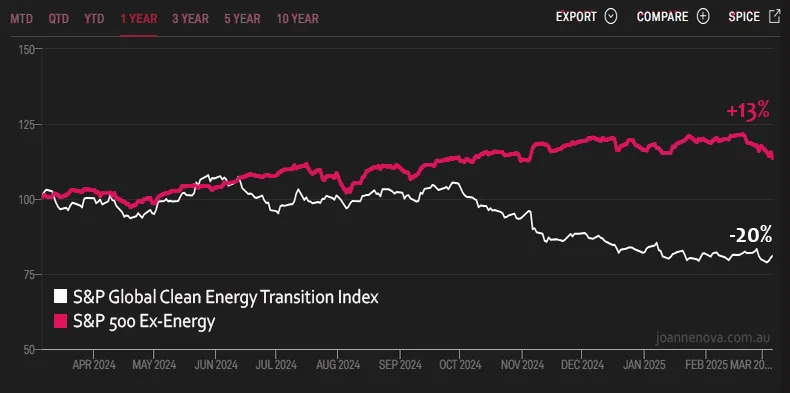
Gupta now says that ““The fundamentals are very poor”. Which is true if you were fundamentally betting on government handouts. The truth is the electrical fundamentals of Green investment were always awful, as were the “carbon” fundamentals. Investors should have got better advice from friends who were engineers who saw that unreliable renewables were an expensive fantasy that were doomed years ago.
He still claims there is some long term need for a clean energy transition, but his big plan is to find the “corners” of the market where he can identify “supply-chain bottlenecks as core investment opportunities”. Apparently that means he’s moved into companies that make compressors, vacuum systems and switches and fuses. Which sounds a lot like a man who’s stepped right out of the clean energy space.
The fall for clean energy shares started at the end of September last year, presumably as it dawned on green investors that Kamala was not going to win and keep the subsidies rolling.
The great unravelling of the Green delusion continues. Amazing that there is still 80% of the clean energy sector value left on the chopping block.


more news

The Strait of Hormuz Crisis Shows the World Still Runs on Fossil Fuels
The Strait of Hormuz, one of the world’s most critical energy chokepoints, highlights the continued global dependence on oil and gas. Recent geopolitical tensions have disrupted energy flows, exposing vulnerabilities in global supply chains and triggering emergency responses across Asia. Despite decades of rhetoric about an energy transition, fossil fuels remain indispensable for modern economies, not only for energy but also for agriculture, plastics and pharmaceuticals. The crisis underscores that energy systems are shaped by geography and economics, and that a full transition away from hydrocarbons will be far slower and more complex than often assumed.

The EU’s Nuclear Phase-Out Was a Blunder
Following Friedrich Merz in January, Ursula von der Leyen has now also admitted that the phase-out of nuclear energy was a major ‘strategic mistake’, not only for Germany but for the EU as well. American researcher Roger Pielke Jr. uses some simple calculations to demonstrate the magnitude of the EU’s strategic blunder.

Paul Ehrlich (1932-2026): Farewell to the Long-Lived Failed Prophet of Miserablism – The Population Bomb author lived a long, wealthy, healthy life, an opportunity his work denied to countless others
Paul Ehrlich, author of The Population Bomb, became one of the most influential voices behind modern environmental pessimism. His warnings of inevitable resource depletion and societal collapse shaped decades of policy and public thinking. Yet, as history unfolded, many of his most prominent predictions failed to materialize—raising enduring questions about the consequences of alarmist narratives in science and policy.

