
Dutch climate skeptics vindicated: KNMI reinstates seven pre-1950 heatwaves after long battle
Seven years after Dutch skeptics first challenged KNMI’s temperature adjustments, the institute has reinstated seven “lost” pre-1950 heatwaves at De Bilt — validating claims of over-correction that had erased 16 out of 23 historical extremes. The breakthrough came via the skeptics’ peer-reviewed paper.


Youngsters in the heat in the fountain on Frederiksplein, Amsterdam, 28 June 1947
(Source: nationaalarchief.nl)
Marcel Crok
Date: 4 February 2026
A miracle just happened. KNMI, the national weather and climate institute in The Netherlands, admitted publicly that we, a group of four skeptical scientists, were right in our critique of their homogenization. This admission means the end of a ‘battle’ that has been dragging on for about seven years.
What was this whole discussion actually about? In 2016, KNMI homogenized their daily temperatures for the period 1901-1950 because of a change in measurement method in 1950 (Pagoda screen to Stevenson screen) and a displacement 300 meter towards open field in 1951. They had parallel measurement for the change in screens but not for the displacement and therefore they had decided to homogenize De Bilt statistically by comparing it with a station 150 kilometers northeast (a place called Eelde) from De Bilt. The homogenization had a negligible effect on the average temperature. However the hottest days of the year (In The Netherlands this means Tmax of around 30oC) in the period 1901-1950 were corrected downwards by up to 1.9oC. Because of this, 16 out of those 23 heatwaves vanished from the official records.
Hot summer
In 2018, when The Netherlands experienced a hot summer, KNMI started claiming in the media that heatwaves nowadays are much more frequent than in the past. I, together with three others, decided to critically examine the KNMI corrections. In March 2019 we launched our first extensive report (in Dutch) about the matter, titled The Mystery of the vanished Heatwaves. The report showed that the KNMI had overcorrected far too much. An article was prepared for a major Dutch newspaper, but after interference by the director of KNMI, the editor in chief of the newspaper decided not to publish the article. A spokesman of KNMI used ad hominem arguments against us (or mainly me as I am the most visible of us four). After questioning this in an email I had a conversation with the director of KNMI and the spokesman. It was a shocking experience. They told me they wouldn’t response to our extensive report as they didn’t “trust me”. I replied science isn’t about trust. “Our report is either right or wrong and in both cases I would like to know”, I replied.
This was the end of it and in the years after they kept using their – in our opinion – fraudulent corrections to claim a strong increase in heatwaves.
Peer reviewed
We had one option left. We decided to try to get our critique published in a peer reviewed journal. As you can imagine this wasn’t easy, but ultimately in December 2021 we succeeded with a publication in the journal Theoretical and Applied Climatology. We focused not on heatwaves but on what we call tropical days (days with Tmax of at least 30oC). The Netherlands has quite a peculiar definition of a heatwave: 5 days of at least 25oC of which three days are hotter than 30oC. Historical heatwaves can easily disappear if one tropical day is corrected downwards from say 30.3oC to let’s say 29.8oC. KNMI used corrections up to 1.9oC and that’s how 16 out of 23 heatwaves in the first half of the 20th century vanished from the books.
In the paper, we presented irrefutable evidence that, as a result of the corrections, De Bilt had become an outlier compared to the four other principal stations we have in the Netherlands. Below is the key figure from our paper. You see the ratio of tropical days before and after 1950. A ratio of one means as many tropical days during 1906-1949 as during 1952-1995. A number larger than one means more tropical days in the first than in the latter period.
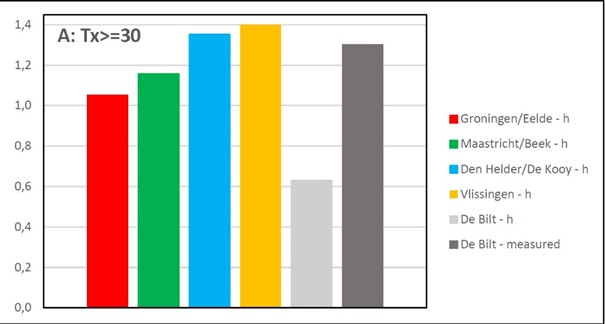
Figure 2 from the paper: ratio of tropical days 1906-1949 compared to 1952-1995
at the five main stations after the KNMI corrections. In dark gray the original
measurements of the KNMI, in light gray De Bilt after the corrections of the KNMI.
The four other main stations in The Netherlands (red, green, blue and yellow) show ratios of slightly more than one. Before homogenization (dark grey) De Bilt has a comparable ratio as the other stations, suggesting that homogenization isn’t even necessary. After homogenization (light grey) De Bilt became a huge outlier. Our conclusion plain and simple: far too many tropical days had been scrapped in De Bilt.
Sensitivity analysis
We examined the effect of a number of choices made by KNMI during the statistical procedure. These include the choice of reference stations, the length of temperature series, the calculation of the statistical distribution of the highest daily temperatures per month and the way in which outliers in the data are smoothed out. This shows that almost all choices made by KNMI lead to a greater decrease in the number of tropical days before 1950. Figure 3 of the paper illustrates the problem:
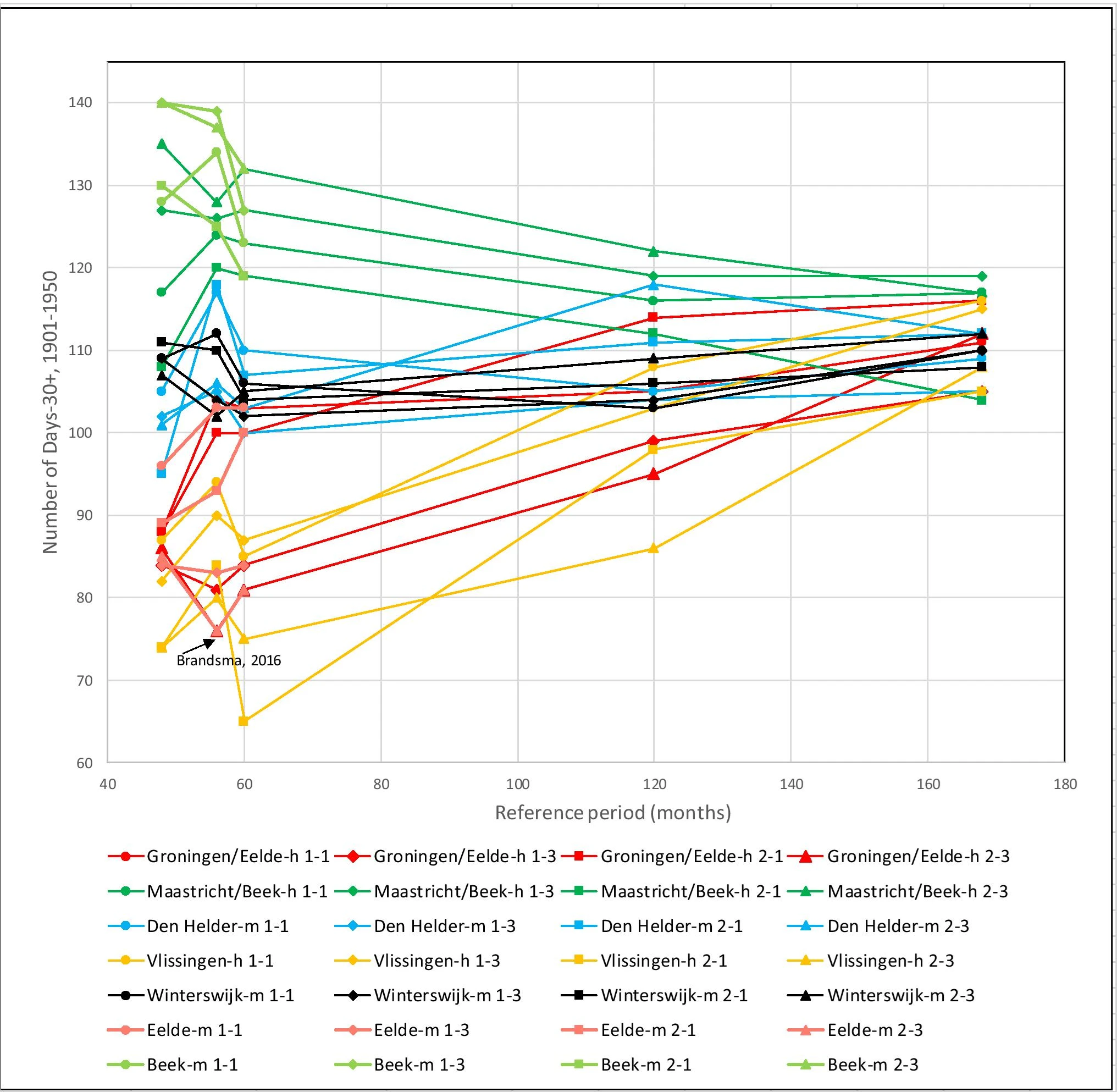
Figure 3 from the paper: number of tropical days after correction based on 116 variants.
KNMI only showed the outcome labelled Brandsma, 2016 in the figure.
The y-axis shows the number of tropical days remaining in De Bilt after the temperature corrections. There were originally 164. It can be clearly seen that the choice made by KNMI (Brandsma, 2016 in the figure, leading to 76 tropical days) is at the lower end of the range of the 116 variants considered by the researchers.
By using longer comparison periods, the method converges towards a narrower range, from 104-119 with a median of 113. This is considerably higher than the 76 according to the KNMI. We are not saying that this number is therefore the correct number. This is merely what you would get if you applied the method used by KNMI but strive for a somewhat more stable outcome.
The Other Newspaper
We again published a press release on our website and also sent it to the Dutch media. The timing though was awkward. The paper was published on 6 December 2021, a moment that the media is more interested in snow and ice. Just one alternative newspaper (De Andere Krant, The Other Newspaper) decided to publish about it and decided to ask for a reaction of KNMI. This time they admitted to the newspaper that our analysis was “interesting” and they promised to look into it in 2022 and publish a new version of their homogenization in 2023.
For the first time in this battle between us, a group of ‘skeptics’ and KNMI, we were in the lead. Their homogenization in 2016 was published in a KNMI report. It was not published in a peer reviewed journal. Now, our critique had been published in a peer reviewed journal.
Still, 2022, 2023, 2024, 2025 went by and there was no news about it. Meanwhile national weathermen kept claiming on national television that heatwaves are much more frequent nowadays. But many people in The Netherlands were aware of our critique, especially on social media platforms like X, Linkedin and Facebook. Last October, finally, the first author of our paper, Frans Dijkstra, was contacted by KNMI and asked to review their homogenization 2.0. Much to our satisfaction, we observed that the KNMI had in fact recognized the validity of our criticism. Last week they silently tried to launch their new version of the homogenization. No press release, just a short article on their website and a pdf of the report. However, a Dutch climate journalist, working for a mainstream and progressive newspaper, realized this was news. He interviewed both me and KNMI and his headline was simply amazing: KNMI ‘Discovers’ Seven Pre-1950 Heatwaves: A Win and Point of Principle for Climate Skeptics.
Vindicated
So, more than seven years after starting to look into this matter, we were completely vindicated, both by KNMI itself and by the media. We never thought this day would ever come. KNMI more or less did what we advised, use more stations to do the homogenization (they now use Eelde and Maastricht) and use longer comparison periods (they now use 15 years). This results in far smaller corrections. Seven heatwaves are back in the records (some are still gone though). Before the homogenization the summer of 1947 had an absolute record with four heatwaves. After the first homogenization three of those four had vanished. After the 2.0 homogenization all four are back.
Although KNMI responded in an unprofessional and dismissive manner to our 2019 report, the publication of our critique in a peer-reviewed journal ultimately proved decisive in shifting the debate in our favor. In contrast to KNMI’s initial homogenization effort — which was not subjected to formal peer review — our critique underwent rigorous peer review and publication. This strengthened our position in the debate. We commend KNMI for adopting a far more professional approach in producing the second version of their homogenization report. Notably, they invited one of our co-authors to serve as a reviewer and chose to publish all reviewer comments along with their responses online. Such transparency is essential in the often polarized climate science debate.
The final word probable hasn’t been said about this matter yet. KNMI keeps claiming that heatwaves are much more frequent now than in the past. It is true that there is an increase in tropical days, especially since the nineties. But the original and also the new homogenized data also show a lot of variability in the past. Here are three versions of the number of tropical days per year (version 0 is unhomogenized), the graph is made by our coauthor Frans Dijkstra.
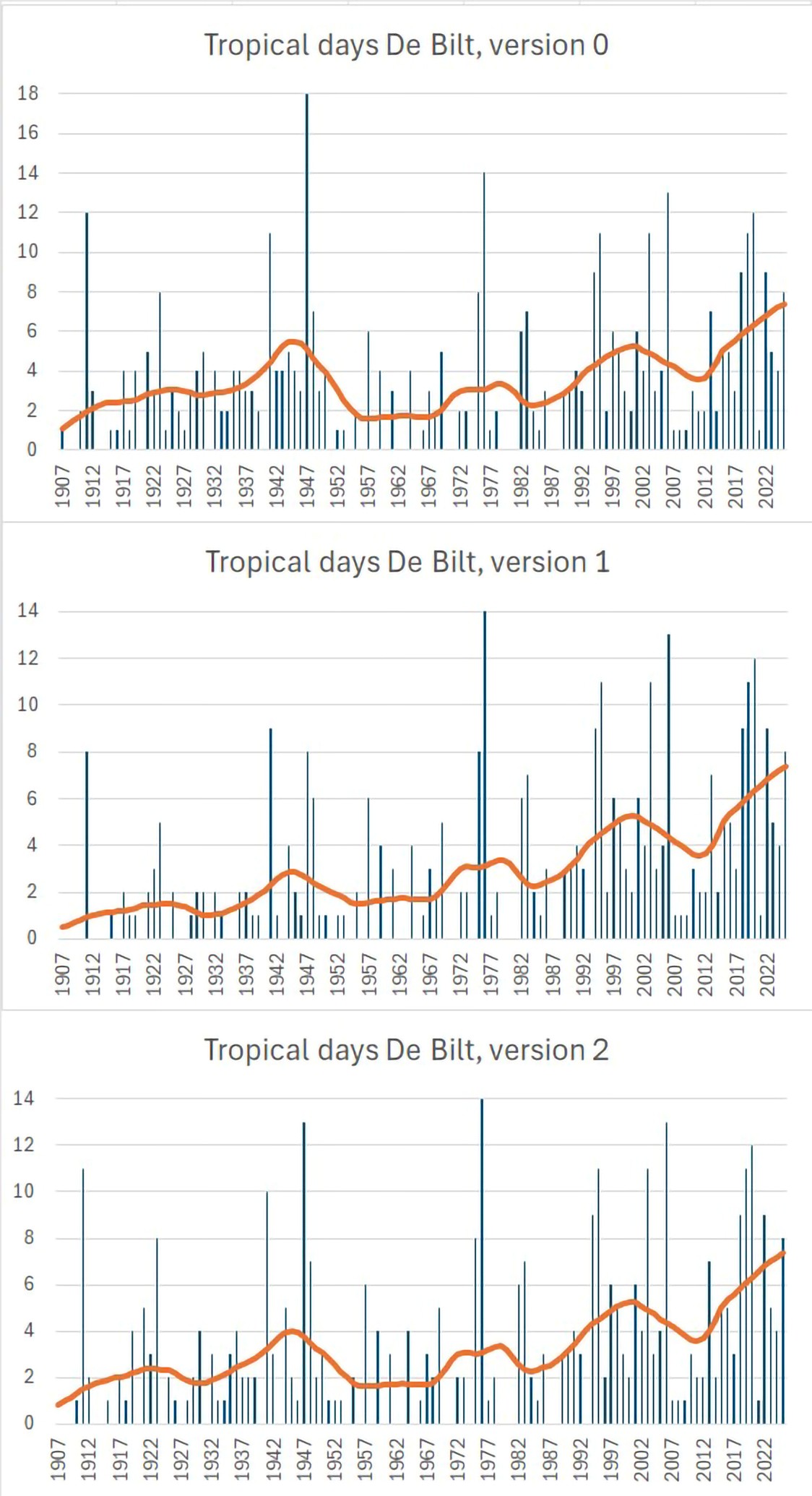
Tropical days at De Bilt, version 0, 1 and 2 (staves) with non-linear trendline (orange solid line).
The trendline was calculated by the LOESS-function with span=20 points.
The long-term temperature trend in the Netherlands is clearly upward, particularly since the 1990s, though a comparable peak occurred in the 1940s. As demonstrated in our peer-reviewed paper with Jos de Laat (who is affiliated with KNMI), Dutch temperatures exhibited a stepwise increase starting in the late 1980s. Furthermore, a compelling study by two Dutch mathematicians — a father-and-son team — argues that changes in atmospheric circulation patterns, rather than CO₂, are the primary driver of temperature variations in the Netherlands. The findings of that paper may well become the focus of the next debate with KNMI.


Marcel Crok
Marcel Crok is a Dutch science journalist who has been writing full-time about the climate debate and climate policy since an award winning article about the notorious hockey stick graph in 2005. He published two books in Dutch (De Staat van het Klimaat (The State of the Climate) and was co-author of the book Ecomodernisme (Ecomodernism)). With the British independent researcher Nic Lewis he wrote an extensive report about climate sensitivity, titled A Sensitive Matter. He was asked by the Dutch government to become expert reviewer of the IPCC AR5 report. Together with the Dutch climate institutes KNMI and PBL, Crok set up an international discussion platform Climate Dialogue.
In 2019, Crok and emeritus professor Guus Berkhout founded the Clintel Foundation. They published the World Climate Declaration, which has now been signed by over 2000 scientists and experts. Together with Andy May and a team of scientists from the Clintel network, Crok contributed to and edited the book The Frozen Climate Views of the IPCC.

more news

Agriculture is a big player in the global carbon cycle
A new study highlights the overlooked role of cultivated plants in the global carbon cycle, showing that agriculture makes a major contribution to CO₂ absorption.

Offshore Wind’s Epic Fail
Feds pull plug on Revolution Wind amid security fears.

INTERVIEW. Dr. Judith Curry on Global Warming: Where Is the Danger?
Renowned climatologist Dr. Judith Curry says it is very tough to make the case of warming becoming dangerous.

