
Ed Miliband is the last fool standing on Net Zero
As the United States moves to reconsider key climate regulations, Britain’s aggressive push toward Net Zero is drawing increasing scrutiny. In this commentary, Matt Ridley argues that unilateral decarbonisation risks leaving the UK economically isolated while much of the world shifts course.

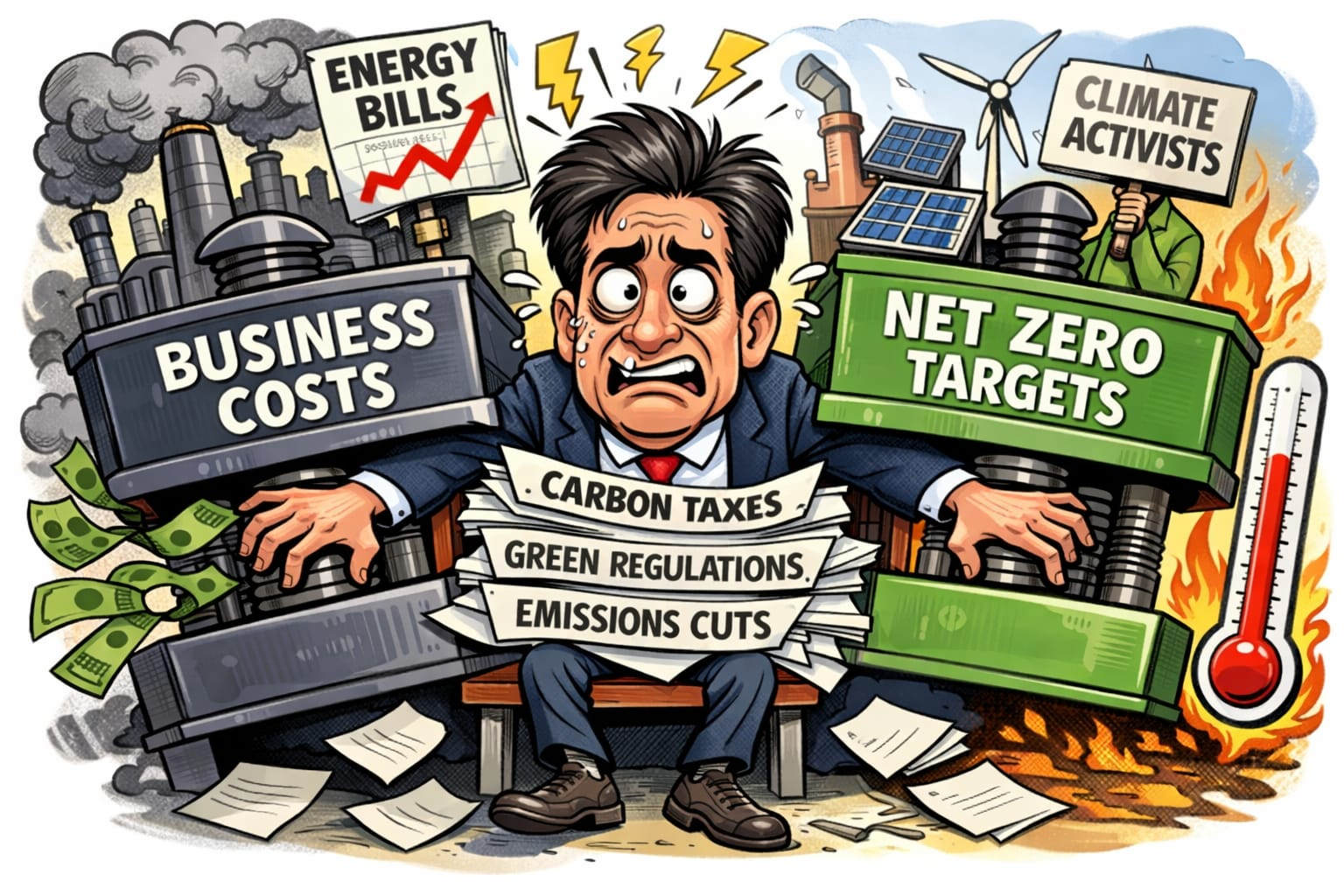
(Image created by ChatGPT)
Matt Ridley
Date: 20 February 2026
So Donald Trump plans to reverse the ‘endangerment finding’ that underpins most climate-related regulation in America. This is further proof that Britain is being increasingly left behind by a global rush to dismantle the climate scare. Ed Miliband is now almost alone in accelerating towards decarbonisation. Even if you think he is brave to jump out of the trench and go over the top, you have to admit it makes no sense to go alone.
Step outside Britain and you realise just how isolated we are becoming on climate policy. America is abandoning most of its climate change subsidies and rules. Stellantis, formerly known as Chrysler, is the latest car manufacturer to take a massive write-down as it backs out of trying to switch to electric cars. The AI industry is embracing gas-fired power to quench its insatiable thirst for electricity. The oil industry is abandoning renewables. The finance industry has disbanded many of its climate initiatives. Even the Democrat party has stopped talking about climate. China and India are building coal plants galore. Europe is watering down its climate targets.
We are soon going to be the only soldier still charging across no-man’s land towards the enemy. Everyone else is safely back in the trench. To put it another way, the effects of carbon dioxide on the world are going to happen anyway so we would be better off adapting to them than trying to reduce our own contribution. About 99.2 per cent of global emissions originate outside Britain, so what we do here has almost no effect.
For years, people like me were told that we did not understand. Britain was setting an example to the world, you see. We had a duty to lead and if we got to net zero first we would reap rich rewards selling the dream to those who followed. Instead we find ourselves dependent on imported gas and oil and relying on unreliable wind and solar power. We are thus saddled with stratospherically high electricity prices, ensuring that we will largely miss out on the real economic opportunities of the late 2020s: in artificial intelligence.
In seeking to persuade us that carbon dioxide was a danger, Britain cooked the scientific books. The technical term for the net harm done by carbon dioxide is the “social cost of carbon”. But if you look up the Government’s position, it says “carbon valuation for policy appraisal no longer uses the social cost of carbon”. The reason for this is that however hard they tried, economists could not make the social cost of carbon greater than the social cost of decarbonisation. So instead, they just decided to cut emissions at any cost.
Likewise, the endangerment finding was a politically motivated action by the Environmental Protection Agency under Barack Obama. The Supreme Court ruled that the EPA could consider carbon dioxide under the Clean Air Act. This gave it the green light to deem carbon dioxide a danger to public health – despite CO2 being an odourless, invisible, non-toxic plant food produced by human lungs at far higher concentrations than found in normal air. If it’s a danger, then so is dihydrogen monoxide, which regularly kills people (i.e., H2O).
Scientifically, the only justification for the endangerment finding was that a child in Chad, say, might die of heat stroke in 50 years’ time as a result of carbon dioxide-induced global warming. But that makes no sense when we know that the same child might not die of starvation today as a result of carbon dioxide-induced global greening – an effect that has increased crop yields and goat fodder by roughly 15-20 per cent in 40 years.
Mr Miliband take note: unilateral economic disarmament never makes sense.

This article by Matt Ridley was first published on February 12th in The Telegraph.
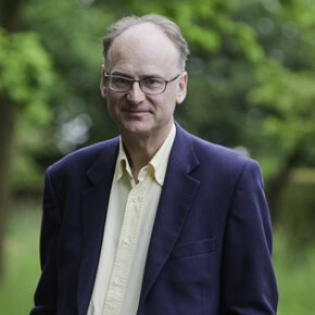
Matt Ridley (photo: Peter Walton)
Matt Ridley
Matt Ridley (1958), 5th Viscount Ridley, is a British science writer, journalist and businessman. With BA and DPhil degrees from Oxford University, Matt Ridley worked for the Economist for nine years as science editor, Washington correspondent and American editor, before becoming a self-employed writer and businessman based in Newcastle.
His books, like The Rational Optimist and The Evolution of Everything, have sold nearly two million copies, been translated into 31 languages and won several awards.
He has been a weekly columnist for the Telegraph, The Times (London) and the Wall Street Journal. He writes regularly in The Spectator, The Telegraph, the Daily Mail, Spiked and other publications. His TED talk ‘When Ideas Have Sex’ has been viewed more than two million times.
He served in the House of Lords from 2013 to 2021, sitting on the science and technology select committee and the artificial intelligence select committee.

more news
Glacier fluctuations don’t yet support recent anthropogenic warming
Holocene glacier records show that glaciers worldwide reached their greatest extent during the Little Ice Age and were generally smaller during earlier warm periods. While glacier length is a valuable long-term regional climate indicator, the evidence does not clearly support the idea of uniform, synchronous global warming.

Challenges to the CO2 Global Warming Hypothesis: (13) Global Warming Entirely from Declining Planetary Albedo
Is the recent warming the result of less reflection of sunlight by the Earth? Two researcher state that declining albedo — not CO₂ — dominates the temperature trend.
Guardian Claims We’re Still Only Approaching the Climate Point of No Return
The Guardian claims the world is edging toward a climate “point of no return,” where unstoppable warming will lock Earth into a catastrophic “hothouse” future. Yet the geological record tells a very different story. Past periods of far higher temperatures and CO₂ levels did not end life or civilization’s prospects — they supported abundance and evolutionary expansion.

