
Hiding the Pea, Revisited: Remove the Scenario, Keep the Result
What happens when the framework changes but the outcome stays the same? This article revisits a controversial glacier loss study to explore exactly that question.


A recent Nature Climate Change paper titled “Peak glacier extinction in the mid-twenty-first century” presents itself as a careful, policy-relevant analysis of global glacier loss under a range of future warming levels. Rather than framing its projections around emissions pathways, the authors organize their results around four temperature outcomes by 2100: +1.5 °C, +2.0 °C, +2.7 °C, and +4.0 °C. This choice lends the paper a contemporary appearance, suggesting a move beyond the controversies that surrounded earlier scenario-based impact studies.
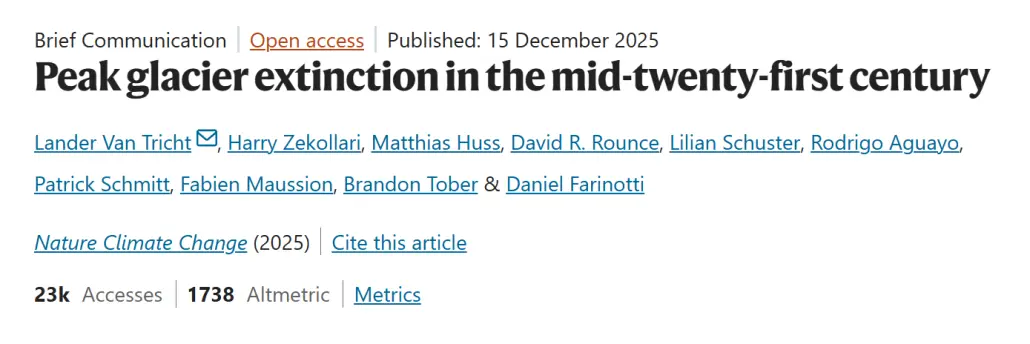
It is important to state clearly at the outset: the paper does not explicitly claim to avoid or correct for RCP 8.5. It does not present itself as a methodological advance over earlier work on those grounds, nor does it acknowledge the debates surrounding the plausibility of that scenario. RCP 8.5 simply does not appear by name.
That silence, however, is precisely what makes the paper instructive. While the scenario label has been removed, the high-end assumptions once associated with RCP 8.5 quietly re-enter the analysis under a different framework. The paper’s most dramatic conclusions—those concerning peak glacier extinction rates approaching 4,000 glaciers per year and near-complete loss by century’s end—are driven largely by a +4.0 °C warming case constructed from SSP5-8.5 and SSP3-7.0 simulations. The result is familiar: the scenario is gone, but the signal remains.
This approach will be instantly recognizable to anyone who followed the paleoclimate proxy reconstruction debates of the past two decades. Steve McIntyre, writing at ClimateAudit.org, documented a recurring procedural pattern. When a particular proxy series was shown to be flawed—often because it was inverted, truncated, obsolete, or otherwise methodologically indefensible—it would be removed. The authors would then announce that the reconstruction was “robust,” because the overall result did not change. What was rarely emphasized was that another proxy, carrying essentially the same statistical signal, had been quietly introduced to take its place.
The pea had not been removed. It had been moved.
The glacier paper follows this same structural logic, translated from proxy networks to scenario construction.
RCP 8.5 has become politically and rhetorically inconvenient. Its assumptions about long-term coal use, population growth, and emissions intensity no longer track well with observed energy trends, and its continued use has attracted criticism even within mainstream climate research. Rather than engaging those criticisms directly, the paper sidesteps them. The RCP framework disappears. SSPs take its place. The analysis is reframed around temperature end-states, severing the connection between projected impacts and the socioeconomic assumptions required to produce them.
The effect is subtle but consequential. By focusing on warming levels rather than pathways, the paper treats a +4.0 °C world as a policy-relevant comparator rather than as an extreme conditional outcome. Nowhere does it ask whether such a trajectory remains consistent with observed electricity generation trends, fuel substitution rates, or historical declines in energy intensity. The scenario exists because the model ensemble allows it to exist, not because the real world is demonstrably moving in that direction.
At this point, a reminder is useful: the issue is not what the authors claim, but what the results depend on.
The paper’s most emotionally potent comparisons—such as equating peak extinction rates to “losing the entire glacier population of the European Alps in just one year”—derive their force almost entirely from the high-end warming case. Under +1.5 °C, the projected peak loss rate is roughly half that value; under +2.7 °C it is intermediate. The wide spread between these outcomes should invite skepticism about policy inference, yet the paper treats the upper bound as a meaningful guide to decision-making.
This is especially striking given the authors’ own admissions about metric fragility. Glacier “extinction” is defined not by physical disappearance in any hydrological sense, but by an area threshold of 0.01 km² or a volume drop below 1 percent of the initial value. The paper acknowledges that glacier number is highly sensitive to inventory resolution, classification choices, and the treatment of small ice bodies, and that it should be interpreted with more caution than mass or area. These caveats are technically correct—and then largely set aside.
What follows is a pivot from conditional modeling to normative language. The authors conclude that their results “underscore the urgency of ambitious climate policy” and that the difference between losing 2,000 versus 4,000 glaciers per year by mid-century is “determined by near-term policies and societal decisions taken today.” This is not merely descriptive. It is prescriptive, and it rests squarely on the same high-end assumptions that have been relabeled rather than interrogated.
This illustrates a methodological culture that treats contested assumptions as interchangeable components so long as the preferred outcome survives. The glacier models are internally consistent. The statistics are competently executed. But the stability of the headline result under substitution is treated as validation, when it should instead prompt the same question McIntyre asked repeatedly in a different context: robust with respect to what, exactly?
In the proxy debates, robustness often meant that removing one criticized series changed nothing because another, functionally similar series had taken its place. In this case, robustness means that removing a discredited scenario label changes nothing because its high-end assumptions reappear under a new framework. The logic is the same. Only the objects have changed.
The pea, once again, has not disappeared. It has simply been moved.
And as before, the audience is invited to admire the steadiness of the result rather than to examine how carefully the cups have been arranged.


more news

The EU’s Nuclear Phase-Out Was a Blunder
Following Friedrich Merz in January, Ursula von der Leyen has now also admitted that the phase-out of nuclear energy was a major ‘strategic mistake’, not only for Germany but for the EU as well. American researcher Roger Pielke Jr. uses some simple calculations to demonstrate the magnitude of the EU’s strategic blunder.

Paul Ehrlich (1932-2026): Farewell to the Long-Lived Failed Prophet of Miserablism – The Population Bomb author lived a long, wealthy, healthy life, an opportunity his work denied to countless others
Paul Ehrlich, author of The Population Bomb, became one of the most influential voices behind modern environmental pessimism. His warnings of inevitable resource depletion and societal collapse shaped decades of policy and public thinking. Yet, as history unfolded, many of his most prominent predictions failed to materialize—raising enduring questions about the consequences of alarmist narratives in science and policy.

US Energy Realism Pays Off in Iran Crisis
The stark contrast between American resilience and European collapse is a permanent lesson. National security should not be subject to the whims of the weather or the approval of climate activists in European capitals.

