
Houston lecture by Guus Berkhout: let the data speak
Guus Berkhout, president of Clintel, recorded a speech for the 2025 GSH spring symposium, that was held in Houston on March 5 and 6 2025. His talk was shown on March 6. As the title of his speech – let the data speak – suggests, Berkhout is favouring an approach for climate science in which measurements take a leading role and climate modelling a much smaller role.
The full – even somewhat extended – speech of Berkhout is available in written format here. One important message of Berkhout is that in the climate debate we focus too much on a simplified indicator for global warming, the iconic global average surface temperature. By showing this one-dimensional picture of the evolving climate, we forget to look at all the data and what we can learn from that.
The alarmistic discussions on climate warming are primarily based on a time function only, meaning that the complex 4D image is simplified to a simple 1D picture: From T(x,y,z,t) to T(t), see Figure 8. Mainstream scientists explain this simple 1D temperature picture by the single factor CO2. A simple narrative can be very appealing indeed. Philosopher Ockham already wrote in the 14th century “The simplest explanation is the best.” Ockham meant with this statement that if you have the luxury to choose from different models that all can explain the observations well, choose the one with the least assumptions. In the 20th century Einstein formulated it as follows: “Everything should be made as simple as possible, but not simpler.” In the past decennia we have seen that a single-factor climate model is too simple to explain the real climate world. Why do academies of sciences keep quiet?
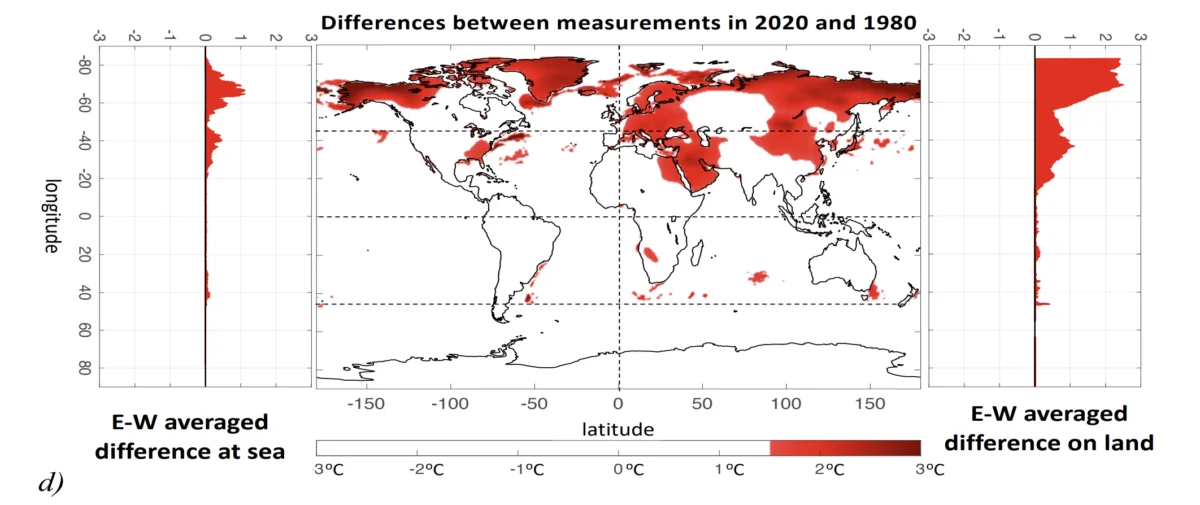
In his figure 7d Berkhout how much more you learn when you show and use all the data. Here in red you see those areas that warmed up more than 1.5 degrees Celsius between 1980 and 2020. Clearly we are not looking at global warming but mainly at warming on the Northern Hemisphere and especially on land and at high latitudes.
Guus Berkhout had a long career in geophysics, a field in which imaging techniques play a crucial role. He strongly believes that progress in climate science also should come from climate imaging and he encourages his colleages from the geophysics community to join his efforts.
The full written version of the speech is here. If you would like to contact Guus Berkhout: guus.berkhout@clintel.org
If you are interested in the World Climate Declaration, you can find it here. If you would like to sign the Declaration go here.
Clintel is an independent foundation, receiving support from citizens and SME’s around the world. If you would like to support us, go here. Clintel is a 501(c)3 in the US.


more news

The Strait of Hormuz Crisis Shows the World Still Runs on Fossil Fuels
The Strait of Hormuz, one of the world’s most critical energy chokepoints, highlights the continued global dependence on oil and gas. Recent geopolitical tensions have disrupted energy flows, exposing vulnerabilities in global supply chains and triggering emergency responses across Asia. Despite decades of rhetoric about an energy transition, fossil fuels remain indispensable for modern economies, not only for energy but also for agriculture, plastics and pharmaceuticals. The crisis underscores that energy systems are shaped by geography and economics, and that a full transition away from hydrocarbons will be far slower and more complex than often assumed.
The EU’s Nuclear Phase-Out Was a Blunder
Following Friedrich Merz in January, Ursula von der Leyen has now also admitted that the phase-out of nuclear energy was a major ‘strategic mistake’, not only for Germany but for the EU as well. American researcher Roger Pielke Jr. uses some simple calculations to demonstrate the magnitude of the EU’s strategic blunder.

Paul Ehrlich (1932-2026): Farewell to the Long-Lived Failed Prophet of Miserablism – The Population Bomb author lived a long, wealthy, healthy life, an opportunity his work denied to countless others
Paul Ehrlich, author of The Population Bomb, became one of the most influential voices behind modern environmental pessimism. His warnings of inevitable resource depletion and societal collapse shaped decades of policy and public thinking. Yet, as history unfolded, many of his most prominent predictions failed to materialize—raising enduring questions about the consequences of alarmist narratives in science and policy.

