
If fossil fuels come from fossils, why have scientists found them on one of Saturn’s moons?
They didn’t tell us, the term “fossil fuels” might be wrong too
Dr Willie Soon unleashes on the failures of climate change and modern science for 40 minutes with Tucker Carlson (see below). As an opening he explained how one of Saturn’s moons has more liquid fuel than than all the oil and gas deposits of Earth, which rather pokes a hole in the idea that fossil fuels are only ever made from fossils.

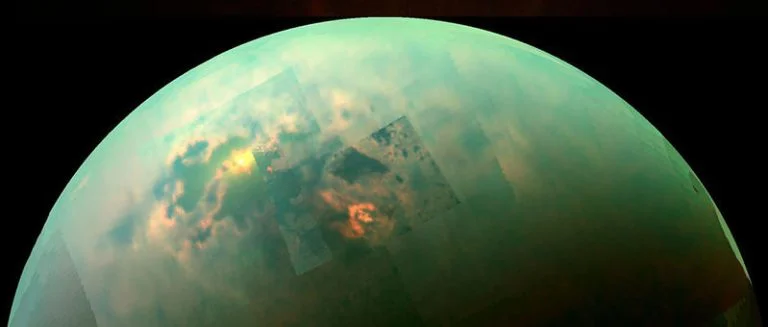
Essentially a frozen, lifeless moon with no dinosaurs, forests or peat bogs, somehow has lakes of methane. Not only does Titan have liquid seas of hydrocarbon fuel — but we’ve known this for years. In fact even in 2005 a NASA scientist quietly admitted that Titan had methane that wasn’t made from fossils. But where was NASA in the 18 years since?
Soon explains that Titan proves that abiotic oil and gas formation is true. In 2009 an experiment showed that when methane is put under great pressure like the kind we find 50-100 miles underground, it can form more complex hydrocarbons. (Kolesnikov). Several papers in the last dozen years find more exotic kinds of polycyclic aromatic hydrocarbons all over the place, like in Titan’s atmosphere and even forming in deep cold interstellar space. (Zhao, Parker, Freissinet) They also found benzene on Mars.
On his CERES sites, Willie Soon explains that in practical terms, we don’t know how much of the oil and gas on earth is made without fossils (in an abiogenic process). It could be forming 50 to 100 miles down, but we’re only drilling 6 to 8 miles deep. I seems we have little idea. Even if abiotic oil exists on Earth, it may form too slowly to be useful. Though there have been these odd claims out there for years that some oil fields are refilling.
What we do know, says Jo, is that they’re not trying to understand this, and they’re not trying to tell us the whole truth either. We’ve taught two generations of children that there is one simple narrative, and if you questioned it you were an idiot. Isn’t it time a civilization dependent on these fuels had an honest discussion about where they came from?
There’s a lot more in the interview about his experience at Harvard, and climate science and the sun.
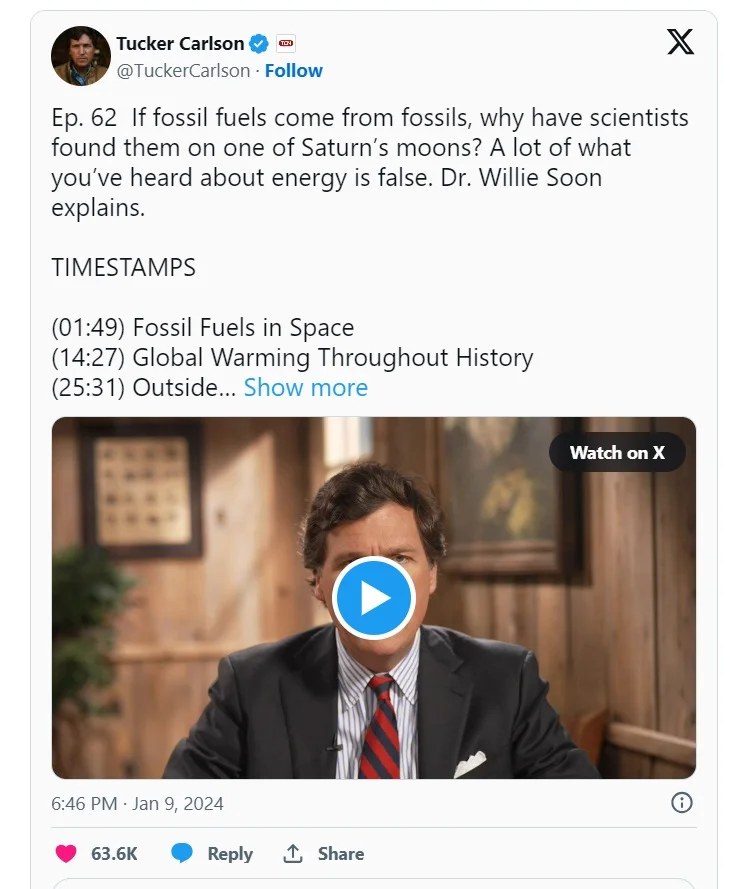
Willie Soon worked at Harvard in astrophysics for 31 years but prefers the freedom to say what he thinks and to research what he wants. He co-founded CERES-Science where you can find his other latest papers.
REFERENCES
Kolesnikov, A., Kutcherov, V. & Goncharov, A. Methane-derived hydrocarbons produced under upper-mantle conditions. Nature Geosci 2, 566–570 (2009). https://doi.org/10.1038/ngeo591
Mastrogiuseppe, M., Poggiali, V., Hayes, A.G. et al. Deep and methane-rich lakes on Titan. Nat Astron 3, 535–542 (2019). https://doi.org/10.1038/s41550-019-0714-2
Hayes, Alexander (2016) The Lakes and Seas of Titan, Annual Review of Earth and Planetary Sciences, Vol. 44:57-83 (Volume publication date June 2016)
Zhao, L., Kaiser, R.I., Xu, B. et al. Low-temperature formation of polycyclic aromatic hydrocarbons in Titan’s atmosphere. Nat Astron 2, 973–979 (2018). https://doi.org/10.1038/s41550-018-0585-y
C. Freissinet, et al (2015) Organic molecules in the Sheepbed Mudstone, Gale Crater, Mars, JGR Planets, AGU, https://doi.org/10.1002/2014JE004737
Dorian S. N. Parker and colleagues (2011), Proceedings of the National Academy of Sciences, https://doi.org/10.1073/pnas.11138271. [Link down, it may refer to this paper “Low temperature formation of naphthalene and its role in the synthesis of PAHs (Polycyclic Aromatic Hydrocarbons) in the interstellar medium”, https://doi.org/10.1073/pnas.1113827108]


more news

Met Office temperature measurements unreliable and systematically biased
The article below by Chris Morrison clearly demonstrates that the reliability of temperature measurements in the United Kingdom is seriously lacking. Based on detailed research, Dr Eric Huxter shows that a large share of recorded temperature spikes is not the result of natural variation, but of artificial influences at poorly located measurement stations. This raises fundamental questions about the quality of the underlying data used for climate reporting and policy decisions.
Australia wakes up to brown coal bonanza: 1,000 years of energy
Finally, we see a few key topics hitting the media in Australia, says Jo Nova. National Party leader Canavan even talks about the thousand-year supply of brown coal, and also about a method of turning coal to liquid fuel.

The Strait of Hormuz’s Bitter Lesson for the European Union
In May 2023, Ursula von der Leyen, President of the European Commission, declared that the fossil-fuel-based growth model is “simply obsolete.” The partial blockade of the Strait of Hormuz starkly exposes the irony of that statement, says Samuel Furfari.

