
Met Office temperature measurements unreliable and systematically biased
The article below by Chris Morrison clearly demonstrates that the reliability of temperature measurements in the United Kingdom is seriously lacking. Based on detailed research, Dr Eric Huxter shows that a large share of recorded temperature spikes is not the result of natural variation, but of artificial influences at poorly located measurement stations. This raises fundamental questions about the quality of the underlying data used for climate reporting and policy decisions.


Illustration created with ChatGPT
Chris Morrison
Date: 5 April 2026
Convincing statistical proof has emerged over the last year to show that the UK Met Office is inflating maximum temperature readings to create Net Zero-supporting climate alarm. Over the last 30 years, the Met Office has produced the vast majority of its data from unnaturally heat-ravaged ‘junk’ sites using newly-installed accurate electronic devices able to record one minute heat spikes. The independent researcher Dr Eric Huxter has taken a year to examine the unnatural sudden rises that supply many daily ‘records’, and compared the overall spike averages with a pristine CIMO Class 1 control station. He concludes that it “could well explain the step change in rate of temperature change, and the marked increase in the step of new daily maximum records since 1990”.
During his year-long project, Dr Huxter examined 340 daily maximum temperature highs recorded across 96 Met Office stations and discovered that these sites showed average short heat spikes around 1.1°C. Most of these spikes occurred around daily ‘records’ in junk CIMO Class 3, 4 and 5 locations. These sites have internationally recognised ‘uncertainties’ or possible errors of 1°C, 2°C and 5°C respectively. But spikes in temperature can occur naturally, so Huxter consulted a full year of individual minute temperature figures at a pristine Class 1 site in open farmland at Rothamsted. From the purchased records – a total of 525,541 – he was able to compile a baseline probability control.
Highly Significant Difference
Here is the kicker – comparing the Rothamsted control with the 360 heat spikes at the largely junk sites, a chi-square test showed a highly significant difference of p <0.0001. This means that if there were truly no difference between the sites, the chances of observing such a large discrepancy in heat spikes would be less than one in 10,000 – in other words, more unlikely than one in 10,000 and quite possibly far smaller – for example, one in 100,000.
Using such obviously flawed data, the Met Office’s Chief Scientist Professor Stephen Belcher calls for Net Zero to “stabilise the climate”, reporting that between 2014-2023 the number of days recording 28°C in the UK had more than doubled, while those over 30°C had tripled compared to 1961-1990. The BBC’s Chief Climate Headbanger Justin Rowlatt adds even more to the gaiety of the nation by reporting a Met Office claim that there has been a 40% increase in “pleasant days”, and these are defined as 20°C and above. “These changes may sound positive, but the UK’s shifting climate represents a dangerous upheaval for our ecosystems as well as our infrastructure”, he extrapolates.
Key Metric
The daily maximum high, along with the minimum low, is a key number in calculating average temperatures and is behind the Met Office’s ubiquitous claims of ‘hottest ever’ days. If the automated sensors, which move much quicker than the old liquid-in-glass thermometers, catch brief exaggerated spikes rather than true ambient air temperatures, then the outlier information will end up corrupting all the daily, monthly, annual and decadal averages. Eventually some of this information will end up in global datasets and will help exaggerate the rate of recent cyclical global warming.
Extreme examples of heat spikes are not uncommon. On May 1st last year, the Met Office claimed its station in Kew Gardens recorded a temperature at 2.59pm of 29.3°C. Promoted by the BBC, this was said to be the highest temperature ever recorded for this day in the UK. But the temperature was a massive 2.6°C higher than that recorded at 2pm and no less than 0.76°C above the figure recorded a minute later on the hour. Minute-by minute changes in temperature would not have been picked up in the past, and it is for that reason that the World Meteorological Organisation (WMO) recommends averaging electronic measurements over five minutes to standardise data and minimise short-term ‘noise’. For some inexplicable reason, despite playing a major part in WMO deliberations, the Met Office does not appear to want to follow this sensible scientific advice.
Minute-by-Minute Data Analysis
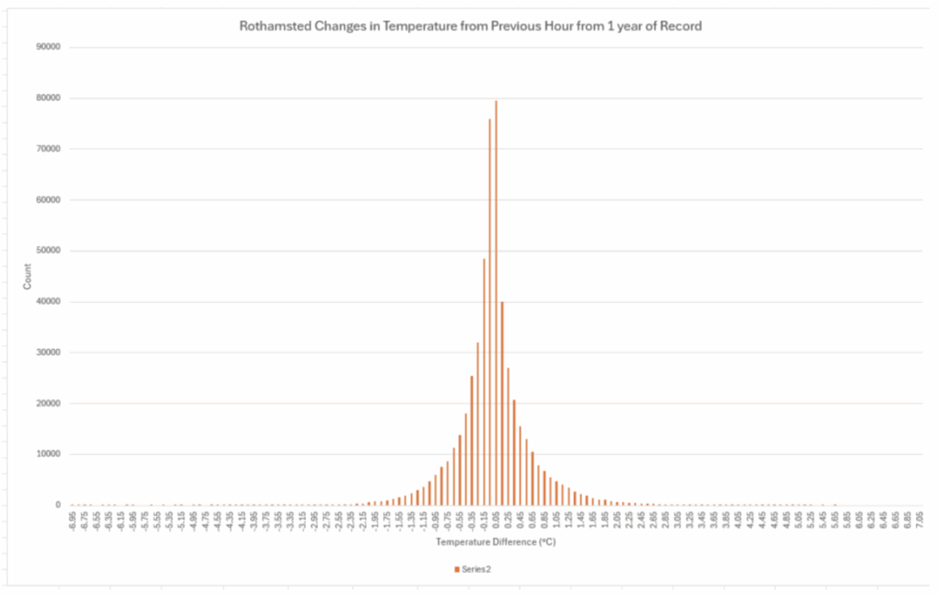
At the Rothamsted control site, the vast majority of the half a million readings vary minute-to-minute with individual differences in a range between –0.15 to 0.25°C. Most of the individual changes from the previous hour were to be found between –0.35°C and 0.45°C. As the graph below shows, the majority of the readings in this band showed considerably less divergence from the hourly recordings.
Contaminated Network
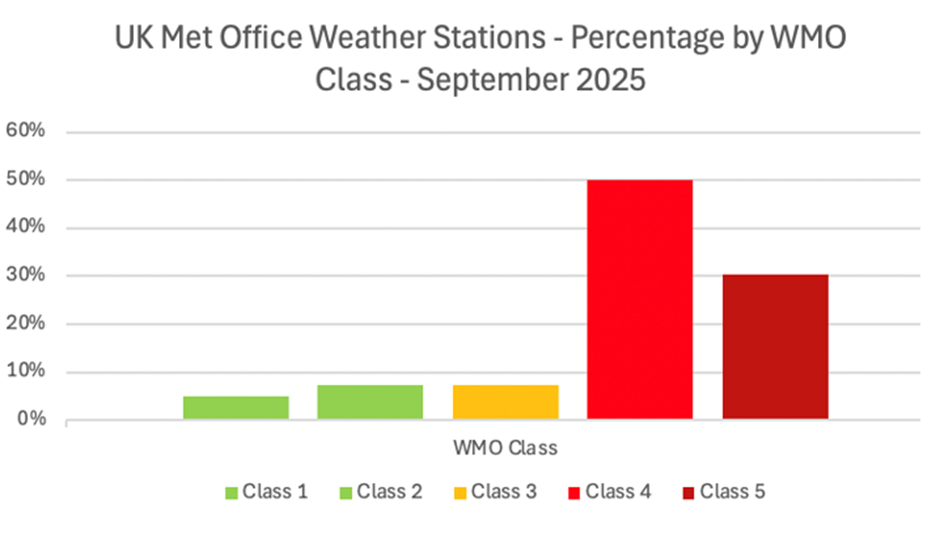
It is hardly a surprise that heat spikes blot the Met Office’s temperature collection programme throughout almost all its nationwide network. A recent Freedom of Information request by the Daily Sceptic revealed that Classes 4 and 5 have increased significantly over the last 18 months, and now total an appalling 80.6% of the entire network of nearly 400 stations. Pristine Class 1 sites such as Rothamsted with no uncertainties are just 4.9% of the total, and in the last 18 months they have fallen in number from 24 to 19.
But what is worse is that the Met Office does not appear to appreciate the scale of its problem, with higher class sites blighted by unnatural heat sources whether it be from jet aircraft, main roads, solar farms, electricity sub stations or tall glass-clad buildings. Little effort seems to have been made to improve matters. Over the last 18 months, 20 new sites appear to have been opened with an astonishing 67.7% starting life in the Class 4/5 junk lane. Why on earth would a reputable science body do that, some might ask. Conspiracy enthusiasts are unlikely to be short of uncomfortable suggestions.
Undermining Scientific Integrity
The importance of Huxter’s work in bringing clarity and reality to the Met Office temperature claims should not be underestimated. His work makes it crystal clear – the UK Met Office does not possess a nationwide temperature measuring network that is capable of determining daily, monthly or annual highs and averages to within one hundredth of a degree Centigrade. Neither should it be using these data for the temperature computer modelling it does at non-existent sites using ‘well-correlated neighbouring stations’. Much of its temperature measuring effort is corrupted by figures that give a fake reading of true ambient air temperature. It has allowed its network to become corrupted over the years with urban heat and it has failed to make allowances for changes in measuring devices. Activists at the organisation should stop weaponising all these dodgy data for political Net Zero purposes, or the good name of the Met Office, built up over decades since Victorian times, runs the risk of becoming severely tarnished.

The original article, titled “Researcher Finds Proof The Met Office is Inflating UK Maximum Temperature Records“ by Chris Morrison, was published on March 29 on dailysceptic.org. Our editorial team has modified the title and added subheadings.

Chris Morrison
Chris Morrison is a former financial journalist and publisher. He is the Environment Editor at Daily Sceptic. Follow Chris on X.

more news

Ed Miliband is the last fool standing on Net Zero
As the United States moves to reconsider key climate regulations, Britain’s aggressive push toward Net Zero is drawing increasing scrutiny. In this commentary, Matt Ridley argues that unilateral decarbonisation risks leaving the UK economically isolated while much of the world shifts course.

Climate change computer projections are manifestly false and dangerously misleading
The alleged threat to the planet from human caused climate change has been at the forefront of Australian politics over the recent half century. Every year, just before meetings of the UN Conference of the Parties (COP) to the Climate Change Convention, slight increases in atmospheric carbon dioxide and global temperature are portrayed in the media as harbingers of future doom. Every extreme weather event is made out to be an ill omen of what is to come unless fossil fuels are eliminated.

Glacier fluctuations don’t yet support recent anthropogenic warming
Holocene glacier records show that glaciers worldwide reached their greatest extent during the Little Ice Age and were generally smaller during earlier warm periods. While glacier length is a valuable long-term regional climate indicator, the evidence does not clearly support the idea of uniform, synchronous global warming.

