
Meteorologist Dr. Ryan Maue Warns “Germany Won’t Make It” If Winter Turns Severe
Meteorologist Dr. Ryan Maue warns at X that if the winter of 1962-1963 happened again with today’s Europeean energy system, then “Germany won’t make it”. The country has “exceptional energy shortfalls.”
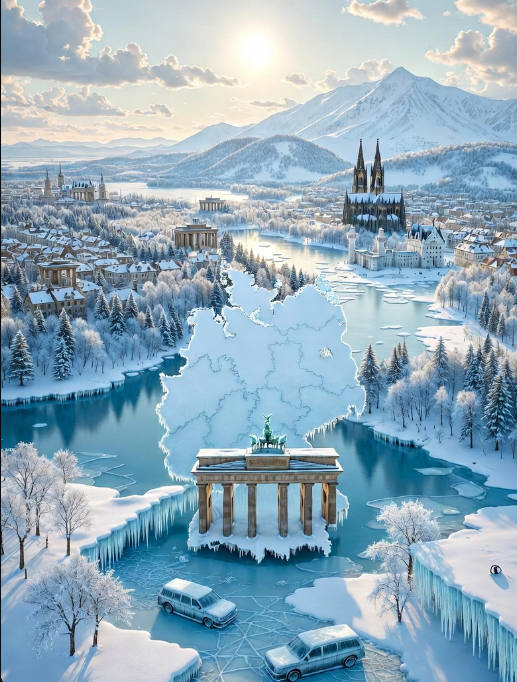
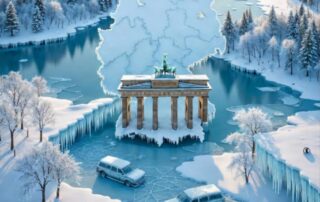
Image generated by Grok AI
P Gosselin
Date: 26 December 2025
And, suddenly, the weather models are hinting at severe winter conditions across Europe for early January.
Maue’s claim leans on a paper titled: “On the Link Between Weather Regimes and Energy Shortfall During Winter for 28 European Countries,” published in Meteorological Applications (2025) by Emmanuel Rouges, Marlene Kretschmer, and Theodore G. Shepherd. The authors examine how specific atmospheric patterns affect the balance between energy demand and renewable energy production across Europe.
Update: so what would happen with today’s Europeean energy system if the Winter of 1962-1963 happened again?
Not good! Germany 🇩🇪 won’t make it … exceptional energy shortfalls https://t.co/xh1jb13TJo https://t.co/X3EHlDqwTC pic.twitter.com/zheCnTaZlk
— Ryan Maue (@RyanMaue) December 25, 2025
The study focuses on energy shortfall, defined as periods when electricity demand significantly exceeds renewable energy production (specifically wind and solar). It analyzes 28 European countries using a “fixed electricity system” model (based on current infrastructure) and historical weather data (reanalysis) to see how past weather would affect today’s grid.
The researchers found that the primary driver of shortfall varies by region. In cold-climate, low-windd capacity countries, a shortfall is primarily demand-driven (e.g., increased heating needs during cold snaps).
In warm climate, high wind capacity countries, a shortfall is primarily production-driven (e.g., periods of low wind speed or “Dunkelflaute”).
The study categorized winter weather into six specific “regimes.” Only a subset of these—primarily those involving atmospheric blocking (which brings cold, still air)—are responsible for the majority of high-shortfall days. These critical weather regimes often affect large portions of the continent simultaneously, meaning many European countries experience energy stress at the same time.
There is a high level of spatial correlation in energy shortfalls. If one country is experiencing a shortfall, its neighbors are highly likely to be in the same situation. This highlights a potential challenge for “sharing” energy across borders during extreme weather events, as many potential exporters might also be facing deficits.
The authors simulated what would happen if the 1962/1963 winter (the coldest of the 20th century in Europe) occurred with today’s energy system. They concluded that the persistent blocking conditions of that winter would lead to extreme and prolonged energy shortfalls across almost all of Europe, far exceeding the stress seen in more recent decades.
The paper emphasizes that as Europe transitions to renewable energy, understanding the meteorological drivers of shortfall is critical. It suggests that energy planners must account for the fact that extreme weather events can cause simultaneous, continent-wide energy crises that current interconnected grids may struggle to mitigate through simple cross-border trading.
Merry Christmas everyone, stay warm!
more news
Hiding the Pea, Revisited: Remove the Scenario, Keep the Result
What happens when the framework changes but the outcome stays the same? This article revisits a controversial glacier loss study to explore exactly that question.
Energy Transition Meltdown Could Mean Global Bifurcation
According to Vijay Jayaraj, 2025 may be remembered as the year the energy transition narrative cracked, exposing a widening divide between ideology-driven policy and energy realism.
Meteorologist Dr. Ryan Maue Warns “Germany Won’t Make It” If Winter Turns Severe
Meteorologist Dr. Ryan Maue warns at X that if the winter of 1962-1963 happened again with today’s Europeean energy system, then “Germany won’t make it”. The country has “exceptional energy shortfalls.”

