
New Ice Core Study Finds No Clear CO₂–Temperature Link
New research from ancient Antarctic ice cores is challenging long-held assumptions about the role of carbon dioxide in Earth’s climate history. Evidence suggests that CO2 and methane levels remained remarkably stable over millions of years—even as the planet experienced dramatic temperature shifts. These findings raise fresh questions about the extent to which greenhouse gases alone can explain past and present climate change.

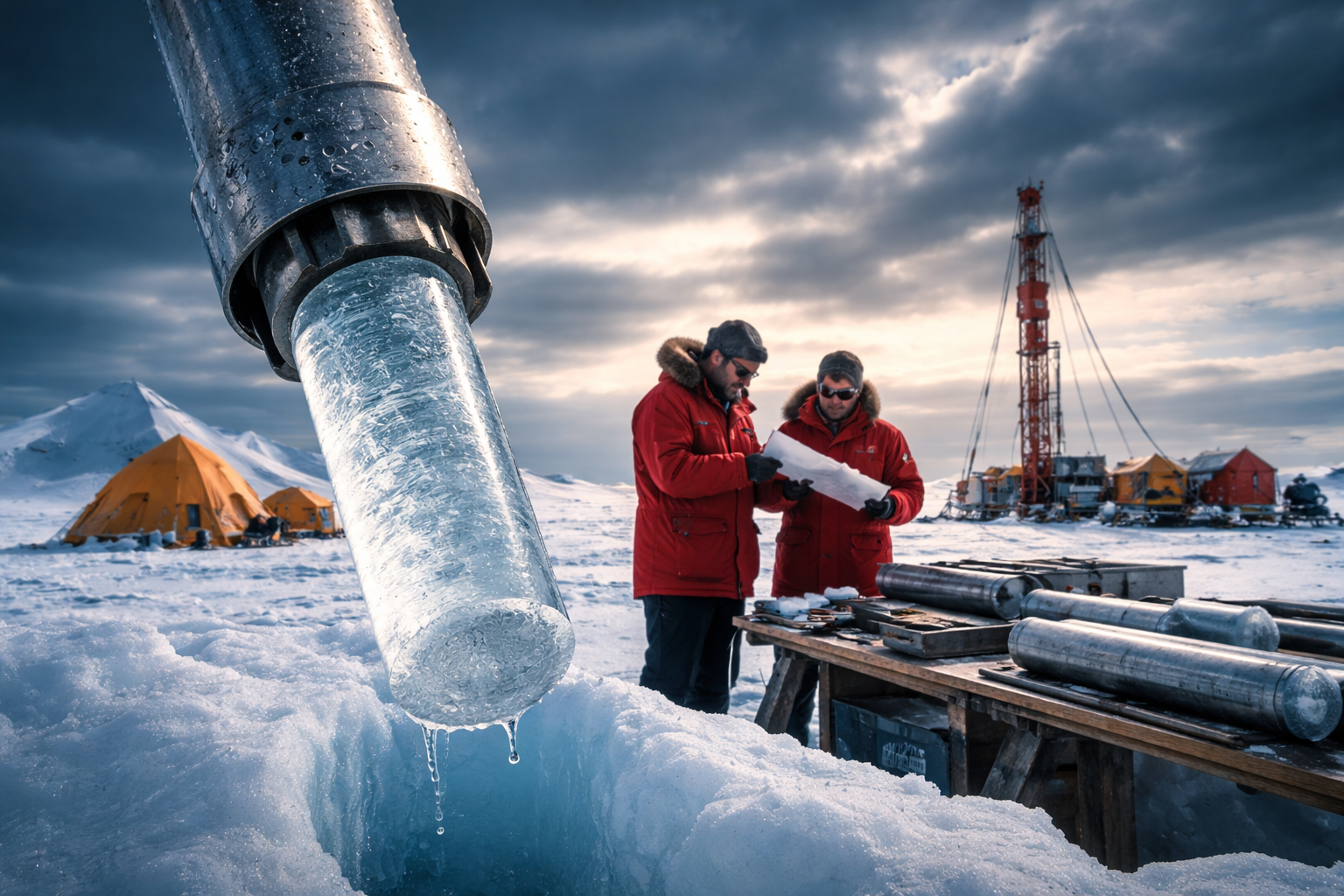
Source: ChatGPT
Chris Morrison
Date: 27 March 2026
The climate science world (‘settled’ division) is in shock following the discovery in ancient ice cores that levels of carbon dioxide remained stable as the world plunged into an ice age around 2.7 million years ago. Levels of CO2 at around 250 parts per million (ppm) were said to be lower than often assumed with just a 20 ppm movement recorded for the following near three million-year period. In addition, no changes in methane levels were seen in the entire period. Massive decreases in temperature with occasional interglacial rises appear to have occurred without troubling ‘greenhouse’ gas levels, and this revelation has caused near panic in activist circles.
New ice core evidence challenges prevailing assumptions
The assumed level three million years ago of CO2 was around 400 ppm, a convenient mark that has been used to explain the subsequent ice age and a drop to 250 ppm. Due to the recently published paper, this explanation has become more problematic and natural climate variation is correctly noted to have occurred with the temperature changes. Alas, similar explanations are mostly ignored in discussing today’s climate changes in the interests of promoting the Net Zero fantasy. Some cling desperately to a dominant CO2 role, including one of the authors of the findings published in Nature. The co-author states that the results suggest even greater climate sensitivity to the warming effect of CO2. In short, there is a great deal of applying the laws of physics and chemistry to one era, but failing to extend the same courtesy to another.
Natural variability remains underplayed in the debate
The title of the paper, produced by 17 America-based scientists, was enough to set alarm bells ringing in the ‘settled’ science, Net Zero-obsessed community: ‘Broadly stable atmospheric CO2 and CH4 levels over the past three million years.’ A related paper examining ocean heat content derived from the ice core record was also published. Carrie Lear, Professor of Past Climates and Earth System Changes at Cardiff University, claimed that the papers “don’t rewrite the role of CO2, they underline how sensitive the climate system is… that is why today’s rapid CO2 rise is so alarming”.
Ah, yes. Even if CO2 movements are minimal, probably within a margin of potential error, they are still responsible for large variations in temperature. The laws of climate science are ‘settled’ – if the trace atmospheric gas CO2 is rising, falling or generally stable, it is almost wholly responsible for large movements in global temperature. Under this rather shaky assumption, humans must stop burning hydrocarbons and return to a neo-Malthusian pre-industrial age.
The dominant role of CO₂ questioned
Study lead author Julia Marks-Peterson noted: “We definitely were a bit surprised. If correct, the findings may suggest that even small changes in greenhouse gas levels could trigger major shifts in climate.” That’s a little bit of a scary thought, she added, possibly with an eye on future grant funding. “May suggest” is doing a lot of the work here, and it may also be suggested that more plausible opinions are available.
Quoted in New Scientist magazine, Tim Naish, Professor of Earth Science at Victoria University in New Zealand, said it was “way too early to thrown the baby out with the bathwater”. Perish the thought that baby should be given its marching orders, ending a science-lite 40-year demonisation of CO2 and related promotion of a hard-Left Net Zero dream.
New data extends the climate record further back
The latest Nature-published research gives a snapshot from ancient Antarctica ‘blue’ ice drilled in the Allan Hills area. It looks back further in time past the usual 800,000 ice core records. The key finding is that over the last three million years, when sea levels fell and ice periods intensified, the level of the main ‘greenhouse’ gases remained remarkably stable. For the first time, the work has pushed the direct gas measurements back into the late Pliocene era. Over the last three million years moving into the Pleistocene, global temperatures showed a long-term cooling trend of several degrees Celsius, interrupted by increasingly large interglacial oscillations. Interglacial temperature swings, as in the current Holocene, often see temperatures rise by 5°C and more.
Critics seeking to downplay ice core evidence often suggest it is too imprecise to provide a wholly accurate record of gas levels and temperature. But it is accurate enough to give a broad cyclical insight. It remains the source of some of the best data we have on the past climate. It is undoubtedly more accurate than most proxy evidence from millions of years ago. But whatever the evidence used, it is hard to detect any obvious and continuous link between CO2 and temperature across the entire geological record going back 600 million years to the start of abundant life on Earth. Certainly none to justify the political notion that humans control the climate thermostat by burning hydrocarbons.
No clear link across the geological record
In fact the evidence is so slim that Les Hatton, Emeritus Professor in Computer Science at Kingston University, was recently able to determine from ice core records that 100-year rises of 1.1°C in the current interglacial, which started 20,000 years ago, have occurred in one in six centuries. Going back 150,000 years, the frequency was around one in six to one in 20 centuries. None of these findings suggest that current warming is either unusual or primarily caused by human activity. Needless to say, none of these findings trouble the headline writers in narrative-addicted mainstream media.


Chris Morrison
Chris Morrison is former financial journalist and publisher. He is Environment Editor of the Daily Sceptic, where this article was published on 25 March 2026. Follow Chris on X.

more news
Is Modern Warming Unprecedented? A Critical Look at Holocene Temperature Evidence
Claims that today’s Arctic or global temperatures are unprecedented in the Holocene are still widely repeated in scientific literature. In this article, Andy May examines temperature proxy records and shows that both the magnitude and the rate of warming during the Holocene have been misrepresented.

The Polar Bear Narrative: What Scientists Knew Before Frozen Planet Aired
In 2011, BBC viewers were told that polar bears in the Barents Sea were starving due to climate-driven sea ice loss. Later scientific evidence shows that this portrayal was inconsistent with data already available at the time.
Why Is the Southern Ocean Cooling? Three New Scientific Explanations Challenge Climate Models
Surface temperatures in the Southern Ocean around Antarctica have cooled for decades, defying the projections of leading climate models and puzzling researchers worldwide. In this article, physicist Ralph B. Alexander examines three recent studies that propose strikingly different explanations for this unexpected climate anomaly.

