
Offshore wind turbines steal each other’s wind: yields greatly overestimated
The energy yields of offshore wind turbines are overestimated by up to 50% in national policy documents. This conclusion is based on an analysis of operational data from 72 wind farms.

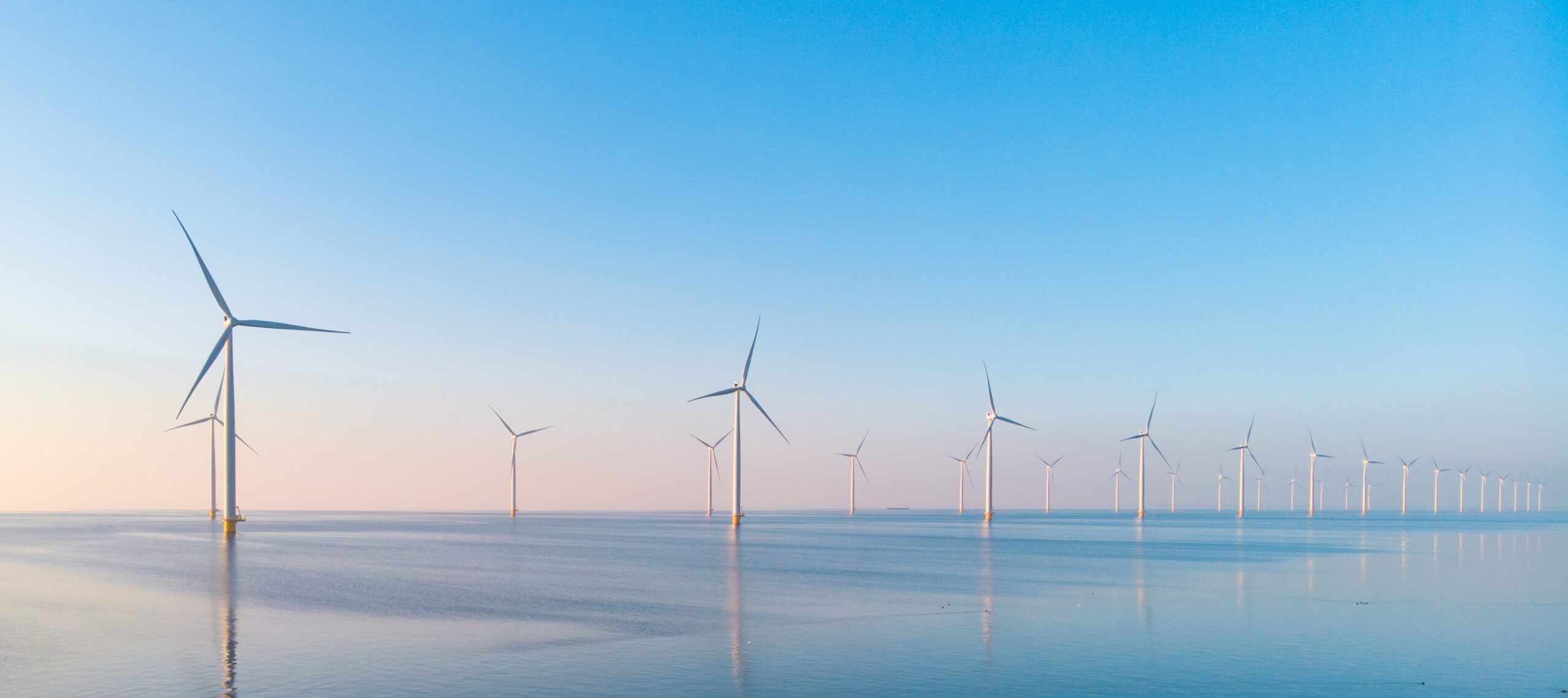
Windpark The Netherlands (Source: Shutterstock)
Bert Weteringe
Date: 30 December 2025
In order to meet the net-zero targets set out in the European Green Deal, offshore wind turbines will have to make a significant contribution to Europe’s future energy supply – at least, that is the plan of European governments. However, these plans are facing setbacks due to high investment costs and uncertainty about returns, as demand is lower than expected. On October 30, outgoing Minister Hermans of the Dutch Ministry of Climate & Green Growth (KGG) announced in a letter to the House of Representatives that no applications for a permit had been received for the tender for the Nederwiek I-A wind farm, which has an installed capacity of 1–1.15 gigawatts. This is a trend that is not limited to the Netherlands. In August, for example, there were no bids for the ten gigawatts of tenders that the German government had put out for offshore wind projects. On top of that, there is now another setback: the energy yields of offshore wind turbines appear to be much lower than assumed in most national policy plans.
“National policy targets show expectations of energy production up to 50% higher than can realistically be achieved”, concludes Carlos Simao Ferreira, professor of Wind Energy Science at Delft University of Technology. He published, together with Danish colleagues Gunner Chr. Larsen and Jens Nørkær Sørensen from the Technical University of Denmark (DTU), an article in the latest journal Cell Reports Sustainability, on November 21. “This study establishes a physically grounded upper limit on wind farm performance, demonstrating that aerodynamic constraints impose a fundamental ceiling on the energy extractable from the marine Atmospheric Boundary Layer”, the scientists continue.
According to the article, the ever-growing wind farms, which are also becoming increasingly denser, extract energy from the lower part of the atmospheric boundary layer, affecting this boundary layer up to several kilometres above the Earth’s surface. The energy extracted from the airflow must be replenished from the higher layers of the atmosphere, but this is only possible to a limited extent due to atmospheric limitations determined by physical principles known from meteorology and geophysics. This means that wind turbines literally steal each other’s wind, which means that the efficiency of wind turbines will decrease even further as their number increases. The scientists demonstrate this with a validated analytical model that defines the physical upper limit of offshore wind farm production.
They built their model based on the actual yields of 72 large wind farms in the United States, the United Kingdom, Germany, France, Belgium and the Netherlands, and compared the actual yields of the wind farms with the theoretically expected yields set out in national policy documents in a number of case studies. In seven of the nine case studies, the national policy targets for offshore wind yields turned out to be way overestimated. Two German wind farms were slightly underestimated.
The limitations of offshore wind revealed in the publication are not new. Scientists from the Danish university and the German Max Planck Institute have previously warned that the expected yields from offshore wind energy could fall by a third or more if offshore wind is scaled up further. In a 2020 publication by the German organization Agora Energiewende, an interdisciplinary and international team that develops scientifically sound and politically feasible strategies for the transformation towards climate neutrality, they showed how the efficiency of wind turbines decreases as the use of wind energy increases in scale. In addition, Axel Kleidon, physicist and group leader at the Max Planck Institute, states in a 2021 publication in the ‘Meteorologische Zeitschrift’ that the energy yields of areas with wind turbines covering more than 100 square kilometres, are up to twelve times lower than those of small wind farms in prominent locations, regardless of the technological advances made in wind turbines. The Cell Reports publication now confirms these earlier findings with hard figures.
The Netherlands stands out most conspicuously: with an overestimation of revenues of 49%, the scientists have labelled the Dutch government’s policy as “internally inconsistent”. The North Sea Wind Energy Infrastructure Plan (WIN), published by the Dutch government in July, assumes a capacity factor of 51 to 56 percent—this is the ratio between the actual electricity production of a wind turbine and the maximum possible yield in the same period. This is despite figures from Statistics Netherlands (CBS) showing that the capacity factor of wind turbines in the Dutch part of the North Sea was 37% and 38% in 2023 and 2024, respectively. The Delft publication cites this as a striking example of how “changing targets, spatial planning, and assumed performance can become misaligned with physical constraints.”
“Such overestimation not only hides true energy costs but also underestimates power variability, integration, and curtailment risks, and it distorts policy pathways”, the scientists argue. They further note that the resulting shortfall in electricity revenues “could have a profound impact on society and the economy.” The effectiveness of large-scale investments in the flexibility of the power grid and in wind energy storage—such as batteries and hydrogen production—depends to a large extent on the actual capacity factor of offshore wind turbines. According to the scientists, the underutilization of these investments in the future will have an impact on several generations. “The heavy demands on society, the economy, and the environment mean that corrective paths may become costly or unfeasible for a country or region”, they state.
Simão Ferreira et al., A theoretical upper limit for offshore wind energy extraction, Cell Reports Sustainability (2025), https://doi.org/10.1016/j.crsus.2025.100573

Bert Weteringe
Bert Weteringe is a Dutch aeronautical engineer and the author of the book Downwind (2023), in which he informs readers about the devastating effects of the climate agenda on society and nature, specifically the impact of large-scale energy generation using wind turbines. As an independent investigative journalist, his focus is primarily on the energy transition. Through his website, he publishes news about the energy transition and wind turbines in particular.

more news

The First Heatwave of the Year… and the Same Old Narrative
March heatwave climate data - How long term temperature records challenge the climate narrative

The Strait of Hormuz Crisis Shows the World Still Runs on Fossil Fuels
The Strait of Hormuz, one of the world’s most critical energy chokepoints, highlights the continued global dependence on oil and gas. Recent geopolitical tensions have disrupted energy flows, exposing vulnerabilities in global supply chains and triggering emergency responses across Asia. Despite decades of rhetoric about an energy transition, fossil fuels remain indispensable for modern economies, not only for energy but also for agriculture, plastics and pharmaceuticals. The crisis underscores that energy systems are shaped by geography and economics, and that a full transition away from hydrocarbons will be far slower and more complex than often assumed.

The EU’s Nuclear Phase-Out Was a Blunder
Following Friedrich Merz in January, Ursula von der Leyen has now also admitted that the phase-out of nuclear energy was a major ‘strategic mistake’, not only for Germany but for the EU as well. American researcher Roger Pielke Jr. uses some simple calculations to demonstrate the magnitude of the EU’s strategic blunder.

