
Samuel Furfari on COP’s and climate policy: “Just blah blah”
In a recent podcast with Tom Nelson, energy expert Prof. Samuel Furfari speaks about the nonsense of COP’s and of climate policy in general. But he is also cautiously optimistic about the future: “If the next UN leader comes from Africa or Asia rather than Europe, they may adopt a more pragmatic and ‘sober vision’ of climate policy.”

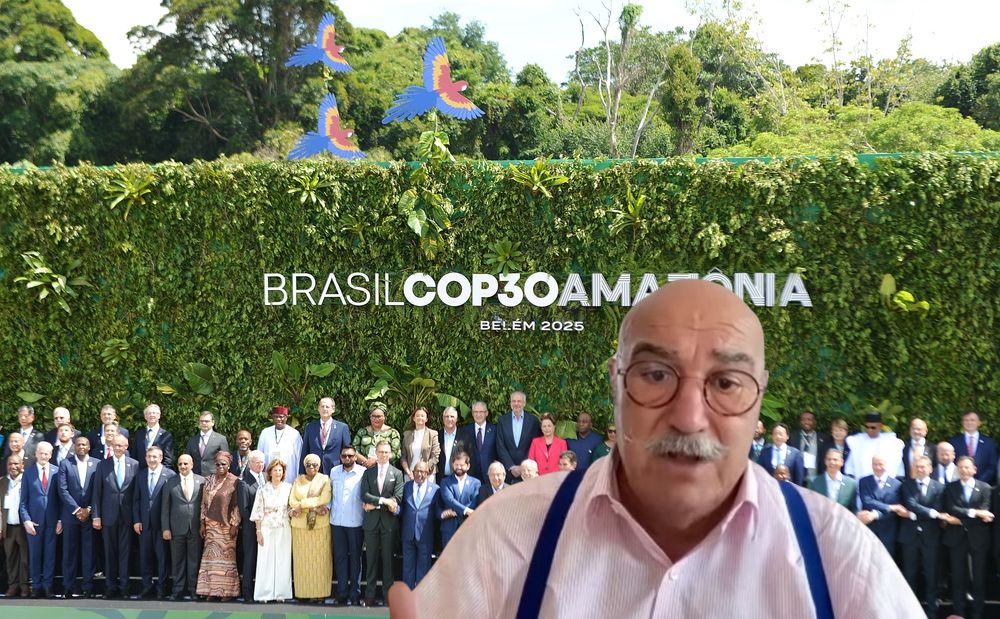
Samuel Furfari thinks the COP’s are mostly “just blah blah”. (Source: Shutterstock/adapted by AI)
Clintel Foundation
Date: 5 May 2026
Dr. Samuel Furfari is a Professor of Energy Geopolitics and Policy, and for 36 years he was a senior official in the European Commission’s Directorate-General for Energy. He is author of numerous books; his latest is The Truth About the COPs, 30 years of illusions. In this recent podcast with Tom Nelson, Furfari speaks about the nonsense of COP’s but also about climate policy in general.
In the podcast Furfari reflects on three decades of international climate policy, offering a critical perspective shaped by his direct involvement since the early 1990s. He traces the origins of global climate governance back to the 1992 UN Framework Convention on Climate Change, which he calls “COP Zero.” From the outset, the goal was to reduce CO2 emissions through annual Conferences of the Parties (COPs), but Furfari argues that the process has largely failed to deliver meaningful results.
Merkel
Furfari describes how early enthusiasm for climate action grew steadily, particularly in Europe. Germany played a leading role, with then-environment minister Angela Merkel helping to drive early momentum. Over time, however, he sees a shift from optimism to disillusionment. According to him, the turning point came around the Glasgow COP (2021), when attempts to impose a global phase-out of coal met resistance from major developing countries like China and India. Because COP decisions require consensus, their opposition effectively blocked stronger commitments, leading Furfari to characterize the event as a failure.
He highlights a broader irony in recent COP meetings being hosted by fossil-fuel-producing nations such as Egypt, the United Arab Emirates, and Azerbaijan. These countries, he notes, rely heavily on oil and gas revenues, making their role as hosts of emissions-reduction conferences paradoxical. He recalls the Azerbaijani president declaring that oil is “a blessing of God,” underscoring the growing divide between climate activism and energy realities.
Furfari argues that over time, developing countries—especially in Africa—have shifted their stance. Initially supportive of climate agreements due to promises of financial aid and technology transfer, they have become more skeptical as these promises failed to materialize.
Emissions have increased
A central theme of Furfari’s argument is that global emissions have continued to rise. “Since COP Zero we have increased the emission by 66%.” For him, this statistic illustrates the fundamental ineffectiveness of the COP process. He likens it to a CEO promising improvements but delivering the opposite outcome, arguing that such failure would not be tolerated in the private sector.
He also critiques what he sees as an underlying ideological agenda behind climate policy, particularly the concept of “degrowth.” According to Furfari, some advocates aim not only to reduce emissions but also to limit economic growth and even population. In this context, he portrays nuclear energy as a neglected solution, arguing that it offers abundant, reliable power but is opposed because it undermines the goal of limiting energy use.
On the future of energy, Furfari acknowledges that synthetic fuels could eventually play a role, especially when fossil fuels are depleted. However, he insists that current costs make them impractical: “While we have oil and gas, nobody will spend so much money to produce a synthetic fuel.” He stresses that market realities, not political ambitions, will determine energy transitions.
The discussion also touches on institutional shifts, particularly the International Energy Agency (IEA). Originally created to ensure energy security after the 1970s oil shocks, the IEA has, in Furfari’s view, drifted toward climate advocacy and renewable energy promotion. He criticizes this shift as ideological and notes recent pressure from U.S. officials to refocus on energy security.
Wind and solar
Furfari is equally critical of renewable energy, arguing that wind and solar remain heavily dependent on subsidies and contribute only a small share of global energy supply. He claims that without government support, these industries would collapse. This perspective extends to his analysis of major energy companies like BP, which he says are returning to oil and gas after unsuccessful ventures into renewables.
Another key point is the changing power dynamics within COPs. Furfari suggests that fossil fuel industries and developing nations are increasingly asserting influence, displacing the dominance of European NGOs and activists. He describes this shift metaphorically: “the cuckoo have taken the nest of the activist.” As a result, he sees less “propaganda” and more realism in recent discussions.
Furfari also criticizes the scale and spectacle of modern COP meetings, which now attract tens of thousands of participants. He questions their value, arguing that negotiations are ultimately conducted by a small group of officials while others attend for visibility or networking. He dismisses much of the activity as “just blah blah,” suggesting that the conferences have become more performative than productive.
Africa
Looking ahead, Furfari expresses hope that future global leadership will prioritize economic development and energy access, particularly in poorer regions. He expresses cautious optimism about the successor to António Guterres (who will be chosen this year), whose term he criticizes for alarmist climate rhetoric. “If the next UN leader comes from Africa or Asia rather than Europe, they may adopt a more pragmatic and ‘sober vision’ of climate policy.” He emphasizes that prosperity depends on energy availability, stating that improving quality of life requires increased energy use. He is especially concerned about Africa, where large portions of the population still lack reliable electricity.
In conclusion, Furfari presents a deeply skeptical view of international climate policy, arguing that it has been ineffective, ideologically driven, and disconnected from economic realities. He calls for a more pragmatic approach focused on development, energy security, and technological progress rather than ambitious but, in his view, unattainable emissions targets.

more news

Michelle Stirling: CBC brings Soviet-style propaganda to Canada
CBC is reporting on a new study by Pruysers et al. (2025) that claims people sceptical of climate change have personality issues associated with the “Dark Triad:” narcissism, Machiavellianism, and psychopathy. In contrast, they say those who agree with catastrophic human-caused climate change narratives exhibit prosocial traits like agreeableness and honesty-humility.

Public Interest in Climate Change Wanes says Friends of Science Society
Recent polls indicate that climate change action is no longer a priority for most North Americans, says Friends of Science Society. This runs counter to the 89% climate action advocacy media project of Covering Climate Now and counter to claims of Canada’s Abacus Data of a spike in climate interest by the public.
Heat waves 2025
Publishing an article on climate change under this title in the middle of a summer heatwave has become something of a tradition. It’s our way of fighting back with some doses of irony the usual climate alarmism campaign, which hibernates like bears in winter before reemerging with a vengeance every summer, taking advantage of the season’s heatwaves (summer: “the hottest time of the year”).

