
Think tank IREF: ‘Against All Rationality, the EU Persists in its Net-Zero Delusion’
The European Commission has approved a new step towards its 2050 ‘net-zero’ objective, targeting a 90% reduction in net greenhouse gas emissions relative to 1990 levels by 2040. But a recent report by the French think tank IREF (Institut de Recherches Économiques et Fiscales) delivers a sobering reality check.

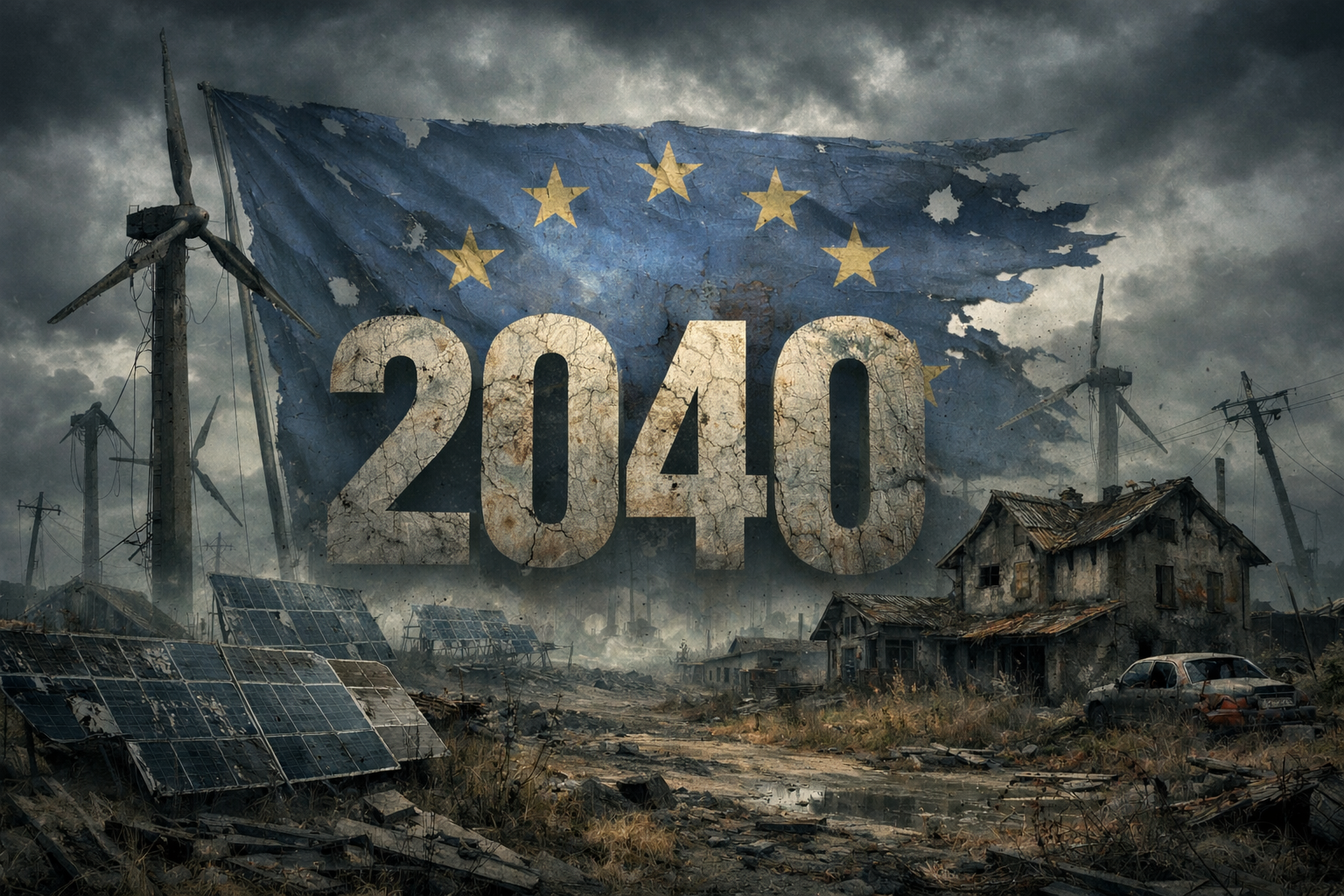
ChatGPT
Clintel Foundation
Date: 2 January 2026
The European Commission now targets a 90% reduction in net greenhouse gas emissions by 2040. Final adoption is expected in 2026, followed by mandatory transposition into national laws. The scale of the plan is staggering. The EU estimates required investments at €21 trillion by 2040—around 7–8% of EU GDP—excluding financing costs. Policymakers expect a mix of subsidies, carbon pricing, and coercive regulation to push most of the burden onto the private sector. The key question is no longer ambition, but feasibility.
A recent report by the French think tank IREF (Institut de Recherches Économiques et Fiscales) delivers a sobering reality check. Simple arithmetic already raises red flags. EU emissions fell by 37% over the 33 years from 1990 to today. Achieving an additional 68% reduction in just 17 years would require nearly tripling the pace of decarbonization. If this acceleration fails, the economic consequences of such a quick drop in emissions would be severe.
EU strategy rests on the assumption that technologies are sufficiently mature to justify a rapid dismantling of decades of fossil-based capital. The plan relies on three pillars: a power system dominated by variable renewable electricity (VRE), massive electrification of industry, transport and buildings, and deep changes in agriculture. The flaw lies in the need for perfect coordination. Grids must expand for renewables, storage must scale faster than intermittency, and demand must rise exactly on schedule. Any mismatch turns ‘transition investments’ into stranded assets.
IREF shows that these mismatches are already widespread. Large-scale VRE deployment produces alternating periods of oversupply—negative prices and forced curtailments—and shortages, when prices spike but renewables cannot respond. Subsidies, initially promised to be temporary, are rising again. These dynamics were warned about years ago by institutions such as the OECD and the Nuclear Energy Agency, but largely ignored.
The April 2025 Spanish blackout exposed another weakness. Despite early denials, investigations showed that excessive reliance on non-dispatchable power sources reduced grid stability. Beyond this event, European transmission operators report a dramatic rise in voltage incidents since 2015, pointing to growing systemic fragility.
The EU response is to call for faster grid expansion and large-scale storage, especially hydrogen. Yet progress lags far behind renewable additions. The Netherlands illustrates the problem: grid congestion now blocks new connections for households and firms, weighing on growth. According to sources cited by IREF, fixing the Dutch grid alone could cost €200 billion by 2040. By contrast, the Commission estimates only €1.2 trillion for the entire EU, only 6 times more—an implausibly low figure that suggests systematic underestimation.
Germany tells a similar story. Only one-sixth of planned transmission lines have been built under the Energiewende. The German development bank KfW estimates that grid investment capacity would need to quadruple to meet 2030 targets, but nobody knows where the money should come from. Hydrogen fares no better. European and national audit institutions have concluded that hydrogen strategies are driven more by political aspiration than by technical or economic realism. Few projects are advancing, and key technologies remain immature. Storage targets for 2040 or 2050 are therefore largely speculative.
Ironically, Germany itself is now acknowledging the limits of its model. Chancellor Friedrich Merz has announced plans to build 71 gas-fired power plants by 2035 to secure backup during recurring wind and solar droughts, alongside subsidies for industrial electricity prices. Correcting the failures of the Energiewende now risks distorting competition within the EU.
On the demand side, reality is equally harsh. Energy-intensive industries are discovering that global markets are unwilling to pay large premiums for ‘decarbonized’ products. For instance, European aluminum production has fallen by 25% since 2010, while global demand rose by more than 70%. High electricity prices and mandatory carbon allowance purchases further restrict investment capacity.
Households face similar limits. Electric vehicle sales have plateaued as concerns over cost, convenience and reliability persist. Heat pumps and insulation followed the same trajectory: early enthusiasm, disappointing returns, collapsing demand once subsidies decline. Only stricter mandates could close the gap—but such mandates would come at the expense of individual freedoms.
IREF concludes that the EU’s net-zero plan is effectively dead on arrival. Its internal coherence is unachievable at this scale, across member states moving at different speeds. Persisting regardless will damage prosperity and liberties, repeating the classic failure of grand central plans—what the Austrian economist Friedrich von Hayek once described as fatal conceit.
The irony is that the climatic impact would be negligible. Based on IPCC formulas, IREF deduces that for Europe, reaching net zero in 2100 rather than 2050 would alter global temperatures by only 0.02 to 0.06°C—below any meaningful measurement threshold.
IREF therefore calls for a strategic reversal: a slower, more realistic path to decarbonization, centered on innovation rather than mandates. France’s nuclear-based electricity system already delivers far lower emissions than the EU’s renewable-heavy vision inspired by Germany’s failed experiment. Gradual replacement of remaining coal and gas with dispatchable low-carbon generation—potentially including advanced nuclear technologies—over the next three decades would be both economically and technically credible. This pathway would avoid radical grid overhauls, unrealistic storage schemes, and mismatches between supply expansion and actual demand.
Europe is beginning to adjust at the margins, softening EV mandates and allowing electricity subsidies. But cosmetic fixes will not rescue a fundamentally flawed strategy. A genuine reassessment is overdue. Better to correct course now than to persist in an illusion that risks undermining the European project itself.

The report, in French: « European Union climate law: an economic and societal disaster with no effect on the climate », Authored by Vincent Bénard, IREF, December 2025 – Vincent Bénard is a civil and territorial planning engineer and economic analyst, who authored several articles and reports for IREF since 2021.

more news

Glacier fluctuations don’t yet support recent anthropogenic warming
Holocene glacier records show that glaciers worldwide reached their greatest extent during the Little Ice Age and were generally smaller during earlier warm periods. While glacier length is a valuable long-term regional climate indicator, the evidence does not clearly support the idea of uniform, synchronous global warming.

Challenges to the CO2 Global Warming Hypothesis: (13) Global Warming Entirely from Declining Planetary Albedo
Is the recent warming the result of less reflection of sunlight by the Earth? Two researcher state that declining albedo — not CO₂ — dominates the temperature trend.

Guardian Claims We’re Still Only Approaching the Climate Point of No Return
The Guardian claims the world is edging toward a climate “point of no return,” where unstoppable warming will lock Earth into a catastrophic “hothouse” future. Yet the geological record tells a very different story. Past periods of far higher temperatures and CO₂ levels did not end life or civilization’s prospects — they supported abundance and evolutionary expansion.

