
We can still avoid the Net Zero trap
Former politician prof. Kees de Lange and Clintel co-founder prof. Guus Berkhout state in a new essay that there is no reason to swim further into the Net Zero trap.

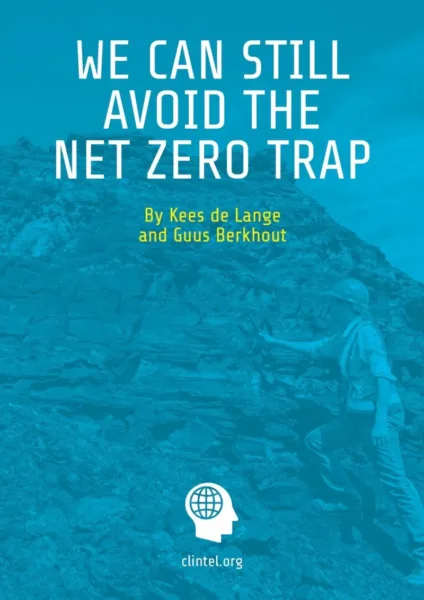
In the first part of their essay they show extensively that there is no climate emergency because of the emission of the greenhouse gas CO2. Amongst other things, they conclude that the focus of climate alarmists on CO2 is very one-sided. Furthermore, the dampening saturation effect that occurs with al greenhouse gasses, is left out deliberately in the fear-inspiring narrative.
The limitations of the current climate models are of such that, for now, they are no serious basis for climate policy. Their premise that the human contribution to CO2 production would be the recipe for a future climate disaster, is not supported by observations. Besides the saturation effect of CO2, the many assumptions on the very complex role of clouds is just as important. Clearly, clouds are the Achilles heel of climate science.
So, De Lange and Berkhout conclude that there is no climate crisis. We are however at the beginning of a self-made energy crisis. That is the focus of the second part of this essay. The reliability of demand-driven fossil energy is currently being sacrificed to supply-driven illusions, like wind and solar energy. The West is apparently prepared to risk prosperity for this. The rest of the world watches in amazement.
A new Dutch cabinet must stop the model-based doom stories about climate disasters and make new choices in energy policy. Amongst other things, De Lange and Berkhout argue for the further development of nuclear energy, with special attention given to the option based on the thorium cycle and its associated advantages. In the long term, this is the only rational way to adequately supply the world with energy. There is therefore no reason to swim further into the Net Zero trap. We can still go back.
Essay by Kees de Lange and Guus Berkhout
For the essay, click here

more news

Absurd new study: hair salons can be a secret weapon for climate action
Great news! Researchers from several British universities have discovered that ‘hairdressers could be a secret weapon in tackling climate change’. Jo Nova reflects on this absurd finding.

Why the modern CO₂ spike looks scarier than it is
Modern CO₂ levels often appear dramatic when recent instrumental measurements are directly compared with long-term ice core records. However, paleo-CO₂ proxies smooth atmospheric signals over centuries, which dampens rapid changes. When modern CO₂ data are smoothed to match proxy resolution, today’s levels still exceed past interglacial peaks but appear far less extreme than the raw measurements suggest.
‘Green’ Ideology is a force for African Oppression
After 2030, the number of people in extreme poverty is expected to start rising again, driven largely by Africa. While the rest of the world marches toward prosperity, Africa is being forced into a trajectory of destitution. The data is an indictment of the modern ‘green’ agenda.

