
Yet more proof that Mother Nature is far worse than man-made climate change
New research suggests that prolonged natural drought — not ecological self-destruction — played a decisive role in the cultural transformation of Easter Island. Using hydrogen isotopes preserved in leaf wax, scientists reconstructed centuries of rainfall data, revealing a severe 16th-century drought that challenges the popular narrative of human-driven collapse.

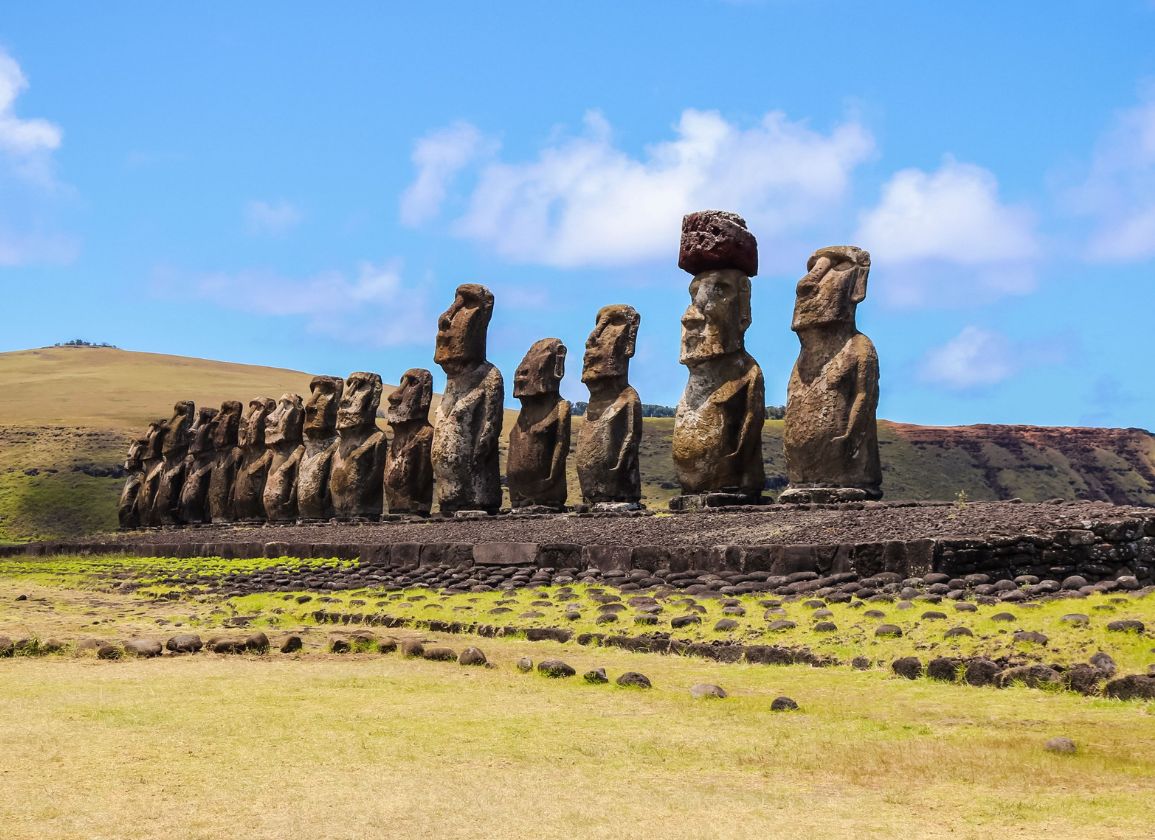
Easter Island (source: Shutterstock)
Jo Nova
27 February 2026
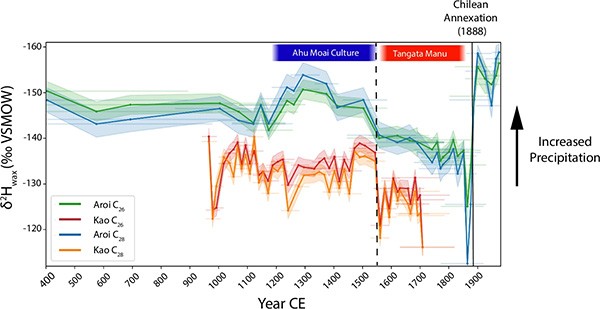
The extinction of tall trees and land birds on Easter Island became the apocryphal story of a man-made ecological disaster, but a new technique for estimating rainfall shows that there was a terrible drought starting in 1550 AD that lasted for 100 years. This would have been a bit dire on a small island that doesn’t even have a river and relied on a crater lakes.
In recent times, catastrophic climate change has apparently reduced rainfall by 370mm. But starting around 1550 AD rainfall declined by a shocking 600 to 800 mm per year. Despite the severe drought the population wasn’t wiped out — their population doesn’t seem to have collapsed. The rainfall shift coincided with many cultural changes and even the development of rock gardens called lithic mulching – where farmers get desperate enough to use rocks as ground cover and a soil improver to keep the evaporation rates down.
https://www.nature.com/articles/s43247-025-02801-4/figures/3
At the same time as the rain declined, the people changed the way they live...Notable cultural shifts also took place during this time. Fewer ceremonial ‘ahu’ platforms were built, and Rano Kao became an important ritual site. A new social system called Tangata Manu emerged, in which leaders were chosen through athletic contests rather than through family ties to the moai statues.
The new rainfall estimate comes from Stein et al, who found a way to estimate rainfall using hydrogen isotopes in leaf wax.
“We think leaf waxes on Rapa Nui are only recording information about local rainfall and aridity”, lead author Redmond Stein explained. By measuring the ratio of ‘heavy’ to ‘light’ hydrogen preserved in those waxes, the researchers reconstructed 800 years of rainfall history. The data shows that rainfall declined sharply in the mid-1500s and remained low for more than a hundred years.So rather than being the foolish people who built stone statues and chopped down every last tree, the people of Rapa Nui are a remarkable survival story.
I’ve written about Easter Island at length in ‘What if Easter Island was a sustainable success story instead of an ecocidal disaster?’
Benny Peiser (of NetZeroWatch fame) published a research paper detailing how the real disaster was when slave traders, whalers and others came in the 1800s.
This tiny patch of land was discovered by European explorers more than three hundred years ago amidst the vast space that is the South Pacific Ocean. Its civilisation attained a level of social complexity that gave rise to one of the most advanced cultures and technological feats of Neolithic societies anywhere in the world. Easter Island’s stone-working skills and proficiency were far superior to any other Polynesian culture, as was its unique writing system. This most extraordinary society developed, flourished and persisted for perhaps more than one thousand years – before it collapsed and became all but extinct.
Naturally the media doesn’t mention any of this, instead the headlines talk about how ‘enigmatic’ the collapse was and how it was more ‘complex’ than anyone thought. These are just weasel ways to not-admit they were wrong.
The drought on Easter Island coincides with the Little Ice Age. A cooler world is usually a drier world, because there is less evaporation. Why would anyone want a cooler world?
REFERENCE
Stein, R., Curtin, L., Balascio, N.L. et al. Prolonged drought on Rapa Nui during the decline of megalithic monument construction. Commun Earth Environ 6, 865 (2025). https://doi.org/10.1038/s43247-025-02801-4

This article was first published at joannenova.com.au

Jo Nova
Jo Nova is science presenter, writer, speaker & former TV host; author of The Skeptic’s Handbook.

more news

No, New York Times, Climate Change Is Not Making Tennis Players Ill
In this article, climate researcher and writer Linnea Lueken examines claims by The New York Times that climate change is making tennis players ill during the French Open. She argues that player health, tournament infrastructure, and individual heat sensitivity provide more plausible explanations than climate change, and that a single heatwave does not constitute evidence of a long-term climate trend.
Kathryn Porter: “The whole model is starting to crumble”
Policymakers and media institutions underestimate the dangers created by unreliable energy systems and rising electricity costs, energy analyst Kathryn Porter recently stated on the Heretics podcast. But she thinks the problem is much bigger than that: “Societies entering periods of political and economic stress, often become more authoritarian. The whole model is starting to crumble.”

Matthew Wielicki on Climate Debrief: “The human condition has never been better”
Students were crying during conversations about the future, their fears largely driven by repeated exposure to highly negative messaging about climate change, recalls ‘professor in exile’ Matthew Wielicki on the Climate Debrief Podcast. He encourages young people to approach environmental and climate concerns with balance, optimism, and practical action rather than despair.

