
You can’t make laws against the sun
Astrophysicist Willie Soon has been researching the influence of the sun on the climate for decades. In an interview with Weltwoche, he explains why he does not view CO2 as a climatic control factor, how political and financial structures shape scientific findings and why he continues to research despite hostility.
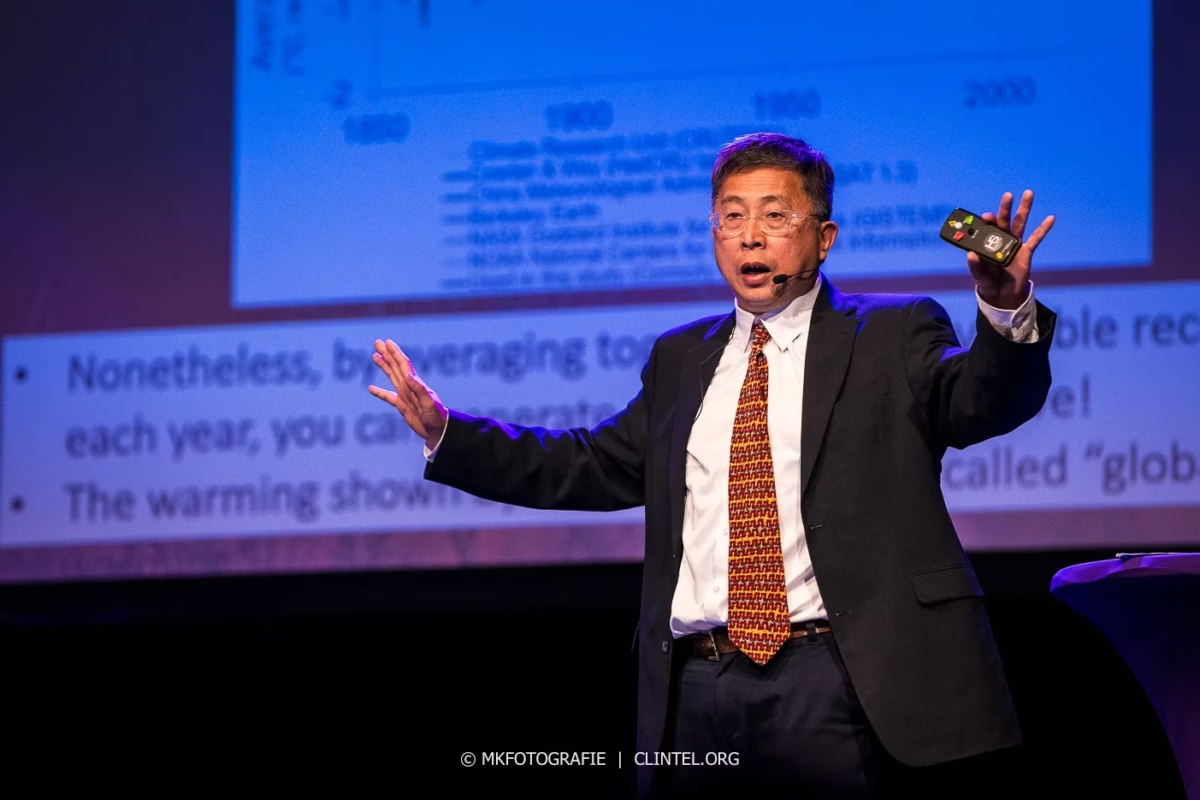
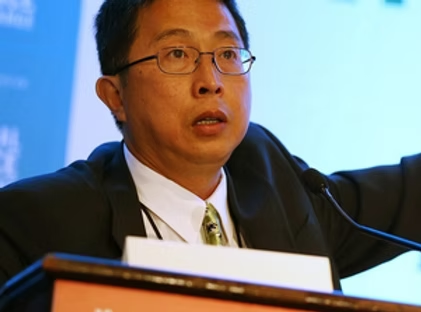
Dr. Willie Soon during his speech at Clintel’s anniversary conference on 18 June 2024
Clintel Foundation
Date: 13 December 2025
Willie Wei-Hock Soon, born in Kangar, Malaysia, is an astrophysicist best known for his controversial views on climate change. After studying aerospace engineering at the University of Southern California, graduating with a doctorate in 1991, Soon worked for many years at the Harvard-Smithsonian Center for Astrophysics in Cambridge, Massachusetts. His research originally focused on solar and stellar physics, particularly the sun’s activity cycles and their potential impact on the Earth’s climate. He is now best known for emphasizing the role of the sun as a key climate driver and that the impact of human greenhouse gas emissions on global warming is overestimated. This attitude placed it in direct contrast to the generally accepted scientific consensus on man-made climate change.
Soon is considered one of the central figures of the «climate skeptic» movement. Proponents see him as a scientist who thinks against the mainstream and points out the complexity of natural climate factors. His opponents, on the other hand, see him as an example of the influence of economic interests on the climate debate and of the abuse of scientific authority for political argumentation. Soon symbolizes the tensions between scientific freedom and the economic and political forces that still shape the climate discussion today.
WeltWoche: Professor Soon, you have been claiming for years that the earth’s climate is naturally changing and that CO2 is not the main driver. What is the core of your argument?
Willie Soon: The Earth’s climate has always been subject to constant change. Shifts of land and sea areas, tectonic forces – and above all the sun – determine its dynamics. The sun provides 99.99 percent of the energy that drives the weather and climate. Without them there would be no wind, no ocean currents, no photosynthesis. Together with two colleagues, I have shown that the best empirical data does not conclusively support the hypothesis of human-caused CO2 warming. Natural factors and solar variability play a much larger role.
WeltWoche: But isn’t the sun a kind of «constant light switch»?
Soon: Anyone who claims this ignores the measurements. The sun’s radiation fluctuates – especially in the UV and X-ray range. These variations affect the atmosphere, air and ocean currents, and long-term climate patterns.
Since the 1940’s, it has been known that variations in solar activity and the Earth’s orbit configuration influenced the ice and warm periods of the last 2.5 million years. Satellite data show that the Sun is not a stable source of radiation. These energy fluctuations can even influence biological processes –perhaps genetic mutations–. Something similar can be observed with other sun-like stars.
WeltWoche: Why do you think the fixation on CO2 is wrong?
Soon: The CO2 panic is not based on solid science. Temperature and flow patterns over the past 150 years are far more consistent with variations in solar activity. Where there is a CO2 signal, according to my analysis it is below the detection limit. CO2 is therefore unfairly demonized as a «climate poison», even though it drives photosynthesis, has improved the water use of plants and caused measurable greening – even in dry regions. Since the 19th century, the earth has become significantly greener, even on desert edges. Conversely, low CO2 levels in ice ages led to poor conditions. The current proportion of CO2 in the atmosphere is 0.043 percent – by no means dangerous, possibly even suboptimal for a thriving biosphere.
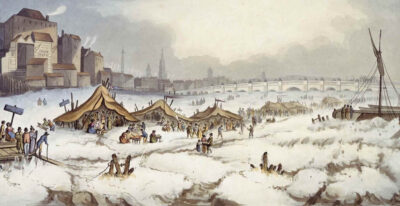
Frozen Thames
WeltWoche: They often refer to the Maunder minimum. What does this teach us?
Soon: It was a period of extremely low solar activity, from about 1645 to 1715. During this time there were almost no sunspots – the sun was unusually calm. This phase coincided with the Little Ice Age: glaciers grew, the Thames froze, chronicles report great cold. This indicates a link between solar activity and climate. We do not yet fully understand the Sun’s magnetic cycles –such as the eleven-year cycle and the transitions in rest phases –, but the observed relationships are robust and global.
WeltWoche: If the sun is so important, why does the CO2 narrative dominate?
Soon: Because you can’t make laws against the sun – but you can make laws against CO2. This leads to taxes, regulations and interventions in energy policy. Since the 1980’s, this has created a complex web of subsidies, bureaucracies and activist networks. Politics demands simple messages, media wants drama – and many scientists adapt. Atmospheric physicist Richard Lindzen called this the «Iron Triangle Effect»: financing politics, delivering science, reinforcing the media.
WeltWoche: Do certain tendencies arise from this?
Soon: Unfortunately, many scientific institutions have adopted an alarmist unity opinion in recent decades. Critics are excluded. Climate policy increasingly serves economic and ideological goals, not objective research. But there is at least one positive sign: Bill Gates recently realized that the climate cannot be controlled by regulating CO2. Instead, he now wants to focus on adaptation – on reducing human suffering through extreme cold or heat. This is a welcome development.
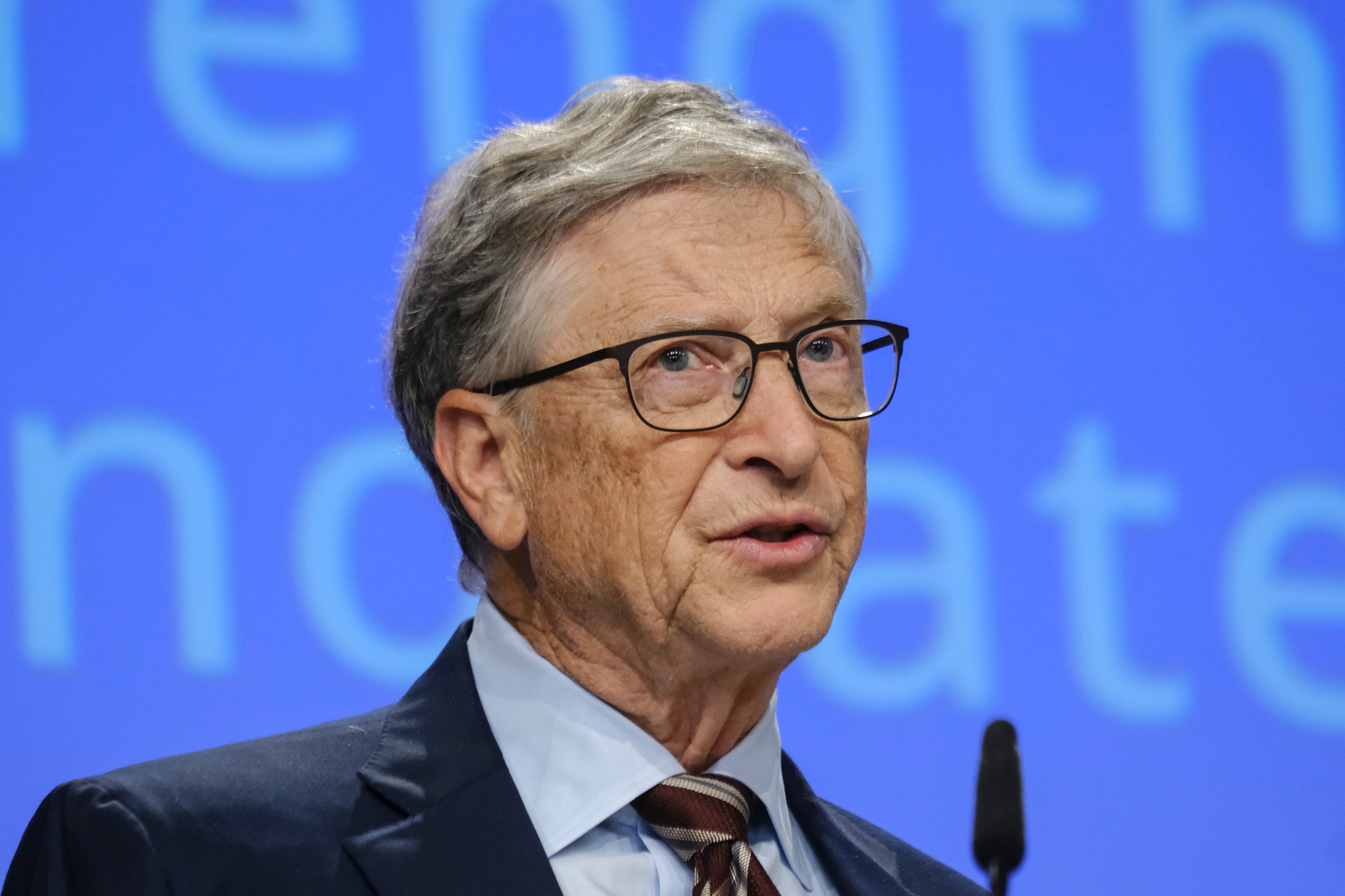
Bill Gates (Source: Shutterstock)
WeltWoche: Since industrialization, CO2 and temperature have been rising in parallel.
Soon: Correlation doesn’t mean causality – and by the way, the correlation isn’t that strong. Despite massive emissions reductions in the USA or Great Britain, for example, CO2 concentrations continue to rise. This shows how important natural feedback is. Even if CO2 contributes something, it doesn’t dominate.
WeltWoche: Was this confirmed during the Covid lockdown?
Soon: Yes. Because despite a global decline in emissions, CO2 concentrations continued to rise This proves: Humans do emit, but the net effect is overshadowed by huge exchanges between oceans, biosphere and atmosphere. CO2 is not a climate thermostat.
WeltWoche: They call the IPCC «selective». What do you mean?
Soon: Of the wide range of scientific studies, only certain models are preferred and others are marginalized. This creates the impression of certainty where there is uncertainty. Scientific integrity requires disclosing uncertainties and testing competing hypotheses. Instead, we receive political reports with a scientific mask.
WeltWoche: Why do many media and academics still support the CO2 thesis?
Soon: Because it is politically useful. Authority does not replace evidence. Scientific truth does not arise through voting, but through repeatable observation and theory. What is worrying is that governments and organizations are increasingly spreading the idea that the climate must remain static.
WeltWoche: Does this restrict scientific discourse?
Soon: Yes. Instead of arguments, you hear accusations. Universities that load controversial speakers teach students that consensus is more important than truth – that’s fatal.
WeltWoche: What role does the media play?
Soon: Many reports rely on morality and drama. Uncertainty sells poorly, nuances sell even worse. This creates a media physics of «global boiling» that has little to do with measurements.
WeltWoche: How do you assess climate models?
Soon: Models are useful, but they contain many assumptions –such as about clouds, aerosols or turbulence. Adjusting to historical data does not automatically improve forecasting. Models must be tested on observations.
WeltWoche: This probably also includes ocean acidification?
Soon: On average, the seas are alkaline, with a pH value of around 8.2. Local fluctuations are normal. Often the subject is dramatized when temperature trends are not threatening enough. Instead of slogans, solid, long-term measurements are needed.
WeltWoche: In your view, how dangerous is sea level rise?
Soon: Reliable level measurements show one to two millimeters per year, without acceleration. That’s a few centimeters per century. Anyone who cannot back a few centimeters does not have a climate problem, but rather a planning problem.
WeltWoche: How do you define «climate»?
Soon: To date there is no precise definition. Climate is more than the average of the weather – it is a dynamic system of energy flows, clouds, albedo, humidity, ocean-atmosphere coupling, land use and aerosols. This complexity is hardly recognized in public debate.
WeltWoche: What about the urban heat effect?›››
Soon: It falsifies many measurements. In cities, temperatures are rising systematically. If you only look at rural stations, other trends emerge. Many global data sets are distorted as a result. New studies by us and others prove this for the USA, Japan and other regions.
WeltWoche: Critics accuse you of being financed by the oil industry.
Soon: That’s wrong. I have disclosed all sources. At the beginning my research came mainly from government funding – NASA, Air Force, NSF. When we asked uncomfortable questions, these remedies dried up. We then sought support from private foundations, including those with ties to the energy industry – from renewable to fossil fuels. No one ever asked me to adjust results. Today my research is financed exclusively through voluntary donations to our independent group Ceres-Science.
WeltWoche: Your opponents say you have concealed sources of money.
Soon: That too is wrong. This campaign comes from a former Greenpeace employee, Roland «Kert» Davies, who published a false report in 2015. Several newspapers took his claims unverified. As Jonathan Swift wrote 300 years ago: «The lie flies and the truth lags behind.» In the end, what matters is the quality of the work, not the morality of the banknotes.
WeltWoche: Where do you think climate research should set the priorities?
Soon: Objective climate research would have to focus on long-term, cleanly calibrated measurements –especially in rural regions. It also needs open data and codes so that results are comprehensible and reproducible. Targeted experiments on the stratosphere, cloud formation and radiation balance are also important. Ultimately, hypotheses would have to be tested honestly against each other instead of just confirming preferred models.
WeltWoche: What do you recommend to politicians?
Soon: Realism and resilience. No centralized experiments that endanger prosperity. Instead: adapt infrastructure, strengthen flood protection, openness to technologies, research without a given result. If you really want to reduce risks, invest in robust systems – not in symbolic CO2 rituals.
WeltWoche: How do you assess how you deal with models and AI?
Soon: Models can be helpful, but many scientists confuse them with reality. With the advent of AI, this tendency becomes even stronger, we need researchers to study the real world again – not just the virtual one. Nobel Prize winner in physics John Clauser once aptly said: «Theorists talk to each other, experimental physicists talk directly to God.» Replication studies are needed. They check published results by repeating them – using the same experiments, data evaluations or methods. Both strengthen scientific reliability.
WeltWoche: What role does ethics play?
Soon: True ethics means honesty over uncertainties – and a sincere balancing of benefits, costs and side effects. The precautionary principle makes sense for likely, reversible risks – but not as a license for large-scale dirigiste projects.
WeltWoche: How do you deal with hostility?
Soon: By publishing, sharing data and scientifically answering criticism. Slander doesn’t impress me. Science is a long-distance race.
WeltWoche: What do you want from politics and the media?
Soon: I would like to see differentiation from the media instead of alarmism. I expect freedom of research, resilience, technology friendliness and investment in infrastructure from politicians, but above all: humility before the complexity of nature Because, as I said, you can’t make laws against the sun – you can only understand it better and make decisions that are realistic, smart and human.
This is the English translation of an interview by Pierre Heumann of Weltwoche, which previously appeared under the title «Man kann keine Gesetze gegen die Sonne machen» and was edited by Willie Soon.
About Willie Soon
Willie Soon, 60, earned his PhD from the University of Southern California in 1991 and then conducted research at the Harvard-Smithsonian Centre for Astrophysics. He has been studying the Sun’s activity cycles for nearly four decades. This work resulted in a dataset that shows that the Sun is not a stable engine, but a variable star – with measurable consequences for the Earth’s climate.
more news
The EU’s Nuclear Phase-Out Was a Blunder
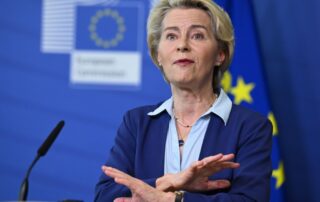
Following Friedrich Merz in January, Ursula von der Leyen has now also admitted that the phase-out of nuclear energy was a major ‘strategic mistake’, not only for Germany but for the EU as well. American researcher Roger Pielke Jr. uses some simple calculations to demonstrate the magnitude of the EU’s strategic blunder.
Paul Ehrlich (1932-2026): Farewell to the Long-Lived Failed Prophet of Miserablism – The Population Bomb author lived a long, wealthy, healthy life, an opportunity his work denied to countless others
Paul Ehrlich, author of The Population Bomb, became one of the most influential voices behind modern environmental pessimism. His warnings of inevitable resource depletion and societal collapse shaped decades of policy and public thinking. Yet, as history unfolded, many of his most prominent predictions failed to materialize—raising enduring questions about the consequences of alarmist narratives in science and policy.
US Energy Realism Pays Off in Iran Crisis
The stark contrast between American resilience and European collapse is a permanent lesson. National security should not be subject to the whims of the weather or the approval of climate activists in European capitals.

