
25 Years of Climate Data Show No Increase in Weather Disasters
In this article, Dr. Matthew Wielicki examines official disaster data from the past 25 years, which show no increase in global extreme weather events despite rising CO₂ levels and record temperatures. The analysis explores what the climate data reveal and why they challenge prevailing climate narratives.

ChatGPT
Dr. Matthew Wielicki
Date: 17 January 2026
For decades, the climate crisis narrative has rested on a single, emotionally powerful claim:
As the planet warms, extreme weather will become more frequent and more intense.
This idea didn’t emerge from nowhere. It has been repeated, often verbatim, by governments, international institutions, scientific bodies, and major media outlets. It became the mechanism by which modest warming was transformed into an existential emergency.
Extreme weather wasn’t a side effect.
It was the proof.
Which is why the figure below matters so much.
The dataset climate alarmists used… until it stopped cooperating
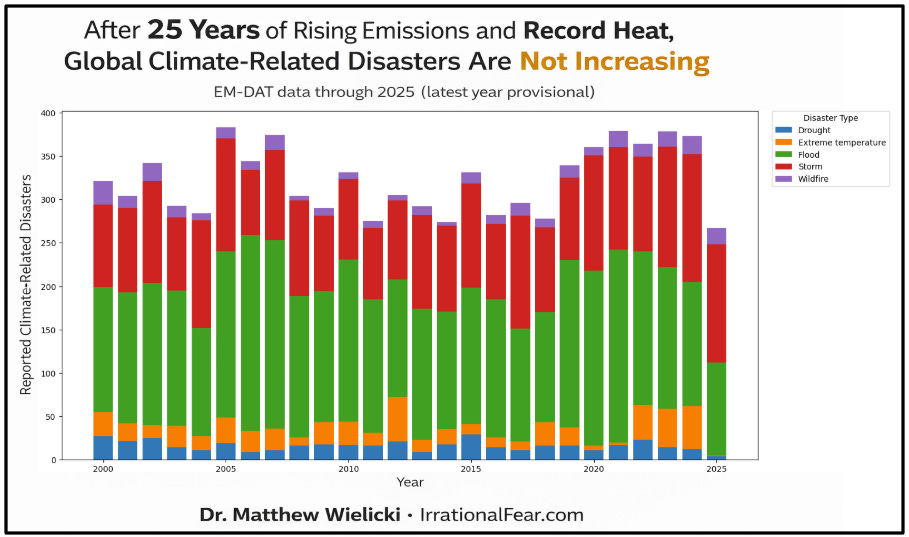
The chart above shows global counts of climate-related disasters, including droughts, floods, storms, wildfires, and extreme temperature events, compiled by the Centre for Research on the Epidemiology of Disasters (CRED) in Brussels.
This database is known as EM-DAT, the Emergency Events Database.
It is not obscure. EM-DAT has been used by:
- The United Nations
- The World Meteorological Organization
- NGOs and insurers
- Climate researchers and IPCC-adjacent studies
For years, it was routinely cited to argue that climate change was already driving an increase in extreme weather.
Now that provisional 2025 data are available, that argument collapses.
What the institutions actually claim
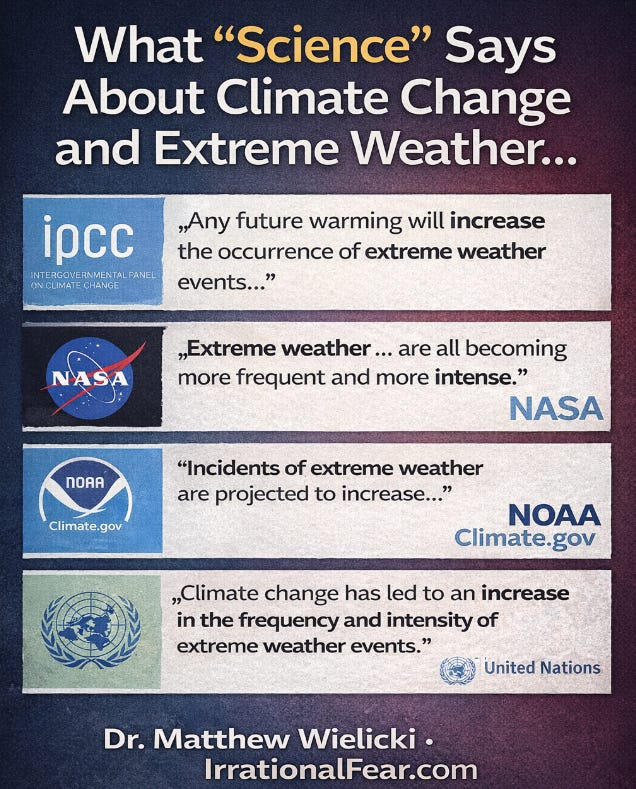
The IPCC Sixth Assessment Report states:
“Any future warming will increase the occurrence of extreme weather events… The frequency and intensity of extreme events will considerably increase with warming.”
NASA echoes this message clearly:
“Record-breaking heat waves, floods, droughts, wildfires, and hurricanes are all becoming more frequent and more intense.”
NOAA’s Climate.gov tells the public:
“Incidents of extreme weather are projected to increase as a result of climate change.”
And the United Nations states bluntly:
“Climate change has led to an increase in the frequency and intensity of extreme weather events.”
This is not subtle language.
This is not hedged or cautious.
This is the backbone of climate crisis messaging.
Now compare those claims to the data.
What the observational data show instead
- Atmospheric CO₂ reached its highest levels in human history
- Global temperatures rose to claimed record highs
- Climate policies expanded dramatically
Global climate-related disaster counts have not increased.
They are flat.
And in 2025, the year following the highest CO₂ concentrations and some of the warmest global temperatures on record, total disaster counts are lower than at any point in the past quarter-century.
Yes, the 2025 data are provisional. EM-DAT has a modest reporting lag, particularly for events late in the calendar year. Minor upward revisions are possible.
But no realistic revision transforms 2025 into a record year for disasters. The signal is not subtle. The trend does not reverse.
If warming were driving an explosion of extreme weather, this is precisely where it should appear.
It doesn’t.
The most revealing detail: extreme temperature events
In the entire world, EM-DAT recorded only one extreme temperature disaster in 2025.
One.
This is remarkable given how often we are told that heat waves are becoming ubiquitous, unprecedented, and increasingly deadly everywhere at once.
EM-DAT does not count warm days or uncomfortable summers. It counts documented disaster events that meet thresholds for impact, displacement, or mortality.
If heat extremes were spiraling out of control, this category should be surging.
It isn’t.
Why temperature was never the real problem
The mid-19th century was an exceptionally cold, unstable, and unhealthy period for humanity… marked by reduced agricultural productivity, widespread disease, and geopolitical turmoil. Returning to 1850 temperatures would not improve human welfare.
What made warming “dangerous,” we were told, were the positive feedbacks:
- More frequent storms
- More intense floods
- Worsening droughts
- Escalating wildfires
- Expanding heat catastrophes
Extreme weather was the mechanism by which warming became a crisis.
And that mechanism is not showing up in the data.
The narrative persists anyway
Because once a narrative becomes institutionalized, it no longer depends on observational confirmation. It depends on repetition, authority, and moral framing.
When EM-DAT appeared to support alarmism, it was cited constantly.
Now that it doesn’t, it’s quietly ignored.
This is not how healthy science behaves.
The smoking gun problem
That doesn’t mean weather doesn’t happen.
It doesn’t mean adaptation isn’t necessary.
And it doesn’t mean the climate stops changing.
It means the crisis narrative is failing its own empirical test.
And that should force a reassessment… not a doubling down.
Closing thought
Fear was always the fuel.
Disasters were always the proof.
Without them, the climate crisis loses its foundation.

This free article was previously published on Irrational Fear.
Want more analysis like this?
On his Substack Irrational Fear, Dr. Matthew Wielicki shares data-driven climate analysis, critiques of official claims, and access to 420+ original articles.
If you prefer evidence over slogans, explore and subscribe here.

Dr. Matthew Wielicki
Earth science professor-in-exile, climate and cultural realist, political orphan, pluralist, husband, father, friend, optimist, Irrational Fear Substack. Dr Matthew Wielicki also appears in the documentary Climate: The Movie on Clintel’s YouTube channel.

more news

American-Japanese Pact Signals Ascent of Energy Realism
The U.S. and Japan are shedding the paralysis of irrational climate policies with a strategic pact covering rare-earth minerals, critical components for semiconductors and next-generation nuclear reactors.

Paris Climate Accord’s Demise – James Hansen was Right
Robert L. Bradley Jr. explores why the Paris Climate Agreement is faltering—and why James Hansen may have been right all along.
Michelle Stirling: The facts just don’t matter to Catherine McKenna
Author Michelle Stirling offers a sharp analysis of Catherine McKenna’s new COP30-aligned report, challenging its claims, assumptions, and implications for climate policy and energy realities.

