
Britain’s Climate Crusade Is Creating an Economic Disaster
Energy analyst Vijay Jayaraj explains how the UK’s climate agenda has driven up electricity prices, weakened industry, and created real economic hardship for British families.

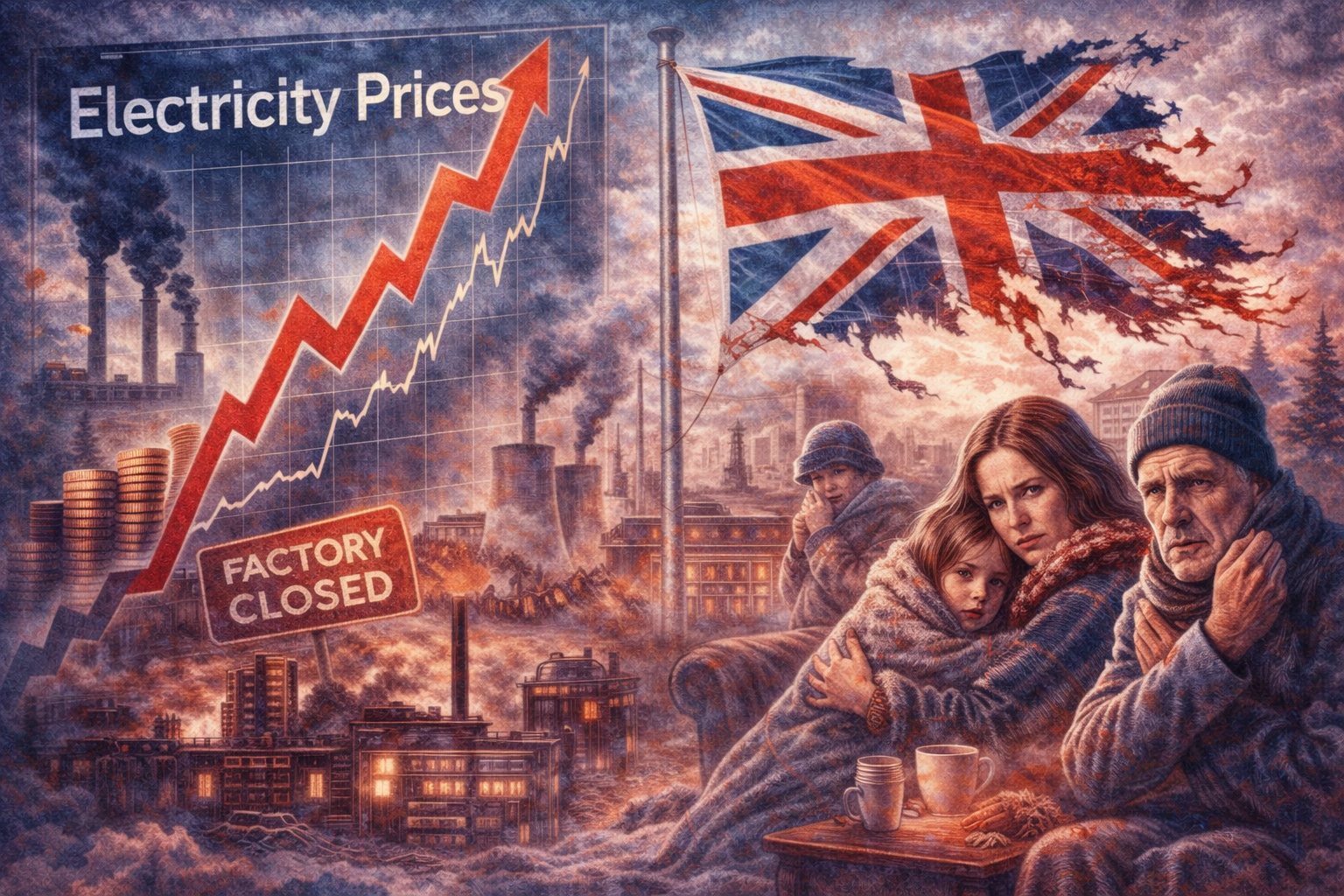
Illustration showing impact of UK climate policy on families, industry and energy prices
(Image created with ChatGPT)
Vijay Jayaraj
Date: 22 January 2026
How UK Climate Policy Is Undermining Prosperity
Across the Atlantic, a self-inflicted disaster is steadily unfolding. One of the United States’ closest allies, the United Kingdom, has surrendered energy riches and industrial prowess.
This decline is not the result of any shortage of capital, technological capacity or natural resources. Instead, it is the consequence of an ideologically driven climate agenda that has elevated “green” symbolism over engineering reality.
For years, politicians have beaten their chests about the U.K.’s “world-leading” renewable capacity. They paraded statistics showing wind and solar generating most of the electricity, conveniently ignoring that this only happens when the wind blows and the sun shines.
When “green” generation doesn’t perform, British taxpayers pay for natural gas-fired power plants to back up idle facilities and stabilize the grid. They also pay “constraint payments” to switch off wind turbines when it is too windy to operate them.
The Hidden Costs Behind “Cheap” Renewable Energy
This is the great deception of the Levelized Cost of Energy (LCOE) metric the green lobby loves to cite. LCOE excludes the enormous price of grid balancing, backup generation, curtailment payments, transmission expansion and subsidies – all required to prop up the green sham.
Rising Energy Prices and Growing Energy Poverty
In the real world – where bills must be paid – the U.K. has created for itself some of the highest electricity rates on the planet, up to four times more than in the United States. One-third of Scots live in energy poverty. But the real cost never shows up in glossy charts that promote manipulated data representing wind and solar as cheap.
The price caps of Great Britain’s Office of Gas and Electricity Markets now dominate household conversations, which are amplified by each winter’s anxiety over lifestyle choices. Heat or eat has shifted from a slogan to a lived reality. Once a power behind the Industrial Revolution, Britain has shamefully imposed on its citizens energy poverty. Families ration warmth while politicians celebrate decarbonization targets.
One reader told U.K.’s Independent of heating only a single room with a wood-burning stove, mimicking a 19th century living standard 200 years later. Such is the “Green Industrial Revolution” promised by know-nothing managers of energy policy.
And for what? So that the U.K. can reduce its negligible contribution to global emissions of harmless carbon dioxide. Meanwhile, China and India build coal plants to power the manufacturing exported to them by those who have frittered away British industrial might.
How UK Climate Policy Is Driving Deindustrialization
Manufacturers have little choice but to leave when a “carbon tax” and heavy-handed regulation on carbon dioxide emissions artificially inflate the cost of energy. Steelmakers are on their knees, facing energy bills that have surged by billions, rendering British steel uncompetitive against foreign rivals free of net-zero dogma.
The Self-Destruction of Britain’s Energy Independence
Nowhere is the insanity more visible than in the North Sea. For decades, offshore oil and natural gas were the crown jewels of the British economy, providing cheap, reliable energy and revenue to fund public services.
Today, this resource is being sacrificed at the altar of climate theology. The Prime Minister’s punitive windfall taxes and refusal to issue new licenses have effectively killed North Sea energy development. Investors have fled. Rigs are decommissioning. Thousands of skilled jobs are evaporating.
Norway’s Energy Strategy Shows What Britain Could Have Been
Compare this to U.K. neighbor Norway, which continues to extract oil and natural gas from the sea and sell to global customers, including the U.K. While Britain dismantles its energy sovereignty to appease the likes of Extinction Rebellion, Norway enriches its citizens and funds its sovereign wealth fund.
The contrast is humiliating. The U.K. imported over 50% of its natural gas supply in 2024 from Norway.
Apologists for this British collapse point to anything but the truth. They blame Brexit and the Russia-Ukraine war. They blame a “global recession,” pretending that the U.K.’s de-industrialization isn’t an outlier. But the fundamental reason for the collapse is the “green” agenda espoused by the political establishment for 20 years.
It has been a bipartisan failure. Tories chased the “green vote” by banning fracking and demonizing diesel. The Labour party doubled down with net-zero mandates that defy the laws of physics and economics. They built a grid fragile to the weather and expensive to the user.
A Green Crusade Creating a Real Economic Crisis
A crusade to avoid an imaginary climate catastrophe of the future has created a very real economic disaster in the present.

This commentary was first published at RealClear Markets January 21. The editors have added subheadings for better readability.

Vijay Jayaraj
Vijay Jayaraj is a Science and Research Associate at the CO2 Coalition, Fairfax, Virginia. He holds an M.S. in environmental sciences from the University of East Anglia and a postgraduate degree in energy management from Robert Gordon University, both in the U.K., and a bachelor’s in engineering from Anna University, India. He served as a research associate with the Changing Oceans Research Unit at University of British Columbia, Canada.

more news

BlackRock CEO Abandons Climate Delusion for Investor Needs
BlackRock CEO Larry Fink has publicly shifted toward what he calls energy pragmatism, admitting that society now demands a balanced approach to meeting power needs rather than adherence to rigid climate agendas. This could be a pivotal moment for global energy policy, as one of the planet's most powerful financial players steps back from decades of ill-advised “green” mandates.

The First Heatwave of the Year… and the Same Old Narrative
March heatwave climate data - How long term temperature records challenge the climate narrative

The Strait of Hormuz Crisis Shows the World Still Runs on Fossil Fuels
The Strait of Hormuz, one of the world’s most critical energy chokepoints, highlights the continued global dependence on oil and gas. Recent geopolitical tensions have disrupted energy flows, exposing vulnerabilities in global supply chains and triggering emergency responses across Asia. Despite decades of rhetoric about an energy transition, fossil fuels remain indispensable for modern economies, not only for energy but also for agriculture, plastics and pharmaceuticals. The crisis underscores that energy systems are shaped by geography and economics, and that a full transition away from hydrocarbons will be far slower and more complex than often assumed.

