
“Carney Climate Plan is more of the same”
Mark Carney, candidate for the leadership of the federal Liberal party in Canada and potentially the next prime minister, released a new platform on climate and carbon taxes that is ‘just more of the same’ says Friends of Science Society in a new report. Carney was formerly head of the Canadian Central Bank, the Bank of England and United Nations special envoy for climate action and finance.

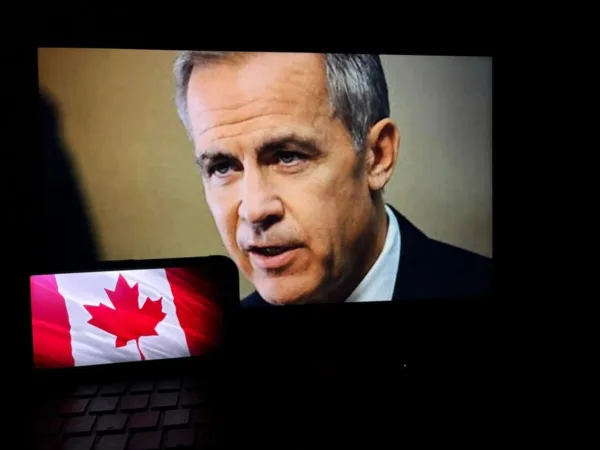
Mark Carney has released his climate platform for his leadership bid for the federal Liberal party of Canada, but it is just ‘more of the same,’ says Friends of Science Society in a new report by Robert Lyman. Titled “Putting Lipstick on a Pig,” Lyman’s report reveals the devastating financial impact of current policies, denouncing Carney’s plan to impose ever more stringent regulations, to shift the unpopular consumer-facing carbon tax to a higher burden on industry. Lyman denounced Carney’s interest in adopting the EU’s Carbon Border Adjustment Mechanism (CBAM), which goes into effect in the EU this year. CBAM is a tariff on imports from countries that don’t have carbon emission abatement programs equivalent to the EU’s or Canada’s. Onerous, mandatory Scope 1, 2 and 3 emissions reporting is inherent in CBAM implementation.
Friends of Science Society had issued a letter to the International Sustainability Standards Board in 2022. In it, potential financial burdens and social damages for mandatory emissions reporting in the USA were summarized by Steve Soukup, author of “The Dictatorship of Woke,” as, “The SEC’s own estimates suggest that the overall cost of disclosure and compliance for public companies will rise from approximately $3.8 billion per year to over $10.2 billion—a more than 250 percent increase, based on this rule alone.”
Carney is former governor of the Bank of England and of the Bank of Canada, and past UN climate finance ‘czar.’ He favors mandatory emissions reporting. He was a principal architect of the Global Financial Alliance for Net Zero (GFANZ) which intended to have the world of finance sway markets. In the US House Judiciary Committee report “Climate Control…” “the committee claims the ‘climate cartel’ is waging a ‘global war on the American way of life.’”
Curiously, in in his keynote speech at the 2021 UN Principles of Responsible Investment (PRI) China Climate Neutrality Week, Carney thanks China for the impetus for establishing the Network for Greening the Financial System and the groundwork for the mandatory emissions reporting which he now promotes.
Key banks and influential asset managers have since left GFANZ and similar organizations have disbanded as the US antitrust investigation continues.
Other Canadian commentators disapprove Carney’s climate plan. The Financial Post of Feb. 11, 2025, published an op-ed “Hiding the Costs of Net Zero doesn’t Reduce Them.” Writing in “The Hub,” energy analyst Heather Exner-Pirot is blunt about Carney’s plan – it is outdated, and the public have moved on to affordability and energy security concerns.
Far from ‘the science is settled,’ a new collection of scientific papers, posted on the Heritage Foundation’s site, demonstrate much of the alarmist rhetoric regarding climate change is vastly overstated. These papers align closely with and support the Trump administration’s current energy policy in the United States.
A new Friends of Science video “Nix Net Zero or Climate Billions will Bankrupt Canada” on the Clean Electricity Regulations released in Dec. 2024, shows that Canada would spend $690 Billion just to reduce 8% of its emissions from the electricity sector – possibly as much as $12 trillion to reduce all emissions. Canada’s annual GDP is only $2.2 trillion. Fraser Institute just released a report “Decarbonizing Canada’s Electricity Generation” on Canada’s impractical, unrealistic decarbonization goals.
Despite President Trump having pulled America out of the Paris Agreements and all other climate-related financial obligations, a group of states and cities called “America-is-all-In” vows to continue its forms of climate action, to meet Paris targets.
Joanne Marcotte, Canadian author of the book Inconvenient Doubts – Climate Change Apocalypse: Really, has written an extensive article about Mark Carney. She says the article could be considered an additional chapter of her book. Here’s the link to the pdf.
About Friends of Science
Friends of Science Society is an independent group of earth, atmospheric and solar scientists, engineers, and citizens who are celebrating its 22nd year of offering climate science insights.


more news

The First Heatwave of the Year… and the Same Old Narrative
March heatwave climate data - How long term temperature records challenge the climate narrative

The Strait of Hormuz Crisis Shows the World Still Runs on Fossil Fuels
The Strait of Hormuz, one of the world’s most critical energy chokepoints, highlights the continued global dependence on oil and gas. Recent geopolitical tensions have disrupted energy flows, exposing vulnerabilities in global supply chains and triggering emergency responses across Asia. Despite decades of rhetoric about an energy transition, fossil fuels remain indispensable for modern economies, not only for energy but also for agriculture, plastics and pharmaceuticals. The crisis underscores that energy systems are shaped by geography and economics, and that a full transition away from hydrocarbons will be far slower and more complex than often assumed.
The EU’s Nuclear Phase-Out Was a Blunder
Following Friedrich Merz in January, Ursula von der Leyen has now also admitted that the phase-out of nuclear energy was a major ‘strategic mistake’, not only for Germany but for the EU as well. American researcher Roger Pielke Jr. uses some simple calculations to demonstrate the magnitude of the EU’s strategic blunder.

