
CERES Team at Heartland Institute’s ICCC16: Bold Voices for Climate Realism
The CERES team presented new analyses at the Heartland Conference and challenges key assumptions and models in climate science. Their talks questioned the Earth’s energy imbalance, criticized IPCC methodologies, and emphasized the need for independent, data-driven research.

Source: CERES Team
CERES Team
Date: 16 April 2026
The Heartland Institute’s 16th International Climate Change Conference (ICCC16), held April 8–9, 2026, in Washington, D.C., brought together leading independent scientists, policy experts, and thinkers committed to evidence-based climate realism.
Against a backdrop of increasingly dogmatic mainstream narratives, the event highlighted alternative drivers of climate variability and critiqued the politicization of science. The Center for Environmental Research and Earth Sciences (CERES) played a prominent role, with co-founders Dr. Willie Soon and Dr. Ronan Connolly delivering three compelling presentations that challenged core assumptions of the IPCC-led consensus.
Their talks underscored CERES’s mission – pursuing rigorous, curiosity-driven research free from grant-driven paradigms or political pressure. From exposing measurement uncertainties in Earth’s energy budget to dissecting the IPCC’s selective curation of “settled science,” the CERES team offered fresh, data-rich perspectives that energized the audience and reinforced the value of genuine scientific debate.
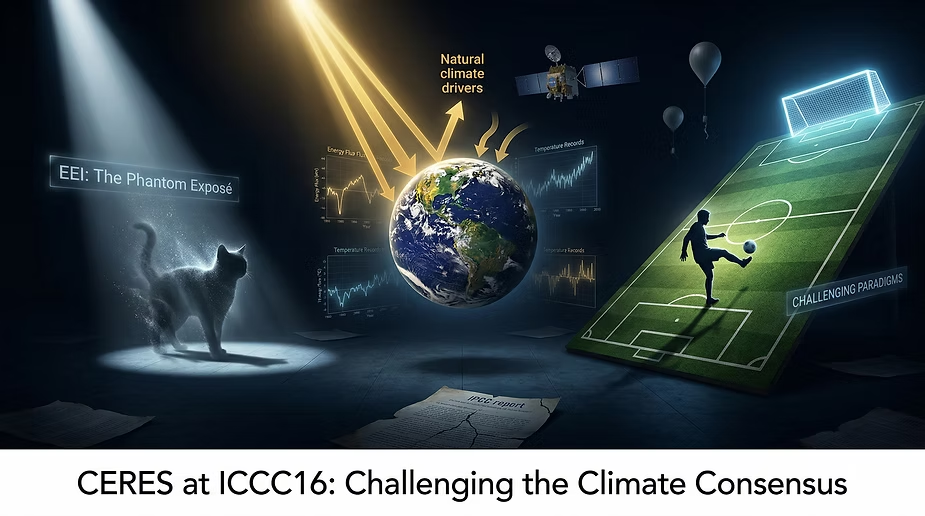
The Phantom 0.7 W/m²: Dr. Willie Soon Exposes the IPCC’s Earth Energy Imbalance Myth
Dr. Willie Soon’s presentation can be viewed here:
Slides can be downloaded here:

In a razor-sharp takedown of a cornerstone claim of the IPCC, Dr. Soon dismantled the much-hyped Earth Energy Imbalance (EEI) of 0.7 W/m² – the supposed “smoking gun” of dangerous human-driven warming. Framed by the unforgettable metaphor of hunting a black cat in a pitch-dark room – only to discover there never was one – he revealed how this number is not a measured physical quantity but a phantom, invented by James Hansen in 1985 as a model output to kill “wait-and-see” climate policy.
Raw NASA CERES satellite data actually shows a 6.5 W/m² imbalance – eight times the claimed signal – yet it was quietly “calibrated” to match climate models. Ocean heat content estimates from Argo floats suffer uncertainties of ±1 W/m² (detailed in the Cohler et al. 2026 paper), dwarfing the 0.7 signal. Total solar irradiance and planetary albedo measurements swing by several watts per square meter – again swamping the IPCC’s EEI claim.
Mainstream climate science, Soon concluded, is shouting “I found it!” while chasing a ghost. The EEI is unmeasurable with today’s instruments.
“We Own the Science”: Dr. Ronan Connolly Exposes How the UN Built the Climate Consensus
Dr. Ronan Connolly’s first presentation can be viewed here:
Slides can be downloaded here:

With signature Irish wit and forensic precision, Dr. Connolly delivered a hard-hitting exposé into the UN’s 2022 assertion that they “Own the Science”. He traced how the UN (via UNEP and the IPCC) has shaped the “scientific consensus” since 1990 – not through open inquiry but through selective curation, last-minute insertions, and ignoring inconvenient evidence.
Connolly walked through the IPCC’s evolution: the relatively balanced 1990 report acknowledging early 20th-century warming and mid-century cooling; the 1995 “smoking gun” fingerprint by Dr. Ben Santer that quickly collapsed; the infamous 2001 Hockey Stick that erased the Medieval Warm Period and Little Ice Age; and repeated reliance in subsequent reports (2007, 2013 and 2021) on detection-and-attribution computer models that downplay solar variability.
He highlighted cherry-picking of Total Solar Irradiance composites, dismissal of urban heat island biases (CERES work shows up to ~39% of Northern Hemisphere warming could be local urbanization), and how dissenting peer-reviewed papers were sidelined or misrepresented.
The punchline: the IPCC doesn’t discover science – it “owns” and curates a narrative, raising confidence levels while data gaps and natural explanations persist.
Far from settled consensus, it’s a carefully managed story.
Uphill Soccer: Why Real Climate Science Is So Hard – Dr. Ronan Connolly at ICCC16
Dr. Ronan Connolly’s second presentation can be viewed here:
Slides can be downloaded here:

In an inspiring masterclass titled “Uphill Soccer,” Dr. Connolly used Prof. Thomas Kuhn’s framework of the history of scientific progress to contrast “normal science” (downhill soccer: easy funding, peer approval, reinforcing the CO₂ narrative) with the grind of paradigm-challenging work.
Drawing from his late father, Dr. Michael Connolly’s legacy, he described how the Connollys pursued climate research in their spare time as environmentalists, rigorously stress-testing every assumption. Their breakthrough came from re-analyzing weather balloon data via the ideal gas law. Plotting molar density (pressure/temperature) against pressure revealed clean straight-line relationships with a fundamental shift at the tropopause.
With this insight, atmospheric temperature profiles can now be explained almost entirely by bulk gases (N₂, O₂, Ar, H₂O), leaving scant room for the greenhouse-gas dominance assumed in current climate models.
The CERES team realised early on that this work breaks too many paradigms for an individual paper. So, they have been tackling the publication of this groundbreaking research in a piecemeal manner, i.e., only questioning a maximum of 2-3 paradigms per paper.
Connolly dedicated the talk to his father and issued a call for courageous, evidence-led inquiry.
In the talk, he also emphasised the role of CERES, co-founded with Willie Soon in 2018, and how CERES’ scientific research embodies this model: science driven by curiosity, not grants, yielding as of today (April 13, 2026), 44 peer-reviewed papers and 174 co-authors across viewpoints.
Final remarks
The CERES team’s presentations at ICCC16 exemplified why independent institutions matter. In an era when funding, publishing, and media often reward conformity over discovery, Soon and Connolly demonstrated that real progress comes from asking hard questions and following the data –wherever it leads.
Their work not only exposes weaknesses in prevailing models but opens exciting new avenues for understanding our climate’s complex, multi-factorial drivers. CERES remains committed to this fearless approach. We invite you to explore the full talks, review our growing body of publications, and join us in supporting truly independent climate science on this website.
The pursuit of scientific understanding is never easy – but as our team showed in Washington, D.C., it’s always worth the climb.

more news
Six Impossible Things to Believe
Like Alice’s White Queen, European and Spanish authorities want us to believe six impossible things about climate change and the energy transition.

Hiding the Pea, Revisited: Remove the Scenario, Keep the Result
What happens when the framework changes but the outcome stays the same? This article revisits a controversial glacier loss study to explore exactly that question.

Energy Transition Meltdown Could Mean Global Bifurcation
According to Vijay Jayaraj, 2025 may be remembered as the year the energy transition narrative cracked, exposing a widening divide between ideology-driven policy and energy realism.

