
Climate.us: A Sign That the Climate Debate Is Far From Over
Many commentators have suggested that recent political changes represent some sort of permanent turning point in the climate debate. That would be a mistake, says Anthony Watts. The Climate.us project for instance, demonstrates that there remains a substantial network committed to maintaining the climate narrative.

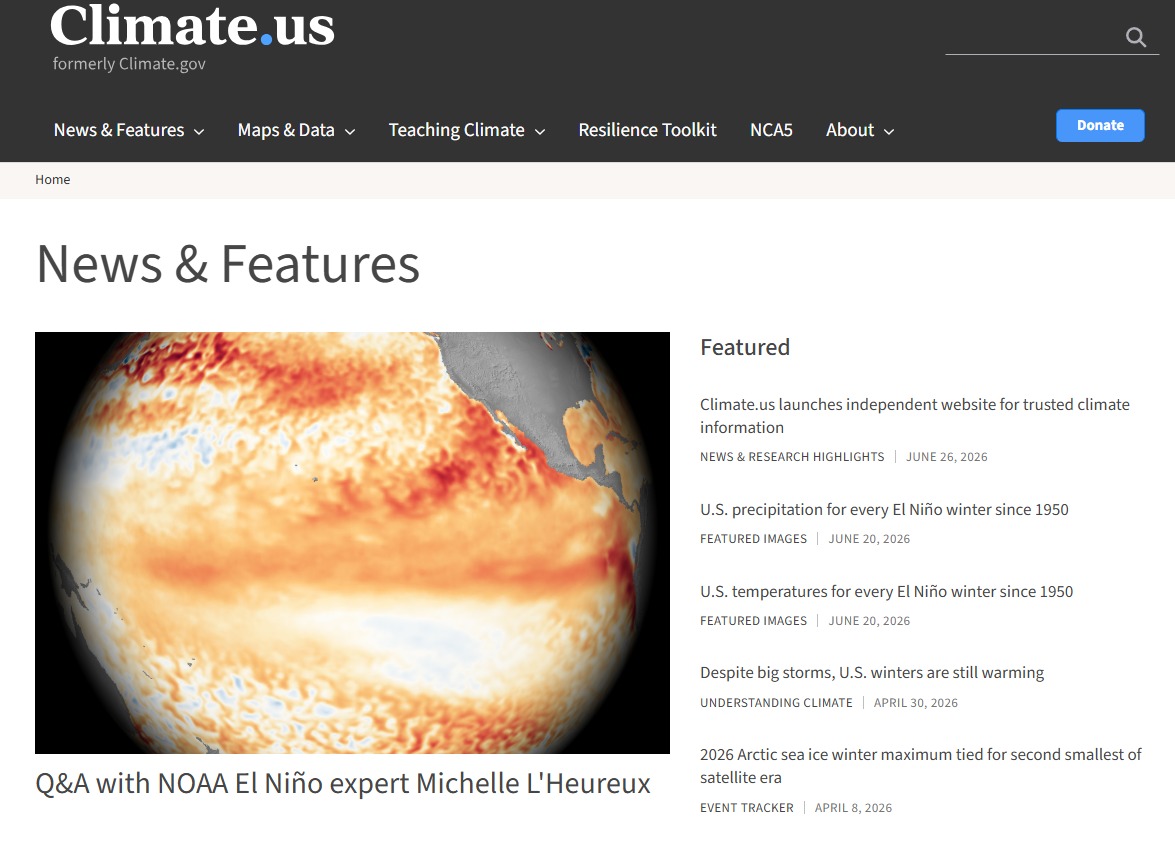
Homepage of the new Climate.us website
Anthony Watts
Date: 28 June 2026
According to a June 23 New York Times report, “Former NOAA Employees Revive Climate Site Shut by Trump Administration,” a small group of former NOAA employees has recreated much of the former Climate.gov website under a new domain, Climate.us, after the original site was effectively retired during the Trump administration. The project reportedly involved former NOAA staff, approximately $280,000 in crowdsourced funding, and the painstaking recataloging of more than a thousand reports, datasets, articles, and educational resources.
The Times presents the effort as a heroic restoration of a valuable public resource. Perhaps. But there is another way to look at it.
The fact that a handful of former government employees devoted substantial time and money to rebuilding a climate communications website demonstrates something many observers have long understood: the climate movement is not disappearing simply because the political environment has shifted. Far from it.
If anything, this episode illustrates the determination of climate advocacy networks to preserve and perpetuate their institutional infrastructure regardless of who occupies the White House.
What Exactly Was Lost?
One detail in the Times story deserves particular attention: NOAA communications director Kim Doster stated that research products previously housed under Climate.gov would remain available through NOAA.gov and affiliated websites.
That raises an obvious question: if the underlying data, research products, and reports continue to exist elsewhere within NOAA’s web ecosystem, then what exactly was being “saved”?
The answer appears to be less about preserving raw scientific information and more about preserving a particular presentation and advocacy interpretation of that information.
Climate.gov was never merely a repository of temperature records, satellite measurements, or hurricane statistics. It functioned as a communications portal designed to translate climate science for public consumption. As the Times itself notes, supporters valued it because it was aimed at teachers, journalists, and the general public rather than exclusively at researchers. In other words, it was a climate marketing tool.
That distinction matters. Scientific data and scientific advocacy/messaging are not the same thing. The existence of a website devoted to interpreting climate information through a particular institutional lens does not automatically make that interpretation indispensable.
The Problem of Relevance
There is another issue that deserves consideration. Much of the material being restored was created under assumptions, projections, and narratives that may or may not remain relevant to current conditions.
Climate science evolves. Datasets change, methodologies are revised, models are updated or cancelled, and forecasts are adjusted. Simply recreating an archived website does not guarantee that every article, educational resource, or explanatory document remains useful or accurate in light of current observations.
Indeed, one of the recurring problems in climate communication has been the tendency to preserve alarming projections long after real-world observations have complicated the original narrative.
That is why scepticism remains important. The question should never be whether information can be preserved. The question should be whether that information remains relevant, accurate, and consistent with observed reality.
Archiving material is easy. Critically evaluating it is harder.
Climate Advocacy Never Takes a Vacation
The broader lesson from this story is political rather than scientific. Many commentators have suggested that recent political changes represent some sort of permanent turning point in the climate debate. The reduction of federal climate programs, the restructuring of agencies, and the reassessment of various climate policies have led some observers to conclude that the era of climate alarmism is winding down.
That would be a mistake. History shows us that movements built over decades do not disappear overnight. The recent rise of irrational socialism is a perfect example.
The Climate.us project demonstrates that there remains a substantial network of activists, former officials, advocacy organizations, academics, and donors committed to maintaining the climate narrative regardless of changes in government priorities.
When one institutional pathway closes, another opens, when one website disappears, another appears, when one source of funding dries up, new funding sources emerge.
This is not unusual. It is how political and ideological movements operate. The climate movement is no exception.
A Preview of What Comes Next
The political winds are always changing, anyone who believes today’s policy environment will remain unchanged indefinitely has not been paying attention to history.
- Administrations change.
- Congressional majorities change.
- Agency leadership changes.
- Public priorities change.
When those changes occur, climate advocacy organizations will be positioned to move aggressively. The infrastructure is being maintained now precisely because its supporters expect future opportunities.
That is perhaps the most important takeaway from this story. The people rebuilding Climate.gov’s advocacy platform are acting on the assumption that climate politics remains a long-term project.
They are probably correct. Clearly, in their minds, the debate is not ending. It is merely entering another phase.
Why WUWT Matters
For that reason, websites such as Watts Up With That remain as important as ever.
The role of WUWT has never been to suppress information. It has been to examine claims, challenge assumptions, scrutinize data, and ask questions that many institutional climate organizations would prefer not be asked.
That mission becomes even more important when climate communications efforts become increasingly centralized and insulated from criticism.
- Independent scrutiny is essential.
- Scientific claims deserve examination.
- Model projections deserve comparison against observations.
- Policy proposals deserve cost-benefit analysis.
- Public communications deserve fact-checking.
Those responsibilities do not disappear when political circumstances appear favourable to climate sceptics.
If anything, this is precisely the moment when sceptical analysis must remain vigilant.
The recreation of Climate.gov under a different name serves as a reminder that climate advocacy infrastructure is resilient and persistent. Supporters of climate alarmism are investing significant effort to preserve the narratives, educational materials, and communication channels they regard as essential.
Those who favour open debate, transparency, and rigorous examination of climate claims should be equally committed to preserving institutions that provide critical analysis and alternative viewpoints.
Because one thing is certain: the climate debate is not going away, it is just waiting for the political winds to shift.
Political fortunes rise and fall. Administrations come and go. Government priorities shift, but the underlying contest over how climate science is interpreted, communicated, and used to justify policy will continue.
And when the political pendulum inevitably swings again, the push for expansive climate and energy policies will likely return with renewed vigour. That is exactly why independent sceptical voices must remain active, engaged, and prepared for the long haul.
We will have the 20th anniversary of WUWT in November; we’ve done it all without government grants, and we survived oppression, demonetization, and blacklisting by Google and other search platforms.
This article was published first on wattsupwiththat.com on 24 June 2026.

Anthony Watts
Anthony Watts is a senior fellow for environment and climate at The Heartland Institute. Watts has been in the weather business both in front of, and behind the camera as an on-air television meteorologist since 1978, and currently does daily radio forecasts. He has created weather graphics presentation systems for television, specialized weather instrumentation, as well as co-authored peer-reviewed papers on climate issues. He operates the most viewed website in the world on climate, the award-winning website wattsupwiththat.com.
The article you have just read was made possible by our donors.
Every day, Clintel publishes articles on climate, energy and science. We also translate and share international analyses in multiple languages, produce videos, publish reports and organize conferences and events around the world.
We receive no government funding and rely entirely on the support of our donors. Your support helps us promote independent research and contribute to a more open and balanced debate on climate and energy issues.
Would you like to support our work? Choose the option that suits you best:
• Become a Friend of Clintel – support us with an annual contribution
• Make a recurring donation – provide ongoing support and help us plan ahead
• Make a one-time donation – every contribution helps
Thank you for your support.

more news

The Tide is Turning Decisively Against Net Zero
The Tide is Turning Decisively Against Net Zero The cracks in the climate industrial complex are no longer hairline fractures; they are gaping holes, writes Tilak Doshi. Even some former apostles of the green faith, such as former UK Prime Minister Tony Blair, now admit that phasing out fossil fuels is “doomed to [...]

Unrealistic Canadian Climate Policy Bogs Down Economy
Unrealistic Canadian Climate Policy Bogs Down Economy "Canadian Climate Policy – What Comes Next?" is a new report by Robert Lyman, published by Friends of Science Society. US Endangerment Finding on carbon dioxide is consequential to central bank and Canadian climate policies. Friends of [...]
Václav Klaus: Should We – and Eventually Can We – Do Anything about Climate?
Should We – and Eventually Can We – Do Anything about Climate? Václav Klaus, former president of the Czech Republic, and a prominent signatory of the Clintel World Climate Declaration, recently gave a talk at the 34th Economic Forum Karpacz in Poland in a session titled “Climate Change– a Shared Responsibility”. Klaus said: [...]

