
Clintel President Václav Klaus: “We are productively and rationally thinking sceptics”
As Clintel enters a new era under the leadership of Václav Klaus, his inaugural address challenges the foundations of global warming ideology and calls for a renewed commitment to rational, evidence-based climate debate.

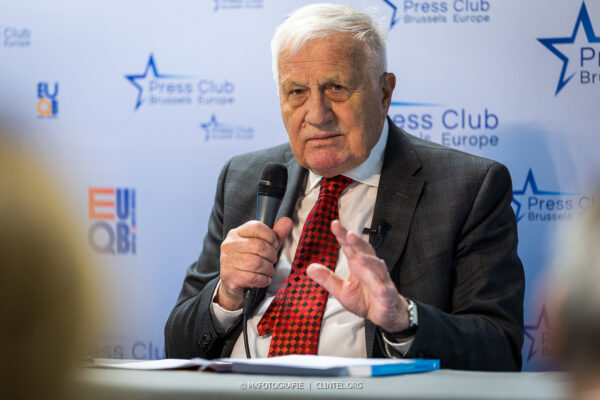
Václav Klaus, president of Clintel
Clintel Foundation
Date: 27 January 2026
In a pivotal moment for the global discourse on climate science and policy, Václav Klaus, the newly elected President of Clintel, has delivered his first presidential address. Titled “Global warming ideology: Clintel’s Contribution to the International Debate,” this thought-provoking piece marks the beginning of Clintel’s second phase, building on the foundational work of our founder and first President, Professor Guus Berkhout.
As many of our supporters know, Clintel was established six years ago to foster a network of over 2,000 scientists, experts, and free-thinking individuals worldwide who challenge the dominant narratives on man-made climate change. Under Professor Berkhout’s leadership, alongside Director Marcel Crok and our dedicated team, we have amplified climate realist voices and emphasized that climate science should be rooted in rigorous, self-critical inquiry rather than unquestioned beliefs.
Klaus, a renowned economist, former President of the Czech Republic, and long-time critic of environmental alarmism, was selected in December 2025 to guide Clintel forward. His address, penned during the Christmas season of 2025, echoes the reflective spirit of his seminal 2007 book Blue Planet in Green Shackles, which warned against the ideological shackles of green policies.
In this new address, Klaus expresses gratitude to our founders and collaborators while outlining a bold path for Clintel.
Key Insights from the Address
Klaus reaffirms Clintel’s core stance: there is no climate emergency. He emphasizes that we, Clintelers, are “no negativists. We are productively and rationally thinking sceptics”. He critiques the Intergovernmental Panel on Climate Change (IPCC) for promoting a “knowledge monopoly” that overemphasizes CO₂’s role while sidelining other climate factors. Drawing from his economic expertise, he highlights the flaws in climate modeling, likening them to outdated, prescientific approaches that ignore the principles of free markets, scarcity, and rational decision-making.
The address traces the roots of modern environmentalism to the Club of Rome’s Limits to Growth and warns of its evolution into a ‘secular ideology’ that threatens freedom more than the climate itself. Klaus notes the destructive impacts of policies like the European Union’s Green Deal and the push for net-zero emissions, which he argues impose unrealistic costs without proportional benefits.
Looking ahead, Klaus poses fundamental questions about human responsibility for temperature changes and the efficacy of climate actions. He proposes five key areas for Clintel’s focus:
- Re-evaluating climatic data and interpretations.
- Challenging the notion that ‘The Science Is Settled’.
- Critiquing the limitations of current climatological models.
- Applying economic analysis to green policies and their consequences.
- Exposing climate alarmism as an ideological construct rather than pure science.
Klaus emphasizes that Clintel is not a group of “negativists” but rational skeptics committed to productive debate. He calls on our network to leverage collective wisdom in an era where science is increasingly politicized.
A Call to Action
This address is a rallying cry for those who value truth over dogma. As Klaus concludes, quoting from his earlier work: “What is Endangered, Climate or Freedom?” We invite all Clintel members, supporters, and curious readers to engage with the full text, available here on our website. Join the conversation: Share your thoughts or consider becoming part of our global network. Together, we can ensure that climate discussions remain grounded in evidence and open inquiry.
If you would like to address one of the five questions raised by President Klaus by writing an article or essay, please contact Marcel Crok at marcel.crok@clintel.org.
Václav Klaus is an economist, author, and statesman whose critiques of environmentalism have influenced international debate for decades. He is founder and director of the Václav Klaus Institute in Prague.

more news
What is a “climate crisis?”
Before we declare a ‘climate crisis,’ perhaps we need a clear definition — grounded not in fear, but in evidence. This piece argues for quantifiable metrics over rhetoric.
COP30 fumbles the hard issue into the future
According to David Wojick the COP30 climate summit in Belém ended without resolving its toughest challenges — delaying decisions on fossil-fuel phase-outs, climate finance and trade policies until some unspecified “future roadmap.”
The Narrative Breaks: IEA Redefines the Future of Energy
The end is nigh – not for the world, but for the climate industrial complex. It has been a decline brought about mainly by the sheer reality of energy economics in the developing world.

