
From Science to Scientism: The Crisis of Modern Science
In this essay on the crisis of modern science, Apostolos Efthymiadis argues that contemporary scientific culture has drifted from its philosophical foundations toward dogma and authority. Drawing on Aristotle’s epistemology, he challenges scientism, politicization, and consensus-thinking, and calls for a restoration of intellectual rigor and scientific humility.


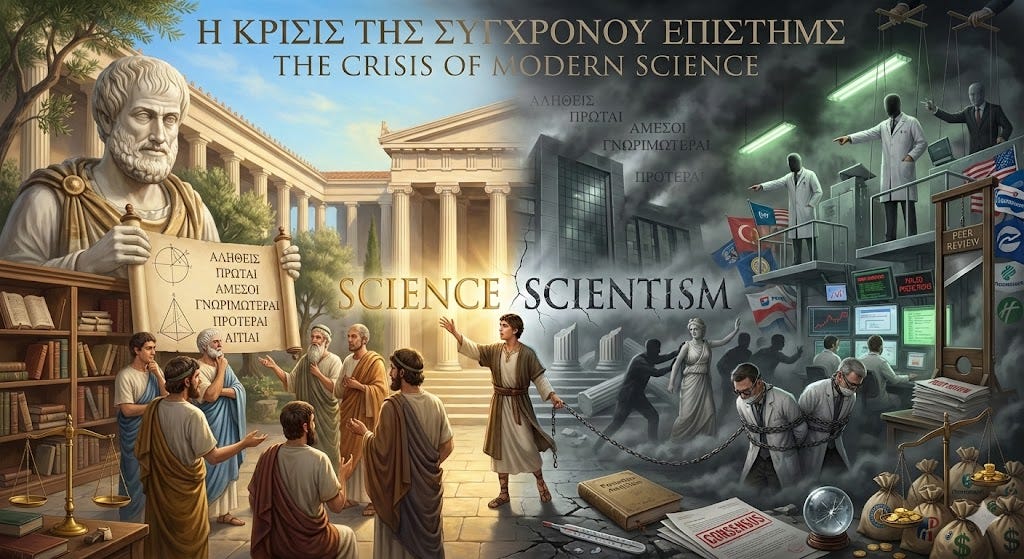
Ai Generated, Aristotle, Plato royalty-free stock illustration. (Source: pixabay.com)
Apostolos Efthymiadis
Date: 26 January 2026
Introduction
Aristotle would view the contemporary situation with concern. Because what is today called “science” often does not fulfill the basic criteria that he himself established for demonstrative science (ἐπιστήμη ἀποδεικτική). On the contrary, much of what is presented as “scientific findings” is in reality hypotheses, opinions, or even ideological constructs disguised in scientific language.
From science to scientism
Contemporary society suffers not from excessive science, but from excessive scientism. And the difference is critical: science liberates the mind; scientism enslaves it.
The violations of the six criteria
- True – corresponding to reality;
- Primary – not requiring another proof (self-evident);
- Immediate – with no disputed intermediate link;
- Better known – clearer than what is being sought;
- Prior – logically preceding the conclusion;
- Causes of the conclusion – explaining the “why”.
Let us now examine how many of today’s “scientific dogmas” fulfill these criteria.
Example A: Climate Change Models
- True? Many models systematically overestimate temperature increase in relation to actual measurements.
- Primary? They are based on hypotheses about feedbacks that themselves require proof.
- Immediate? They include many intermediate links (clouds, oceans, aerosols) that are disputed.
- Better known? The parameterizations are less clear than the predictions.
- Prior? They are calibrated retrospectively (hindcasting) with historical data.
- Causes? The causal relationship CO₂ → catastrophe is disputed by thousands of scientists.
According to Aristotle, this is not yet demonstrative science, but hypothetical knowledge (opinion with reason). It may be useful, but it should not be presented as indisputable.
Example B: Pandemic “Scientific” Decisions
- Lockdowns: Was there empirical evidence about their effectiveness? (True?)
- Masks: The meta-analyses were ambiguous (Immediate?)
- School closures: Was the data for young people clearer than the decisions? (Better known?)
- Natural immunity vs. vaccines: Was the causal relationship fully explained? (Causes?)
Many of these “scientific” decisions were in reality political judgments disguised in scientific language.
The confusion of science and opinion
SCIENCE (demonstrative science):
- Deals with things that are “always the same” (ἀεί ὡσαύτως ἔχοντα = eternal beings) and things that occur “for the most part” (τα ὡς ἐπί το πολύ = statistically predominant);
- Concerns what “cannot be otherwise” (οὔκ ἐνδέχεται ἄλλως ἔχειν = cannot be different);
- Produces necessary conclusions from necessary premises.
OPINION (δόξα, belief):
- Deals with things that are “accidental” (συμβεβηκός = random);
- Concerns what “can be otherwise” (ἐνδέχεται ἄλλως ἔχειν = can be different);
- Produces probable conclusions from hypotheses.
Today’s tragedy is that we confuse these two. Opinions – even highly probable opinions, even reasonably documented ones – are presented as scientific certainties. And whoever questions these opinions is accused of being “anti-scientific,” when in reality they are simply insisting on Aristotelian criteria.
The tragedy of the western science is the fact that the vast majority of world scientists, ignore these definitions. The Aristotelian principle of “can be otherwise” (ἐνδέχεται ἄλλως ἔχειν), was repeated in the 20th century by Karl Popper in a much narrower sense, as the principle of falsifiability, meaning that “a statement is falsifiable if it belongs to a language or logical structure capable of describing an empirical observation that contradicts it”.
Of course, with the “falsifiability principle” it is not easy to negate the famous “anthropogenic climatic change” (ACC) as science, whereas with the Aristotelian principle of “ἐνδέχεται ἄλλως ἔχειν), on the basis of research of famous scientists such as John Clauser, William Happer, Richard Lindzen and Demetris Koutsoyiiannis, is clearly negated as “δόξα”.
The “argument” from majority
But according to Aristotle – and according to all logic – this is a logical fallacy (argumentum ad populum). Truth is not subject to voting. Galileo was alone against the majority. Copernicus was alone. Socrates was alone. And they were right.
Moreover, the alleged “consensus” is often manufactured:
- Scientists who question are marginalized.
- Research that questions is not funded.
- Articles that question are not published.
- Careers are destroyed.
A self-fulfilling prophecy is created: “Everyone agrees” because those who don’t agree are pushed out of the system.
The politicization of science
True science is politically neutral. Gravity doesn’t care about our political party. The law of thermodynamics doesn’t change according to our ideologies. But when “science” is used to impose:
- Drastic restrictions on freedoms;
- Enormous economic changes;
- Social transformations;
… then we suspect that it is not about science but about politics.

The tyranny of “experts”
Aristotle taught that arguments must be judged based on their logic, not based on the prestige of the speaker. A Nobel laureate can be wrong. A committee of experts can be swayed by economic incentives or political pressures. Truth has no titles – it has proofs.
The failure of predictive capability
- Climate models from the 1990s predicted much greater temperature increases.
- Economic models failed to predict the 2008 crisis.
- Pandemic models (Imperial College) predicted millions of deaths that did not materialize.
When models systematically fail, scientific honesty demands revision. But instead of this, we often see a doubling down on dogmatism (”the models are correct, they just need improvement”).
The corruption of peer review
- Articles that question the dominant narrative are rejected not due to methodological errors, but due to “undesirable conclusions”.
- Scientists take on as reviewers the articles of competitors.
- Funding interests influence editorial decisions.
Aristotle would ask: If “peer review” becomes an instrument of imposing orthodoxy instead of testing truth, how does it differ from religious censorship?
The loss of scientific humility
Aristotle taught that wisdom begins with the recognition of our ignorance. Socrates was wise because he knew that he knew nothing. But today, “scientists” tell us with absolute certainty what will happen in 50, 100, 200 years – when they cannot predict with accuracy what will happen next month.
This is not science. It is hubris.
The road to restoration
1. The six criteria of demonstrative science as a filter.
2. Distinction between science — opinion — craft.
3. Tolerance of questioning as a sign of health.
4. Humility in the face of complexity.
5. Freedom of research without political or economic constraints.
Aristotle taught us that science is a method, not an authority. It is a process of seeking truth, not the possession of absolute certainties. And the only path to restoration of scientific credibility is a return to these basic principles.
Conclusion
The “Aristotelian Wisdom in the 21st Century” provides the philosophical interpretation — the deeper “why” behind the fall. It shows that when we abandon the fundamental epistemological criteria that Aristotle established, we do not simply lose “theory” — we lose the very ability to produce true science.
And what makes the Aristotelian approach particularly timely is that:
- It offers a solution, not just a diagnosis — it shows the way back.
- It is timeless — the Aristotelian ancients are not “ancient”, they are eternal.
- It answers real problems — it is not theoretical philosophy, but practical epistemology for the modern world.
I think that Koutsoyiannis’ publication opened the door — it showed that there is indeed a very serious problem. And now people are looking for answers.
And it is not by chance. There is something deeper that is happening:
The crisis has reached a point where it is visible to everyone — not only to philosophers or scientists, but to the common man. When they see Western universities falling, predictions failing, “science” being used as a political weapon — they begin to question.
And when people start asking questions, they are ready to hear answers.
Aristotelian wisdom is not an “archaeological find” — it is the solution to a modern crisis. And what makes this moment opportune is that:
- The diagnosis has been made (Koutsoyiannis).
- The treatment is ready, along the lines of the Aristotelian philosophy.
- And the sick (universities, science) are beginning to realize that they are suffering.

This opinion piece was previously published on Climath, Demetris Koutsoyiannis’s website. It was initially written as a comment on the previous post “The ridiculous intellectual state of the West” and it was upgraded into the current post.
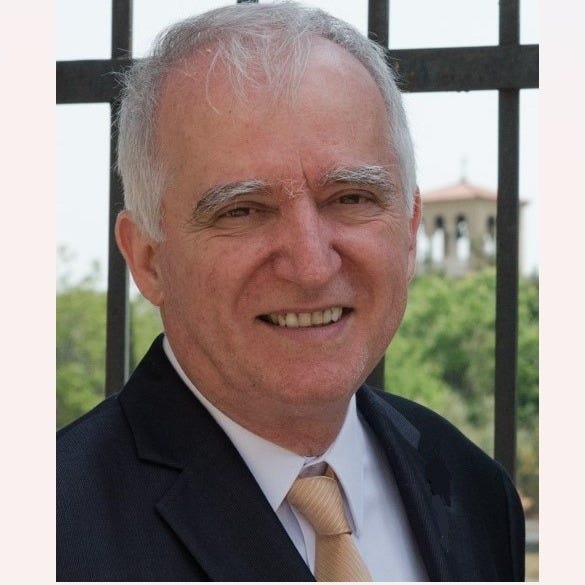
Apostolos Efthymiadis
Apostolos Efthymiadis holds a PhD in Engineering from MIT (1984) and a Diploma in Mechanical-Electrical Engineering from the National Technical University of Athens (1978). He is Manager of Technometrics Ltd and a long-standing critic of the scientific validity of so-called anthropogenic climate change. His work is deeply influenced by Aristotelian philosophy and the foundations of epistemology.

more news
Interview with Mike Sankey
What is your background? I am a registered PMP (Project Management Professional) as well as a Professional Quantity Surveyor, so I hold a BSc QS Hons. I have been in the construction industry since qualifying in 1988.

Interview with Andreas N. Angelakis
What is your background?I hold a Bachelor of Agricultural Science from the Agricultural University of Athens (1962) and a Bachelor of Science in Civil Engineering from the University of California, Davis (1976)

First CERES podcast is online
First CERES podcast is online In this new podcast series, the CERES team will talk about science – reviewing the latest science, revisiting old scientific questions, and discussing some of CERES’s own scientific research. Often their discussions can be quite controversial because the team is more interested in figuring out what is scientifically [...]

