
If fossil fuels come from fossils, why have scientists found them on one of Saturn’s moons?
They didn’t tell us, the term “fossil fuels” might be wrong too
Dr Willie Soon unleashes on the failures of climate change and modern science for 40 minutes with Tucker Carlson (see below). As an opening he explained how one of Saturn’s moons has more liquid fuel than than all the oil and gas deposits of Earth, which rather pokes a hole in the idea that fossil fuels are only ever made from fossils.

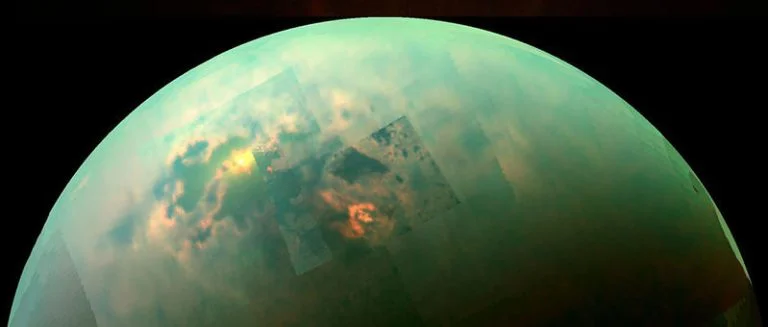
Essentially a frozen, lifeless moon with no dinosaurs, forests or peat bogs, somehow has lakes of methane. Not only does Titan have liquid seas of hydrocarbon fuel — but we’ve known this for years. In fact even in 2005 a NASA scientist quietly admitted that Titan had methane that wasn’t made from fossils. But where was NASA in the 18 years since?
Soon explains that Titan proves that abiotic oil and gas formation is true. In 2009 an experiment showed that when methane is put under great pressure like the kind we find 50-100 miles underground, it can form more complex hydrocarbons. (Kolesnikov). Several papers in the last dozen years find more exotic kinds of polycyclic aromatic hydrocarbons all over the place, like in Titan’s atmosphere and even forming in deep cold interstellar space. (Zhao, Parker, Freissinet) They also found benzene on Mars.
On his CERES sites, Willie Soon explains that in practical terms, we don’t know how much of the oil and gas on earth is made without fossils (in an abiogenic process). It could be forming 50 to 100 miles down, but we’re only drilling 6 to 8 miles deep. I seems we have little idea. Even if abiotic oil exists on Earth, it may form too slowly to be useful. Though there have been these odd claims out there for years that some oil fields are refilling.
What we do know, says Jo, is that they’re not trying to understand this, and they’re not trying to tell us the whole truth either. We’ve taught two generations of children that there is one simple narrative, and if you questioned it you were an idiot. Isn’t it time a civilization dependent on these fuels had an honest discussion about where they came from?
There’s a lot more in the interview about his experience at Harvard, and climate science and the sun.
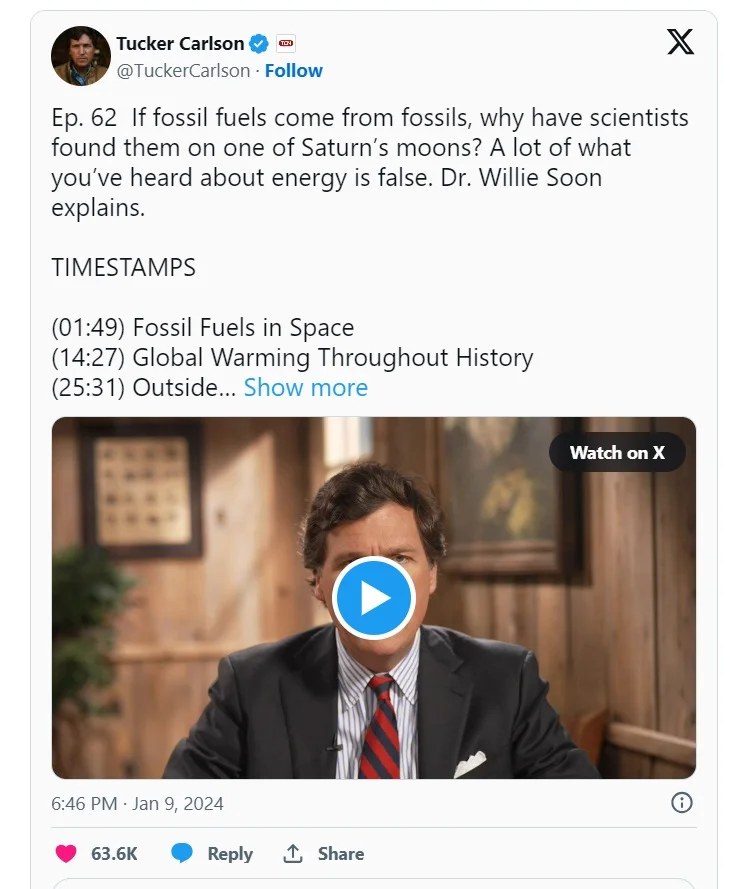
Willie Soon worked at Harvard in astrophysics for 31 years but prefers the freedom to say what he thinks and to research what he wants. He co-founded CERES-Science where you can find his other latest papers.
REFERENCES
Kolesnikov, A., Kutcherov, V. & Goncharov, A. Methane-derived hydrocarbons produced under upper-mantle conditions. Nature Geosci 2, 566–570 (2009). https://doi.org/10.1038/ngeo591
Mastrogiuseppe, M., Poggiali, V., Hayes, A.G. et al. Deep and methane-rich lakes on Titan. Nat Astron 3, 535–542 (2019). https://doi.org/10.1038/s41550-019-0714-2
Hayes, Alexander (2016) The Lakes and Seas of Titan, Annual Review of Earth and Planetary Sciences, Vol. 44:57-83 (Volume publication date June 2016)
Zhao, L., Kaiser, R.I., Xu, B. et al. Low-temperature formation of polycyclic aromatic hydrocarbons in Titan’s atmosphere. Nat Astron 2, 973–979 (2018). https://doi.org/10.1038/s41550-018-0585-y
C. Freissinet, et al (2015) Organic molecules in the Sheepbed Mudstone, Gale Crater, Mars, JGR Planets, AGU, https://doi.org/10.1002/2014JE004737
Dorian S. N. Parker and colleagues (2011), Proceedings of the National Academy of Sciences, https://doi.org/10.1073/pnas.11138271. [Link down, it may refer to this paper “Low temperature formation of naphthalene and its role in the synthesis of PAHs (Polycyclic Aromatic Hydrocarbons) in the interstellar medium”, https://doi.org/10.1073/pnas.1113827108]


more news

Yet Another Reason Why Wind And Solar Will Never Work
The idea that wind and solar power can easily replace fossil fuels sounds appealing. But behind this optimistic narrative lie complex technical challenges, such as intermittency, grid stability, and the crucial roles of synchronization and inertia in maintaining a reliable electricity system, concludes Francis Menton after a powerful presentation by Kathryn Porter.
CO₂ Can Cause Cooling Too? Climate Models Say Yes (Sometimes)
As Dr. Matthew Wielicki dryly put it: “Is there anything CO₂ can’t do?” The study behind that remark claims that rising CO₂ levels may even lead to regional cooling under certain conditions—highlighting just how flexible—and uncertain—climate model outcomes can be.
Press release GWPF: Event Attribution Studies are “a blot on science”, says Ralph B. Alexander
Extreme weather attribution studies are based on flawed logic and misleading statistical practices, according to a new report by The Global Warming Policy Foundation (GWPF). Author Ralph B. Alexander argues that these studies, which link individual weather events to climate change, are driven more by political and legal agendas than by robust scientific evidence.

