
Intellectual Yet Idiot: Ed Miliband and Britain’s Energy Crisis
“There are some ideas so absurd that only an intellectual could believe them,” said George Orwell. This seems to be the case with Ed Miliband who is now doubling down on the very climate policies built atop a now-discredited foundation.

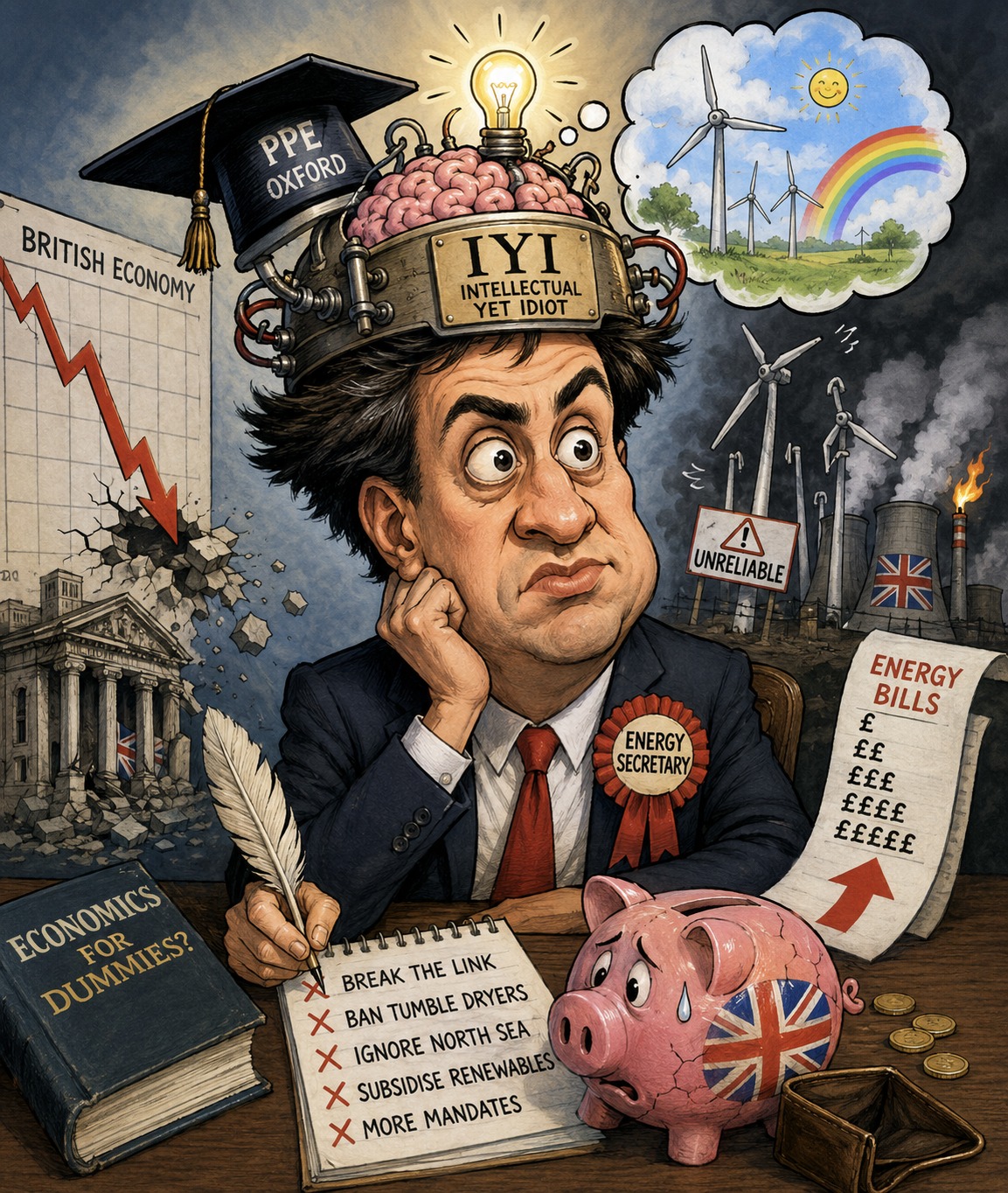
Ed Miliband as an IYI (Intellectual Yet Idiot). Image created with ChatGPT
Tilak Doshi
Date: 19 May 2026
The international committee responsible for the UN Intergovernmental Panel on Climate Change’s official climate scenarios quietly delivered a bombshell last month: the notorious RCP8.5 “business-as-usual” pathway — the extreme emissions scenario that has underpinned virtually every climate alarm, every net-zero urgency claim, and every justification for Britain’s ruinous energy policy for the past fifteen years — has been declared officially “implausible” and eliminated from the next generation of models feeding into the IPCC’s Seventh Assessment Report. The “era of global boiling” speech of the UN Secretary General António Guterres in 2023 now sounds even more ludicrous than it already did then.
Roger Pielke Jr. – whose research has been heavily cited by the IPCC across all three Working Groups – analysed this stunning admission by the panel in his Substack The Honest Broker on 29th April. The high-emissions scenarios (RCP8.5, SSP5-8.5 and SSP3-7.0) that dominated research papers, government reports, and headlines are now recognised as describing futures that will not happen.
Yet while the IPCC itself has finally abandoned the nonsense doomsday model it once promoted as the “baseline”, British Energy Secretary Ed Miliband, his fellow net-zero zealots in Whitehall, and his globalist colleagues in power in the EU, Canada and elsewhere press ahead with Net Zero undeterred. Indeed, ‘Mad Ed’ and gang is doubling down on the very policies built atop that now-discredited foundation. This is Intellectual Yet Idiot governance.
The IYI Class and Miliband’s Credentials
In a 2016 essay, Nassim Nicholas Taleb coined the term “Intellectual Yet Idiot” to describe the credentialed class — policymakers, academics, journalists and think-tankers — who impose grand narratives on society while bearing none of the costs.
What we have been seeing worldwide, from India to the UK to the US, is the rebellion against the inner circle of no-skin-in-the-game policymaking “clerks” and journalists-insiders, that class of paternalistic semi-intellectual experts with some Ivy league, Oxford-Cambridge, or similar label-driven education who are telling the rest of us 1) what to do, 2) what to eat, 3) how to speak, 4) how to think… and 5) who to vote for.
They may ace exams, dominate elite discourse and signal virtue from the safety of their stately homes in the countryside or Oxbridge common rooms but lack practical judgment and “skin in the game.” As the essayist and blogger Marcus Stone observed in his analysis of intelligence without judgment, that there is a clear distinction among mere ignorance (the absence of knowledge), outright stupidity (reflecting the bell curve in the distribution of IQ, a fact of life), and the irredeemable learned idiocy of those who cling to narrative over reality.
Long before Taleb, George Orwell put across the point acidly: “There are some ideas so absurd that only an intellectual could believe them.” Thomas Sowell was another keen observer of the phenomenon: “There is usually only a limited amount of damage that can be done by dull or stupid people. For creating a truly monumental disaster, you need people with high IQs.”
Ed Miliband, Britain’s Energy Secretary and a PPE – which does not stand for Pernicious Political Elite – graduate of Oxford, embodies the IYI archetype with alarming precision. He even wants to ban tumble dryers to appease Goddess Gaia. His recent pronouncements on “breaking the link” between gas prices and electricity bills, his dismissal of North Sea oil and gas resources, and his relentless program of mandates and subsidies for unreliable intermittent renewables reveal not just policy error. Miliband exposes a profound economic illiteracy that threatens Britain’s prosperity and energy security. The Guardian-reading ideologues and comfortable Oxbridge academics repeatedly intone net zero mantras and incantations of “cheap” renewables while ordinary citizens pay the bills.
“Breaking the Link”: Misunderstanding Marginal Pricing
Miliband’s flagship idea — repeated by his civil-service wonks, favoured economists such as Professor Mariana Mazzucato of University College London, and dutifully echoed by the Guardian and even the increasingly gone-woke Economist — is that the UK must “break the link between gas price and power price.” Chancellor Rachel Reeves (“Rachel from Accounts”) backs Miliband on this quest.
The argument runs that it is unfair for renewables to be priced at the marginal cost set by “expensive” natural gas generation. This, we are told, makes “cheap” wind and solar artificially expensive. It is a claim so basic in its misunderstanding of markets that it would fail an A-level economics exam.
Every freely traded commodity or service — electricity, gas, oil, copper, wheat, pork bellies, haircuts — prices at the margin. The highest-cost supplier needed to meet demand sets the price paid to all suppliers in equilibrium where the supply and demand curves intersect. The same principle is illustrated by Adam Smith’s water-diamond paradox: water is cheap because it is abundant at the margin; diamonds are costly because the marginal unit is scarce.
To be sure, no one expects Miliband and his PPE buddies to have read Adam Smith’s Wealth of Nations at school:
The things which have the greatest value in use have frequently little or no value in exchange; and on the contrary, those which have the greatest value in exchange have frequently little or no value in use. Nothing is more useful than water: but it will purchase scarce anything; scarce anything can be had in exchange for it. A diamond, on the contrary, has scarce any value in use; but a very great quantity of other goods may frequently be had in exchange for it.
Miliband and his fellow IYIs appear never to have encountered the concept. They mistake the foundational principle of marginal pricing in economics for a policy failure that can be legislated away. As independent energy consultant Katherine Porter explained in her excellent recent Spiked interview, every market participant understands this; only the IYI class treats it as a quirk unique to British power markets that can be abolished by decree.
North Sea Oil and Gas: Domestic Benefits Ignored
The same learned idiocy, so well described by Marcus Stone, infects Miliband’s second favourite talking point: that developing North Sea oil and gas is pointless because “we cannot influence world prices.” Again, the narrative trumps reality. Natural gas has no single world price; it trades in regional markets — Europe’s TTF, Asia’s JKM, America’s Henry Hub — because pipelines and LNG liquefaction and shipping impose large transaction costs on fungibility.
Increased domestic production would displace the most expensive marginal supply (often imported LNG cargoes), lowering the clearing price for British consumers. Ms. Porter said that increasing North Sea gas output could displace LNG entirely in summer months, when imports are low, and reduce prices accordingly. The gas from a North Sea rig does not magically enter a global pool; it flows through pipes straight into the British grid. And, yes, it will be priced at the margin, at the point where the most expensive supplier of North Sea gas meets the utility-consumer with the highest willingness to pay.
Oil is much more fungible since it is far easier to store and transport and there are global reference prices such as West Texas Intermediate (“WTI”) and Brent. Other crude oils price against these reference prices once differences in the quality of the crude and its location are accounted for. But the principle holds: increased North Sea production of oil or gas adds to the nation’s GDP whether it is exported or supplied to the domestic market. It also creates jobs, skills development, shareholder returns and tax revenues.
Again, Miliband’s PPE does not seem to have covered (or it was unlearned soon after school finished) the simple accounting convention GDP = C + I + G + (X – M) which is the most famous identity in macroeconomics. Britain’s GDP is the total value of all goods and services finally produced in the country in a year. By the accounting identity, it is also the sum of expenditures in consumption, investment and government spending plus exports (money foreigners spend buying British goods and services) less imports (money British people spend buying foreign goods and services).
Policy wonks
What is it that the policy wonks in Whitehall don’t get? How can it be fine for the UK to chase out further investments from its own jurisdictions of the North Sea while at the same time buying oil and gas from Norway in the face of this simple macroeconomic accounting? In a Robin Hood reversal, is Miliband’s aim to impoverish the country’s own citizens while enriching the already much richer Norwegians? This is all in the name of Britain’s “climate leadership” as Rupert Darwall has thoroughly dissected.
Under Miliband’s punitive windfall tax regime, it was reported last week that even BP is considering selling its North Sea assets for a full exit while Norway invests afresh. Norway’s government, unafflicted by Stone’s learned idiocy, issued 70 new drilling permits for oil and gas just last week.
Another garbled argument offered by UK’s Net Zero proponents in their quest to shut down new investments in the North Sea goes as follows: “Oil and gas are globally traded commodities. The UK is too small a producer to affect the world price. Therefore, more North Sea drilling will not materially reduce UK energy prices.”
At one level, this is trivially true. But anyone with a smattering of A-level economics would ask, “what has that got to do with anything?” Do countries produce stuff only if it reduces domestic prices? In what universe? Countries produce because it is profitable for them to do so (collectively speaking, since it is business firms that actually produce output). Increased production adds to the country’s GDP. The firm’s shareholders benefit as do those that gain employment and skills from the increased activity. And this does not include another elementary economic principle of the “multiplier effect”: the process by which an initial increase in spending, investment, production or income generates additional rounds of economic activity throughout the wider economy.
There is yet another version of idiot economics. An argument that circulates among Miliband allies, climate campaigners, net-zero commentators and mainstream media hacks runs roughly as follows: “North Sea oil is sold on international markets anyway, so it does not belong to Britain in any meaningful sense. Therefore drilling more does not improve British energy security or reduce bills.”
Yet again, one must summon much mental fortitude to grapple with the thoroughly befuddled logic. What happens to the UK’s balance of payments in all of this? Do not British exports improve the current account and strengthen the pound? Furthermore, how can increased output of North Sea oil and gas not enhance UK’s energy security, one asks incredulously. But in vain, for in the world of net zero zealotry, such views smack of right-wing Thatcherism.
IYI Economics vs. Real World
In the normal world, ordinarily, exports are good, production is good, profitable industries are good, trade surpluses are good, high-value industrial sectors are good. But in the leftist-globalist world of IYI governments and policy makers – where the Church of Climate rules supreme – fundamental laws of economics are legislated against, and hydrocarbons production is cast as morally suspect and economically irrelevant. When saving the world is at stake, these issues raised by level-headed economists are mere fripperies.
Profitability itself is suspect and attracts the charge of culpability. In a now deleted post on X, Mr Miliband accused BP of profiting from the Iran war crisis in arguing for retaining the windfall tax on North Sea investments. He considered it “morally economically wrong.” Of course, he did not try to understand why in times of extreme price volatility, commodity trading desks with sharp traders — as BP has — do exceptionally well. That is not, by any stretch of the imagination, war profiteering. Without the imprimatur of a PPE qualification, the double-barrelled adjective presented by Mr. Miliband is a bit of a poser. Back in the normal world, profits are good – since they pay for wages, rents, taxes and happy shareholders.
The British public has stirred. Britain’s stunning local election results delivered an unprecedented rout against both Labour and the Conservatives in favour of the relatively right-leaning Reform UK party which became electorally consequential only in the last year. It is a revolt by indigenous working- and middle-class voters against what David Starkey has called Britain’s long-standing ‘uniparty’ elite. It may mark the beginning of the end of the Westminster two-party system that has defined British politics since the late 17th century when the very concepts of the modern state first emerged.
To be sure, the revolt wasn’t just against Miliband’s punitive net zero mandates but against the entire package deal offered by the globalist uniparty elite which includes open borders, ever closer union with the EU despite Brexit, and the excesses of a politically correct welfare state that values immigrants over indigenes. The ballot box remains the only reliable mechanism for removing those who suffer no consequences for their luxury beliefs and idiot economics.
A sane energy policy — now that the IPCC itself has backed off from its implausible “end is nigh” scenarios — would start by recognising marginal pricing, not futilely trying to abolish it; allowing North Sea oil and gas output to rise so long as the private sector is willing to invest under competitive auctions; dropping the pointless carbon pricing on gas and indeed on all energy-intensive industry; putting a stop to the endless subsidies for renewables; ending the mandates for EVs that few want to buy; and cutting over-regulation of the nuclear power sector along, for example, proven South Korean timelines and costs rather than under Britain’s regulatory bloat.
Britain cannot afford another decade of IYI governance. Keeping the lights on, quite literally, depend on it.
This article was published first on 18 May 2026 on Tilak Doshi’s Substack

Dr Tilak K. Doshi
Dr Tilak K. Doshi is the Daily Sceptic‘s Energy Editor. He is an economist, a member of the CO2 Coalition and a former contributor to Forbes. Follow him on Substack and X.

more news

In a Warming World, Rising Cold Deaths Outnumber Heat Deaths 12 to 1
A new paper shows that in the USA, cold weather is a much larger contributor to mortality than heat, and that social vulnerability plays a major role in determining outcomes.

“It’s the sun, stupid!” gets new relevance
A new report from the World Meteorological Organization once again led to apocalyptic headlines in the newspapers last week. Unintentionally, writes Marcel Crok, the report opens the door to the most important factor in our climate: the sun.

Yet Another Reason Why Wind And Solar Will Never Work
The idea that wind and solar power can easily replace fossil fuels sounds appealing. But behind this optimistic narrative lie complex technical challenges, such as intermittency, grid stability, and the crucial roles of synchronization and inertia in maintaining a reliable electricity system, concludes Francis Menton after a powerful presentation by Kathryn Porter.

