
Jacob Nordangård: From the Polycrisis to a World Government
Climate Alarmism is part of a much bigger agenda driven by the UN, says Swedish scientist, author, and musician Jacob Nordangård. What is the real plan behind all this? The Swiss news outlet Transition News spoke with Nordangård.

Jacob Nordangård was one of the speakers at Clintel’s Conference in 2024. (Source: MK Fotografie/Clintel.org)
Sophia-Maria Antonulas/Transition News
Date: 18 May 2026
Transition News: Some believe that the recent crises and the associated profiteering are pure coincidence and that capitalism simply works this way: one thing leads to another, no one is planning a world government. However, in your book “The Digital World Control”, which has just been published in an updated and expanded German and English edition, you clearly demonstrate that some are following a specific plan, with the United Nations at its center. On what sources do you base your research?
Jacob Nordangård: I use original sources from the United Nations and all those organizations that prepared the UN’s Pact for the Future. This means, my research is primarily based on the statements of these institutions themselves. I also consult other sources, for example, the World Economic Forum (WEF), which has entered into a partnership with the United Nations.
Since when has this partnership between the United Nations and the World Economic Forum existed?
The official signing of the agreement took place in June 2019, attended by former WEF CEO Klaus Schwab, then-WEF President Børge Brende, UN Secretary-General António Guterres, and UN Deputy Secretary-General Amina Mohammed. However, the UN and the WEF had already been cooperating prior to this. Mohammed, for example, served on the board of the Young Global Leaders program. This means that the United Nations and the WEF had been closely linked for about a decade before the official partnership.
Did the developments surrounding Jeffrey Epstein have any impact on your work?
When I wrote the Swedish edition of this book, I was focused on the UN’s Our Common Agenda. It was only with the release of the Epstein files that I realized how deeply Epstein was involved with some of the key figures of this UN agenda, such as Brende. I have incorporated some of this information into the English and German version of my book.
The contents of the Epstein files essentially confirm my previous observations, about which I have written in my earlier books, including “Rockefeller – Controlling the Game” and “The Global Coup-Etat”. In these books, I describe these actors and networks.
Epstein was a member of the Trilateral Commission, which was established by David Rockefeller in 1973. Rockefeller brought Epstein into this group and also into the Council on Foreign Relations, another important think tank that primarily shapes American foreign policy.
What was Epstein’s role?
In his last interview with Steve Bannon in the spring of 2019, he recounts how David Rockefeller invited him to join the Trilateral Commission when he was in his early thirties, primarily because of his financial expertise. He also confirms, however, that he had good contacts and a network. He possessed several skills that were useful to the Trilateral Commission.
Currently, the focus is primarily on sex trafficking and the minors involved. But Epstein was important for connecting people. For example, he befriended Brende, the former president of the World Economic Forum, and they discussed how the WEF could take on the role of the United Nations. He was therefore a key figure in these influential networks.
In a recent article, you write that we are in the midst of the collapse of the old order. What is this “old order”?
The old order emerged after World War II with the Bretton Woods institutions – the World Bank and the International Monetary Fund – the founding of the United Nations, and the United States as the leading superpower. This was followed by the Cold War. I refer to the second part of this era as the “warm war” because climate change was then elevated to one of the greatest global problems. The post-Cold War era is dominated by the United States – it is therefore a unilateral system.
What is happening now is this: This old order is crumbling. The role of the United States will change, and as a consequence, the UN as a world organization will also change. This marks the end of the petrodollar system and of the American empire’ achievements. The UN’s Pact for the Future is part of this impending development.
Before we take a closer look at the UN’s Pact for the Future: The English title of your book is “The Digital World Brain”. Who came up with the idea of a world brain?
I borrowed the title from H.G. Wells, the science fiction and political writer. He belonged to the Fabian Society and was very interested in utopian ideas for a new world system. In his book World Brain, he describes a new system with a world government that controls the global flow of information and uses science to create a utopia. Science decides what is done and what humanity is supposed to believe – based on scientific findings controlled by a select few. It is, therefore, a scientific dictatorship. This text dates from the 1930s. However, the underlying idea is older and has been revisited many times.
The modern concept of scientific dictatorship can be traced back to Wells. But Julian Huxley, a friend of Wells, and the Jesuit Pierre Teilhard de Chardin also held similar views on technological change and a technological society, a kind of techno-utopia.
In “The Digital World Brain”, you analyze the twelve proposals of the United Nations contained in Our Common Agenda. This agenda was published in 2021 to establishment commitments for implementing the 17 Sustainable Development Goals (SDGs). These commitments include, among other things: leave no one behind, build trust, and listen to young people. It all sounds quite reasonable. What does this have to do with a scientific dictatorship or a techno-utopia?
Such plans are always packaged in fine words. But we need to see the plans behind these well chosen words. Let’s take the slogan “Leave no one behind” and look at what the UN’s Our Common Agenda and Pact for the Future actually intend: It’s about the digitization of more or less everything on this planet, everything that can be recorded and monitored.
It is a perfectly ordered and controlled system. No one is to be left behind, as everyone must be part of the system. As a precaution, everyone is monitored.
And when “we” say they want to listen to people, according to “our shared agenda”, it’s about learning what people do and think. Not about giving citizens a real say. “We” have a vision and a pact for the future. And “our” plans are to be implemented, so “we” want to know how people react.
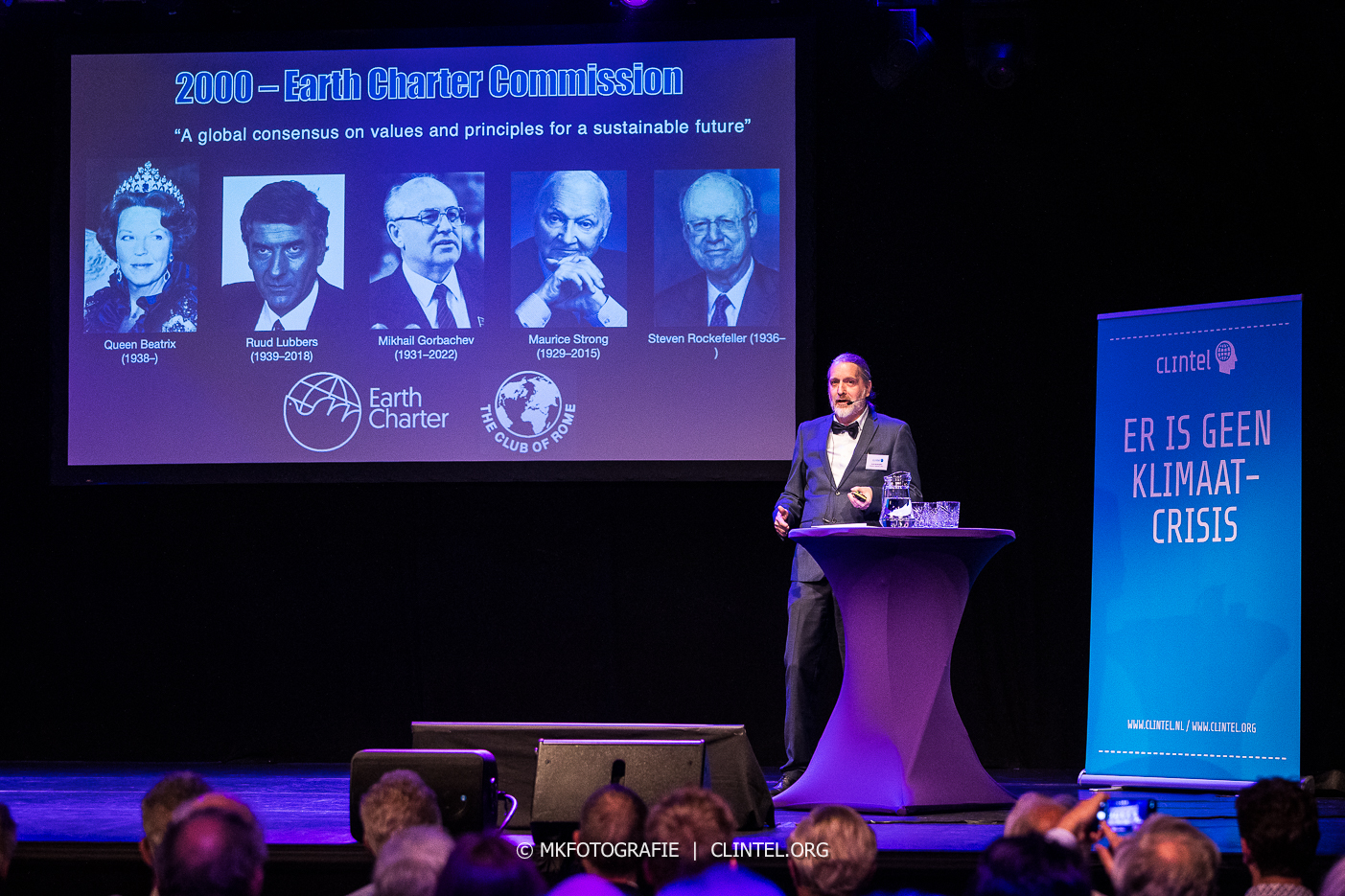
Jacob Nordangård at Clintel’s Conference in 2024. Source: MK Fotografie/Clintel.org
Pseudoscience as Religion
But everything is based on “their” science. I consider this to be pseudoscience. It’s not real science, but a political vision sold as science. I taught and researched at the university for many years—science means questioning everything in order to constantly improve. But here, “science”, which is largely based on model calculations and computer simulations, is being instrumentalized as a religion: If people follow “our” path, it leads to paradise; if not, it leads to hell. “We” must therefore convince people to choose the path “we” discuss at the United Nations. “We” have this one great goal.
Our Common Agenda and The Pact for the Future are based on behavioral design and behavioral science. This behaviorism is used to steer people in the right direction. This corresponds to totalitarian thinking. It is not a particularly empathetic way of dealing with people, but rather turns them into objects that can be programmed to better conform to the visions of those behind these plans.
And when they say: “We want to listen to young people and work with them,” it basically means that young people are to be steered in a certain direction.
Young people can’t simply express their opinions freely. They are asked: “What do you think of climate policy? Should it be stricter or more lenient?” “I don’t believe in it” is not an acceptable answer. These “facts” must not be questioned. Questionnaires and focus groups serve only to justify the implemented measures.
Why is there such a focus on the year 2030?
Because these 15-year plans exist. From 2000 onwards, there was this test run with the Millennium Development Goals until 2015 – few have heard of it or remember it – and the goals were not met. But this time, for the year 2030, everything has gained enormous importance and has been used for propaganda purposes since 2015. However, I suspect that the United Nations will no longer be able to successfully implement the Sustainable Development Goals as they are presented to the public by 2030.
So there will be new goals for 2045 – a crucial milestone. In future scenarios, the project is described as The Great Transition – the aim is to establish a world government by the UN’s 100th anniversary. The period leading up to it is a transitional phase, and we are currently in the first stage of this transformation. 2030 is simply a pivotal year on the path to achieving this goal.
Cyber-biological Systems
And how does artificial intelligence (AI) contribute to implementing this one world government?
I believe the elites of this world view AI as a perfect system because they previously relied on other people to carry out their orders – that is why totalitarian systems can never last in the long run.
If they use this AI-driven system instead, no one stands in the elites’ way: no one can destroy it from within. They can set rules and regulations and tell the autonomous AI system, the world’s control system, what they want to achieve, and it will be implemented.
From where does this idea that humanity could unite with machines and the financial system actually stem?
This too is an old idea and closely linked to transhumanism. Eugenics, with its aim of changing and improving humanity, is part of this. Transhumanism has taken this to a new level by using technology to modify us, integrate us into the system, and digitize us.
This development took place at the beginning of the computer age, especially from the 1990s onward. Like many others, I simply considered it the pipe dreams of a few tech enthusiasts at the time. But now it’s ubiquitous and serves as the foundation of the Fourth Industrial Revolution. These transhumanist ideas found particularly fertile ground at the World Economic Forum.
And in 2019, the United Nations and the WEF entered into this very partnership, enabling the World Economic Forum to support the UN in implementing the 2030 Agenda. This is being achieved using the technologies of the Fourth Industrial Revolution, more precisely, cyber-biological systems. In this process, humans, machines, and the financial system are merging. This is a crucial aspect, as it leads to a complete transformation of the old, dying system. We will, therefore, integrate ourselves into the financial system.
How far has this project, the cyber-biological system, progressed? Are the elites on schedule?
We only need to look back three decades to see that much has already been achieved – people are very adaptable. Here in Sweden, cash is hardly used anymore. Thirty years ago, everyone paid in cash; card payments were uncommon. The so-called pandemic or even wars serve to change systems without much fanfare because people are thinking about other things.
Wars are also being fought locally, like here in Sweden, in my hometown: We have bombings, shootings, and crime. At the same time, this agenda is being implemented: Surveillance cameras have been permitted in public streets for two years now, and they are now installed everywhere.
From the WEF to an UN 2.0
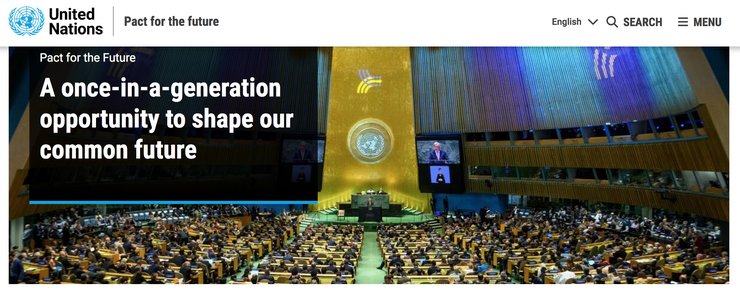
Screenshot of the UN website ‘Pact for the Future’
How has the UN’s Pact for the Future, which seems to be a very important milestone, been developed?
In 2020, the member states of the United Nations adopted a resolution calling on Secretary-General Guterres to produce a document addressing the following question: How can we create a better, more effective UN that can respond to crises such as a pandemic?
Negotiations then took place, and eleven strategy papers were published. Parts of these were incorporated and supplemented in Our Common Agenda. This agenda is rather concise and only describes the desired goals. In addition, there were policy briefs that are considerably more comprehensive, discussing all topics in detail and developing concrete proposals for achieving the desired goals.
The member states then met to discuss these recommendations and thus develop a document that would serve as a Pact for the Future. There were therefore three successive phases. All states were required to agree to the UN’s Pact for the Future in advance in order to implement it more efficiently.
Back in 2024, did all countries agree to the Pact for the Future and a UN 2.0? And if so, what purpose does the multipolar narrative serve?
As I said, the pact was agreed upon by all member states and adopted by the United Nations and the member states. Russia has stated that it will not implement all points. In my book, I explain that they intend to follow the points they consider sensible, particularly the digitalization agenda.
Regarding multipolarity: I see the world currently in the same state as after the Second World War, when Great Britain lost its power and the British Empire gradually disintegrated after the Suez Crisis. We are experiencing something similar now. The United States can no longer do or achieve the same things as before, and it is expensive – that’s usually how an empire ends: the money runs out, the resources are exhausted, it’s no longer profitable.
A multipolar system with regions is now being prepared. An organization called the Stimson Center has been significantly involved in drafting the recommendations for the UN Pact on the Future and repeatedly emphasizes this future world order with regions.
The geostrategist Zbigniew Brzezinski co-founded the Trilateral Commission with David Rockefeller and served for a time as Jimmy Carter’s national security advisor. In his book “The Grand Chessboard”, he developed proposals for how the American empire should function. His goal was to prepare for and shape a new world in which the United States would no longer be the dominant force, but rather the UN would assume this role: The world’s regions would cooperate under the umbrella of the United Nations—a modernized, effective organization capable of operating efficiently on a global scale and no longer merely an informal circle.
Trump and the Polycrisis of the Superclass
In this context, what purpose do crises such as Covid-19, the energy and food crisis – the polycrisis – serve?
These crises serve as a trigger. Because in 2024 something very important was not achieved with the UN’s Pact for the Future: the creation of a so-called emergency platform. Instead, we now find ourselves in this permanent crisis situation, which shows the world that we are unprepared and unable to solve these problems.
I have already written about this in my doctoral thesis, about these events that are necessary to introduce new political measures and gain public approval. And the actions of US President Donald Trump are creating even more problems. This, too, is about gaining approval for the new world system in order to push through the emergency platform and a UN 2.0. The current multi-crisis will ultimately help those who developed these plans for modernizing the United Nations to obtain the necessary approval for their implementation.
What role does Trump play in bringing about the United Nations 2.0?
I call him “Wreck-It Trump” because he’s razing the old structure to the ground. He’s destroying the existing system. The United Nations isn’t functioning as it should, and he’s paving the way for something new. Trump is the perfect candidate for it. Nothing will be left of the old system. And when he’s finished and his time is up, they can simply take over with this new system.
And everyone will say: “Finally, reason prevails. A new system that will make the world safer again.”
“It’s not about reforms. It’s about power. And about the question: Who decides about our lives?” This is a quote from the description of the German edition of your book. Who are these few who want to control the lives of billions of people?
They belong to the superclass, as David Rothkopf calls them in his book. These are oligarchs who control the global financial world and the economy. They can be found, for example, in the World Economic Forum and in philanthropic organizations.
In Rockefeller – Controlling the Game I write about one of these families, and I show how the climate protection agenda came about and what lies behind it.
Here in Sweden, a family named Wallenberg is very powerful. Like the Rockefellers, they belong to the Bilderberg Group and the Trilateral Commission. These are extremely influential networks that shaped the old order and now want to gain control of the new one.
They also bring in people from other regions, such as multi-billionaires from India, South Africa, China, and Japan. This elite seems to think they are the chosen ones. Those who have the potential to be successful, to reach the highest positions of power, and to run successful companies consider themselves better than others. This can also be seen in Epstein’s mindset and his statements.
How many are at the top of the pyramid?
Well, the superclass comprises several thousand individuals worldwide. And among them, of course, there are hierarchies. Some are higher up. But who really knows who’s at the top?
Other agents
In “Digital World Control” you also introduce the key players driving this agenda, such as Johan Rockström, who advised Greta Thunberg. Who is this man?
Johan Rockström is an agronomist. He was selected by Bert Bolin for a position at the Stockholm Environment Institute. Bolin, in turn, was the first chairman of the Intergovernmental Panel on Climate Change (IPCC), and Rockström succeeded him. He is a key figure in climate policy and now heads the Potsdam Institute for Climate Impact Research (PIK) outside Berlin.
Previously, Rockström headed the Stockholm Resilience Centre. This center was founded with the goal of developing a system for “planetary boundaries”. This explanatory model is crucial for the worldview of the elites and their control system. Rockström and his network of scientists use it to define what we as human beings are even capable of doing on this planet.
He speaks regularly at the World Economic Forum. Furthermore, he is connected to several highly influential networks that advise not only the wealthy and powerful, but also governments worldwide. These include the Climate Governance Commission (CGC), which recommended, even before the 2024 Summit on the Future of Europe, that the UN General Assembly declare a climate emergency because humanity is exceeding planetary boundaries – of which there are nine.
The emergency platform is intended to serve as a means of implementing the super-class’ plans worldwide.
Rockström belongs to the elite group of scientists who define our limits and determine how many resources we are allowed to use or what we can eat. He is also a member of the organization EAT which advocates for a transformation of the global food system.
This man is very influential, but he’s just one player. Before him, Hans Joachim Schellnhuber headed the Potsdam Institute for Climate Impact Research (PIK). He advised Angela Merkel, the European Commission, and even the Pope on climate issues. People like Rockström or Schellnhuber work on this topic until they retire, and then there’s a successor. They certainly play an important role in achieving the goals, but the real power brokers are the philanthropists, the super-rich.
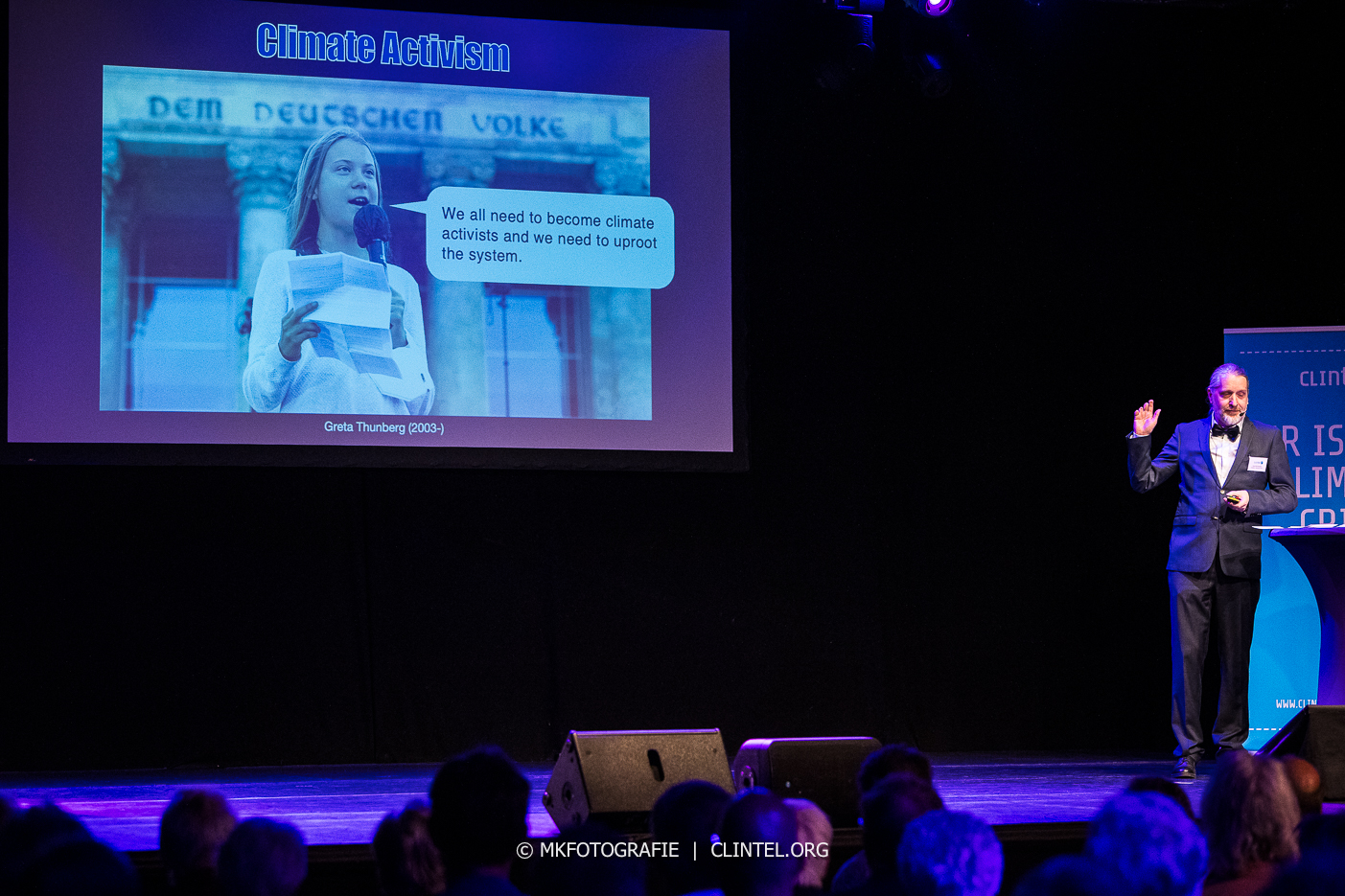
Jacob Nordangård at the Clintel conference in 2024. Source: MK Fotografie/Clintel.org
What is Sweden’s role when it comes to creating a world government?
Sweden acts, in a sense, as a mouthpiece for these influential forces, including the Trilateral Commission, the Council on Foreign Relations, and the Bilderberg Group. My home country assumed this role quite early, in the 1950s, and expanded it in the context of climate research and environmental protection.
Sweden hosted the first UN Conference on the Human Environment in 1972, and numerous key players driving this agenda originate from there. However, they are more or less merely proxies for these influential networks. As previously mentioned, the Wallenberg family largely holds the reins in Sweden and controls many large companies; they are very closely connected to the super-class. They have always had influence over the Swedish government—regardless of whether the Social Democrats or the Moderates are in power.
Furthermore, according to futurologist Graham Molitor, innovations are implemented particularly quickly in Sweden. We seem to simply adopt new technologies without questioning them because we are so progressive .
On the other hand, the Green Party in Sweden achieves about six percent of the vote.
That doesn’t matter. Because, if you look more closely at the climate and environmental agenda, you’ll find that it’s not genuine green policy, but rather digital policy. It doesn’t matter whether the country is governed by right or left leaning parties.
When it comes to this global agenda, everyone agrees. The Greens are only the activist arm.
In my doctoral thesis, I have examined how these environmental organizations are financed and organized by elite networks to popularize these activists and their actions – ultimately, it’s about controlling the entire population, every single individual. That’s why we need these opposition parties and movements.
I also have a history with the Greens; I experienced all of this firsthand. Therefore, it was quite a shock for me when my research revealed that oil barons like the Rockefellers were behind the environmental movement. They were involved in developing precisely the kind of policies that we as Greens supported.
Via Berlin and Kyiv to Technocracy
What purpose does the climate agenda serve, if oil companies exploit this narrative?
The Rockefellers and their philanthropists clearly dictate what “we” want to achieve. The climate agenda originated at a meeting with eugenicists in the 1950s. In 1952, John D. Rockefeller III and Detlev Bronk, then head of the National Academy of Sciences (NAS), met to discuss a population control plan. This led to the formation of the Population Council. Roger Revelle also attended the same meeting.
In the 1950s, Revelle made global warming a central concern and an important area of research. He also played a crucial role as an advisor to US President Lyndon Johnson in the 1960s. At that time, there was a project called the Special Studies Project with support from the Rockefeller Brothers Fund.
The Rockefeller Brothers Fund, in turn, was managed by the sons or grandsons of John D. Rockefeller. We have David and John D. III, and Lawrence and Winthrop. These brothers received money from the Standard Oil Corporation – oil money – and considered how they wanted to change the world. They came to the conclusion that science was a good way to transform society, given the scientific collaborations between countries. They themselves had established these collaborations, for example, through the Rockefeller Foundation, by providing funding to universities around the world.
The basic idea was that such problems cannot be solved by any one nation alone. They must be solved, more or less, by an international body. So, on the one hand, we have population control, and on the other hand, the idea of a kind of world authority that has to assume control. The other scientific problems were pandemics and the associated global health problems.
Diseases were recognized as a global lever as early as the 1950s. Everything happens quite openly. Why do so few people engage with this topic?
Questioning these things comes at a price. After I uncovered these networks, it was very difficult to keep my job as a university lecturer.
When I defended my doctoral thesis – “Ordo ab Chao: The Political History of Biofuels in the European Union. Actors, Networks and Strategies” – in 2012, my opponent said right at the beginning: “You know, my institution has just received funding from the Rockefeller Foundation.” The chairman of the Club of Rome also tried to prevent my dissertation from being accepted at all.
But what surprised me most was this: I came from the environmental movement myself, but when I tried to warn my fellow activists that these oil companies were involved, some of them got really angry. The more we talked about sustainable development, the more cars and technologies were introduced. Nobody wanted to question that. Universities and environmental organizations alike receive funding from these foundations. In the end, it’s all about the money.
But you continued working as a lecturer after that?
Yes, first for a few years at Linköping University and then at Stockholm University. But it became increasingly difficult. Because many, especially junior researchers, discovered that I don’t really subscribe to the climate dogma. And that makes you less trustworthy. We don’t want to tolerate such a “climate denier” at “our” institution.
Apparently, it was just one student who googled me and found out I had written a critical paper on climate change; he probably complained to the head of the institute. For me, this was no longer a pleasant working environment.
But after I wrote the book “The Global Coup-Etat” in the first year of the “pandemic” it became unbearable. Mainstream medicine and the Covid-19 mandates could not be criticized. That was morally unacceptable.
Did you immediately recognize the fraudulent scheme in March 2020?
More or less. In April 2019, I published my book about the Rockefeller family, describing how their plans for the world were to be achieved through the Fourth Industrial Revolution. While researching climate change, I also came across information related to the health sector. So, it was quite easy for me to put these pieces of the puzzle together.
And have the mainstream media reacted to your publication about the coup?
No. My view was simply considered extremist at the time. Sweden was, of course, the better place to live during the “pandemic.” But the media stated, “anyone who doubts that is an idiot.” Alternative media outlets reported on my book, which was published in December 2020, and it quickly sold out.
In 2024, the WEF opened the Global Government Technology Center in Berlin. What happens there?
The goal is to build new systems for governance. These will not be controlled by humans, but by an agent AI. Stanley Milgram coined the term “agentic state” – a state in which someone simply follows the wishes and instructions of the authorities.
A white paper from the Global Government Technology Center bears precisely this title: “The Agentic State”. The agentic AI will be the authoritative body, issuing commands and carrying everything out efficiently, and is intended for use in the UN emergency response platform – without humans who could say: “No, I won’t do that.”
Another Global Government Technology Center is located in Kyiv, where these systems can be tested – this is easier to accomplish in a country at war. That’s why many WEF representatives are working with Ukraine.
To cope with these dystopian plans of the superclass, you have even founded a rock band?
Being creative is very important, because this is part of being human. In addition, I give lectures and write about my research findings. That’s how I process everything. And I’ve made some very good friends along the way.
But how should humanity ideally respond to this technocratic threat?
This attempt by the superclass to rebuild the Babylonian Tower will fail. As soon as the last piece of the puzzle is in place, everything will begin to crumble and collapse. Those building this system use lies and every possible manipulation technique to bring people under their total control. And while the truth lags behind, it is catching up.
People see through this. The truth will come to light and wash everything away. So they are trying an impossible undertaking.
At the same time, I think such projects are inevitable. There have always been, and always will be, people who strive for power. When this tower collapses, someone will try to rebuild it. But perhaps we have some time in between to better prepare the world for these psychopaths.
This interview was originally published in German on Transition News on 11 May 2026
The book Rockefeller – Controlling the Game by Jacob Nordangård is available in our Webshop.

more news
An engineer takes a sober look at the Net Zero 2050 project
“At first, I thought the Net Zero 2050 project was pointless, but after careful consideration, I think it’s insane.”
Orwellian Sacking of Editor for Allowing Debate Over Climate Change
An academic editor has been dismissed after publishing research that challenges mainstream climate discourse, raising serious questions about the state of open debate in science and media.

The ‘Climate Crisis’ of 1695
Centuries-old thermometer records show central England warmed 2°C in 40 years—twice the rate of modern warming.

