
Michelle Stirling: CBC brings Soviet-style propaganda to Canada
CBC is reporting on a new study by Pruysers et al. (2025) that claims people sceptical of climate change have personality issues associated with the “Dark Triad:” narcissism, Machiavellianism, and psychopathy. In contrast, they say those who agree with catastrophic human-caused climate change narratives exhibit prosocial traits like agreeableness and honesty-humility.

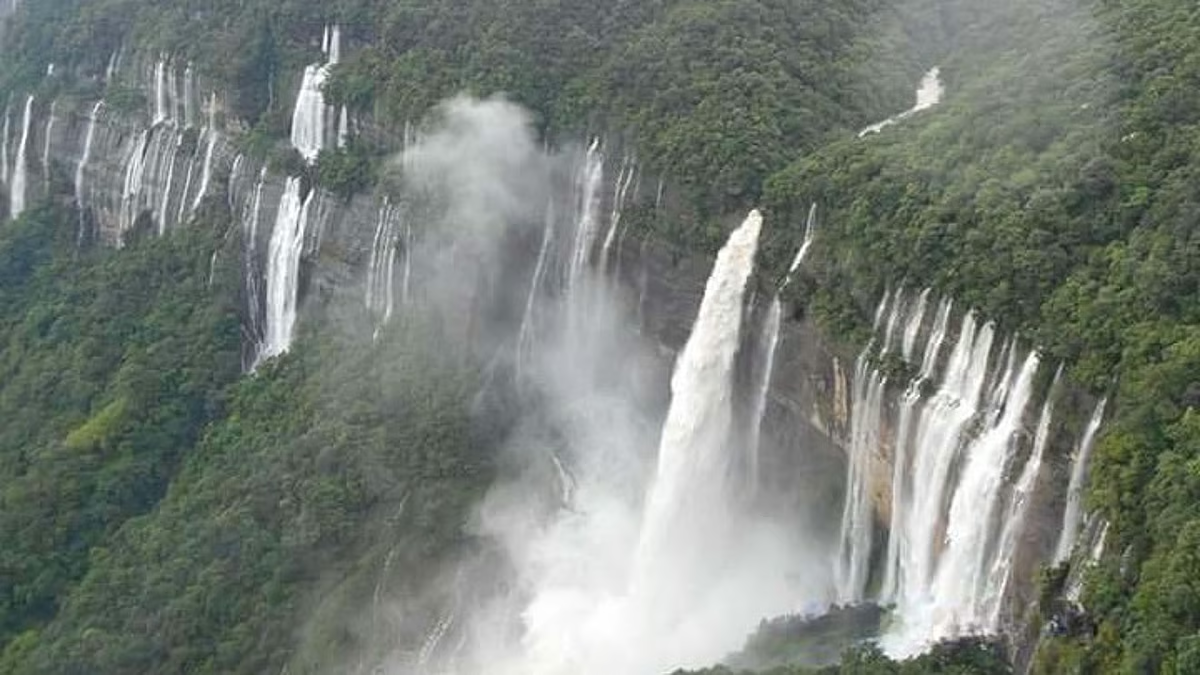
The gorgeous Meghalaya area has given it’s name to a new geologic age, thanks to the discovery there of a stalagmite used to completely mark out its duration Sangita Chatterjee
Source: westernstandard.news
Clintel Foundation
Date: 22 July 2025
‘Political scientists claim climate sceptics marked by Dark Triad traits in flawed paper.’
CBC is reporting on a new study by Pruysers et al. (2025) that claims people sceptical of climate change have personality issues associated with the “Dark Triad:” narcissism, Machiavellianism, and psychopathy. In contrast, they say those who agree with catastrophic human-caused climate change narratives exhibit prosocial traits like agreeableness and honesty-humility.
Deniers versus compliers, eh?
This is another case of the CBC acting as repeaters, not reporters. At no point did they interview any climate skeptics or leaders of formal skeptical organizations such as CLINTEL (Climate Intelligence,) a Dutch-based international network. In fact, I first learned of the Pruysers paper through Reynald du Berger, CLINTEL’s Canadian French-language ambassador.
The climate-related statements used in the survey are poorly worded. Respondents were asked to rate their agreement on a five-point scale. Consider the first item:
“I am certain that climate change is happening.”
This statement fails to distinguish between human-caused and natural climate change. That ambiguity likely skewed responses. Ask any geologist: we have 4.5 billion years of evidence that climate change is certainly happening.
“Claims that human activities are changing the climate are exaggerated.”
Ironically, the Pruysers survey was done in 2020. Yet two years earlier, in 2018, the International Union of Geological Sciences (IUGS) — representing over one million geoscientists across more than 120 countries — declared we are now in the Meghalayan Age. At the time, the IUGS dismissed the “Anthropocene” as having only sociological, not scientific, significance.
In 2021, the Intergovernmental Panel on Climate Change (IPCC) released its AR6 Physical Sciences Working Group I report. The terms “climate emergency” and “climate crisis” appear just once each — and only in reference to media usage. That same report includes Table 12.12, which shows no increase in extreme weather events.
This suggests the authors of the Pruysers paper were not only out of their depth in 2020 but have failed to update their knowledge since.
Meanwhile, respected scientists such as Steven Koonin, Judith Curry, François Gervais, and Fritz Vahrenholt have published books, and physicists William Happer, Richard Lindzen, and W. A. van Wijngaarden have published peer-reviewed papers showing that climate change is largely driven by natural variation.
CLINTEL now has 1,995 scientists and scholars signed onto its World Climate Declaration, which states there is no climate emergency and that natural forces — especially the Sun — play a far greater role than human CO₂ emissions.
Yet Pruysers et al. casually smear all of these people as psychological deviants in a taxpayer-funded study — and the taxpayer-funded CBC repeats it without question.
“By highlighting the psychological roots, our results provide insight into why climate skepticism is so persistent. The results further suggest that combatting climate skepticism will be a difficult task that requires strategies that take individual differences in personality into account.”
Combat it? How about debate it?
Climate skepticism persists because the facts do not support the alarmist narrative. Al Gore recently released a TED Talk filled with brimstone and hellfire against “climate realists” (aka skeptics). But these realists understand the path to “net zero” is a fantasy — one that could have catastrophic human consequences.
Professor Michael J. Kelly recently pointed out in BOOM Finance (via Dr. Gerry Brady) that the path to net zero is “an engineering fantasy.” It’s also economically unworkable: “Welcome to Global USSR.”
So is it any surprise that old Soviet tactics are resurfacing — labeling dissenters as mentally ill? In the tenth anniversary year of the Paris Agreement, the climate catastrophe narrative is collapsing.
The climate cartel is desperate. And desperate people are dangerous people.
Greta isn’t scaring the masses anymore. More and more “skeptics” are starting to think for themselves.
Because real science is about inquiry — not compliance.

more news

Cliff Mass: “Global Warming not an Existential Threat”
Human-caused global warming is a modest problem. It is not an existential threat to humanity, says popular American meteorologist Cliff Mass.

Tree from Morteratsch Glacier shows climate narrative is wrong
A larch trunk that began to grow over 10,000 years ago, was subsequently buried by a Swiss glacier and uncovered again in 2025. It shows that the official climate narrative is simply wrong.

Let the Climate Canaries speak
The book Canary in a Climate World brings together 38 contemporary thought leaders from across science and other critical disciplines. Together, they present a body of work that challenges the Net Zero narrative and many of the assumptions driving modern climate policy.

